
What is a retractable axle?
Sometimes trucks will have an axle that they can lift up – a retractable axle. If it’s on the tractor unit it’s often called a pusher axle while if it’s on a trailer it’s often called a tag axle. Retractable axles are sometimes called dead axles, lift axles, cheater axles or drop axles. These are freely rotating – they don’t have any drive from the engine.
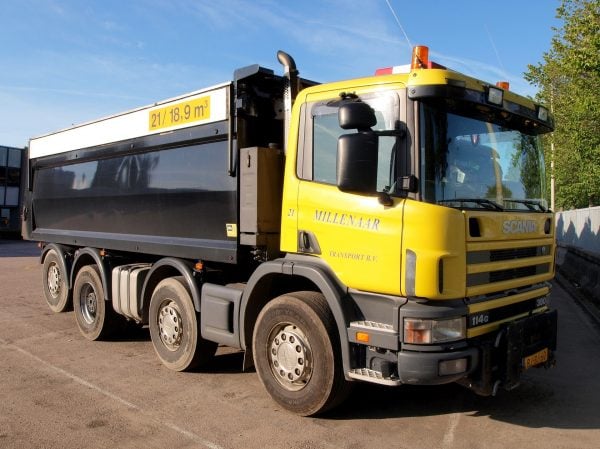
Axles and axle sets have maximum weights. For single instances of these axles, the maximum weight a truck can carry on each axle is:
- Single (S) (i.e. two tyres per axle): 6000kg
- Super-single (SL): 7200kg
- Mega-single (SM): 7600kg
- Dual or twin (T) (i.e. four tyres per axle): 8200kg
If you put more than one axle together (e.g. a tandem axle), it’s not necessarily twice the weight of the single axles.
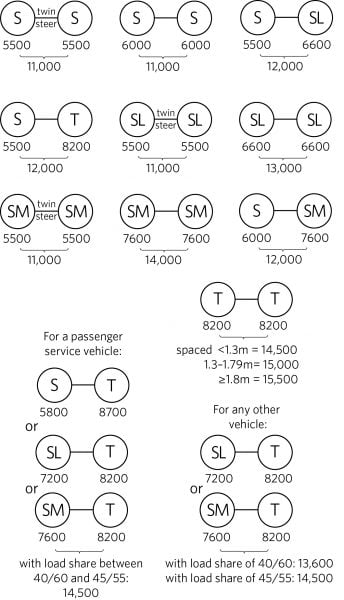
Trucks carrying a heavy load must spread out that load over the road surface to stay within the safe operating limits of the tyres and to reduce the amount of damage caused to the road surface.
However, any tyres that are touching the road create rolling resistance which uses extra fuel, and it wears the tyre out. The three rear tyres on a tri-axle semitrailer create about 57% of the rolling resistance. As rolling resistances contribute about 15% of the total fuel costs (depending on the type of driving), lifting one of those axles could save 2-3% in fuel costs. Therefore when not carrying a load, it makes sense to try to reduce the number of axles with tyres touching the road surface. You can often see this with empty logging trailers stacked on top of one another.
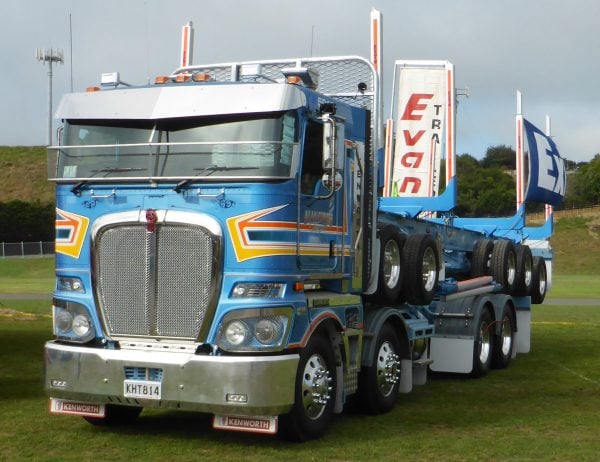
Additionally, the more axles you have, the more they scrub sideways around corners. This is why quad-axle trailers (i.e. a trailer with four axles) will have a turning axle at the rear to reduce this scrubbing and help preserve the tyres.
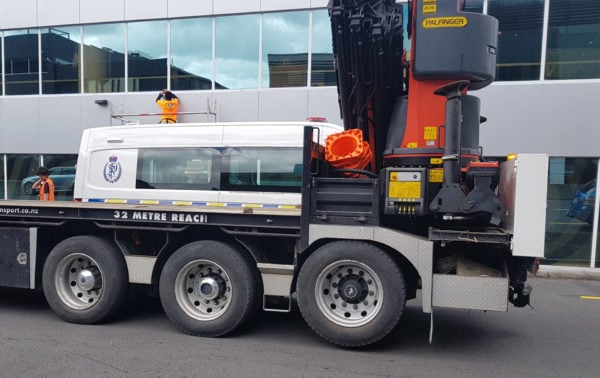
Retractable axles are not very common in New Zealand. Section 3.11 of the Land Transport Rule Vehicle Dimensions and Mass 2016 explains retractable axles:
A heavy motor vehicle, other than an A-train or a B-train, may have a retractable axle if
(a) the retractable axle is either—
(i) a drive axle; or
(ii) in a rear axle set; and
(b) the retractable axle has an automated control that ensures the remaining axle or axles and axle set or axle sets in contact with the ground remain within the mass limits in Schedule 3 and within all manufacturer’s component ratings for all retracted axle configurations; and
(c) the forward-distance requirements and rear overhang requirements in Schedule 2 are complied with, whether the axle is in contact with the road or is in a retracted position; and
(d) the retractable axle is certified for compliance with this clause by a vehicle inspector or inspecting organisation; and
(e) the vehicle meets all applicable requirements in the Road User Charges Act 2012.
(e) the vehicle meets all applicable requirements in the Road User Charges Act 2012.
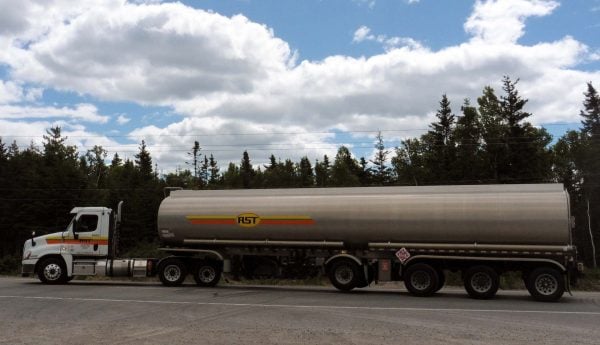
Only unladen vehicles are permitted to operate with an axle retracted, i.e. if you are carrying a load, all available wheels must be in contact with the road surface.


Darren has written over 3000 articles about driving and vehicles, plus almost 500 vehicle reviews and numerous driving courses. Connect with him on LinkedIn by clicking the name above
 Disqus