
Every time you provide first aid, you’re potentially exposing yourself to blood-borne pathogens. Hepatitis B, Hepatitis C, and HIV can all be transmitted through contact with infected blood and body fluids. You won’t know someone’s infection status when you’re kneeling beside them after a workplace injury, and it’s not the time to ask.
Standard precautions exist to manage this risk. We teach this and more in our first aid online refresher course.
The principle is straightforward: treat all blood and body fluids as if they’re infectious, every time, regardless of who the person is. Blood-borne pathogens need a route into your body to cause infection, typically through broken skin, your eyes or mouth, or a puncture wound. Standard precautions block those routes.
Gloves are your first line of defence
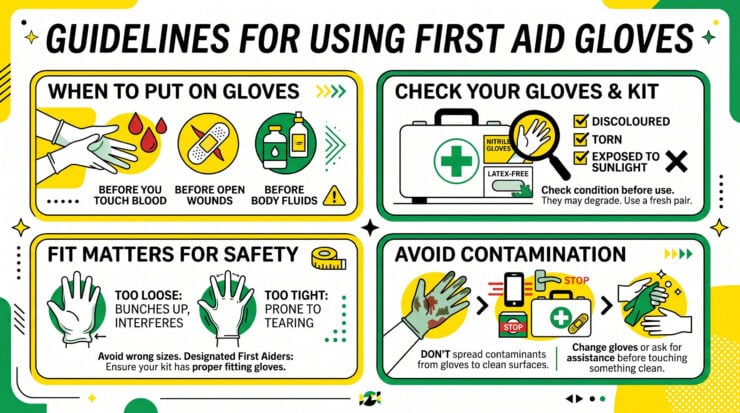
Put gloves on before you touch blood, open wounds, or body fluids. Your workplace first aid kit should contain disposable nitrile gloves (most kits have moved away from latex because of allergy risks). Check them before you put them on: if they’re discoloured, torn, or have been sitting in a kit exposed to sunlight for months, they may have degraded. Use a fresh pair.
Fit matters. Gloves that are too loose will bunch up and interfere with dressing a wound or applying pressure. Gloves that are too tight are more likely to tear. Most first aid kits carry a single size; if you’re a designated first aider, it’s worth making sure your kit has gloves that actually fit your hands.
Once gloves are on, be conscious of what you touch. If you’ve been applying pressure to a bleeding wound and then reach into the first aid kit to grab a bandage, you’ve now contaminated the kit and everything in it. The same applies to phones, door handles, and any other surface. If you need to touch something clean, change your gloves first or ask someone else to hand you what you need.

Consider a common workplace scenario: a forklift operator clips a racking upright and the impact throws them forward into the steering column, splitting their eyebrow open. There’s a lot of blood (head wounds bleed freely). Your instinct is to grab something and press it against the wound immediately. But those 20 seconds it takes to pull on gloves are worth it. Ask the operator to hold a clean cloth against the cut themselves while you glove up. You’re not being slow; you’re being safe. If you get their blood into a small cut on your own hand, you’ve potentially exposed yourself to a serious infection.
Taking gloves off without contaminating yourself
Glove removal has a specific technique, and it exists for a reason. Pinch the outside of one glove at the wrist and peel it off, scrunching it into a ball. Hold that ball in your still-gloved hand. Then slide your bare fingers under the wrist of the remaining glove and peel it off inside-out, trapping the first glove inside. The contaminated surfaces end up contained within the second glove. Drop both into a sealable plastic bag.
Hand hygiene after every contact
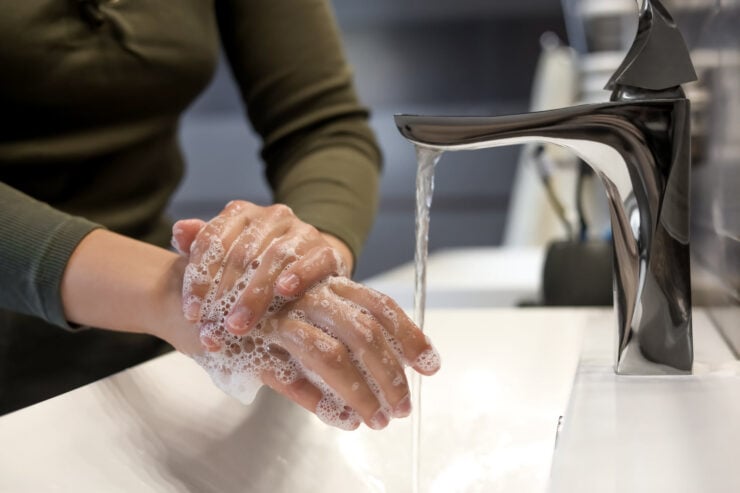
Wash your hands with soap and warm water for at least 20 seconds after removing gloves. This isn’t optional even though you were wearing gloves. Disposable gloves can have micro-perforations you can’t see, and you may have touched your skin during removal without realising it. Soap and water is the gold standard. Alcohol-based hand sanitiser (at least 60% alcohol content) is an acceptable backup if there’s no running water available, but wash properly as soon as you can.
WorkSafe’s guidance on first aid at work is clear: first aiders should wash their hands before and after giving care. The “before” part is often forgotten, but matters too. You’re about to touch someone’s open wound; clean hands protect them as well as you.
When you need more than gloves
Gloves deal with contact through your hands. But blood can splash. If someone has severed an artery, e.g. a deep laceration from sheet metal on a fabrication bench, arterial blood spurts with each heartbeat and can reach your face. Safety glasses, goggles, or a face shield should be used whenever splashing is a realistic possibility. Your eyes and mouth are mucous membranes: exactly the kind of route blood-borne pathogens can enter through.
For CPR, a barrier device (face shield or pocket mask) prevents direct mouth-to-mouth contact and protects you from saliva, blood, and vomit. These should be in your first aid kit. If your workplace doesn’t have one, raise it with whoever manages your health and safety.
Cleaning up after an incident
Once you’ve provided care, there are likely contaminated surfaces, used dressings, and soiled gloves that need proper disposal. Place items that have contacted blood or body substances into plastic bags, securely tying or sealing them, and disposing of them with your usual waste. Used dressings, gauze, and gloves all go in the bag.
Blood spills on hard surfaces need more than a wipe-down. Put on fresh gloves, absorb the spill with paper towels, then clean the area with a solution of one part household bleach to nine parts water. Leave it on the surface for at least 10 minutes before wiping dry. Make sure there’s ventilation when you’re using bleach, and wear eye protection if there’s any chance of splashing.
Sharps and broken glass
If there are used needles, lancets, or blood-contaminated broken glass at the scene, never pick them up with your hands. Use tongs, a scoop, or two pieces of cardboard. These items go into a rigid, puncture-proof sharps container, not a regular rubbish bag. Many workplaces have dedicated sharps containers; if yours doesn’t and you have workers who use insulin or other injectable medications, it should.
After a vehicle accident on a yard, e.g. say a reversing truck clips a parked car and shatters a window, broken glass with blood on it is a genuine sharps hazard. The temptation is to start clearing it by hand. Don’t. Treat blood-contaminated glass the same way you’d treat a used needle: pick it up with a tool, not your fingers, and put it in a puncture-resistant container.
What to do if you’re exposed
Despite best efforts, accidental exposure happens. A glove tears, blood splashes into your eye, or you discover a small cut on your hand after removing gloves. If it happens, act quickly. For a skin wound, let it bleed freely and wash thoroughly with soap and running water. For a splash to your eyes, nose, or mouth, flush with clean running water for several minutes.
Report the exposure to your supervisor immediately and seek medical attention. Time matters: post-exposure prophylaxis for HIV, for example, is most effective when started within hours. Your GP or local emergency department can assess the risk and arrange baseline blood testing. The incident should be recorded through your workplace’s incident reporting system.
Hepatitis B vaccination for first aiders
Hepatitis B is the blood-borne pathogen most easily transmitted through occupational exposure. Unlike Hepatitis C and HIV, there’s an effective vaccine for it. If you’re a designated workplace first aider, particularly in an environment where contact with blood is likely (construction, manufacturing, transport yards), talk to your GP about your Hepatitis B vaccination status. Most New Zealanders born after 1988 received the vaccine as part of the childhood immunisation schedule, but immunity can wane over time, and there are a lot of people in NZ who were born overseas. A booster or a blood test to check your antibody levels is a practical step.
Infection control goes both ways
Standard precautions protect you from the patient’s pathogens, but they also protect the patient from yours. Washing your hands before providing care, using sterile dressings where available, and avoiding coughing or sneezing over an open wound are all part of the same principle. An open wound is a direct route for infection; your job is to keep it as clean as the circumstances allow.
If your workplace regularly deals with injuries (and industries involving vehicles, machinery, and manual handling typically do) infection control should be part of how you think about first aid readiness. Check that your first aid kits contain gloves that haven’t degraded, that there’s a face shield or pocket mask for CPR, and that you have a plan for cleaning up blood spills. These aren’t extras; they’re the basics.


Darren has written over 3000 articles about driving and vehicles, plus almost 500 vehicle reviews and numerous driving courses. Connect with him on LinkedIn by clicking the name above