
Regulation 13 of the Health and Safety at Work (General Risk and Workplace Management) Regulations 2016 requires every PCBU to provide adequate first aid equipment, ensure workers can access it, and ensure there are enough trained first aiders. The word “adequate” does the heavy lifting in that sentence. A small accounting firm in an office block five minutes from a medical centre needs something quite different from a transport depot running forklifts, trucks, and a workshop on a 24-hour roster.
“Adequate” comes down to three things: what’s in the kit, where the kit lives, and who keeps it stocked.
What goes in a standard workplace kit
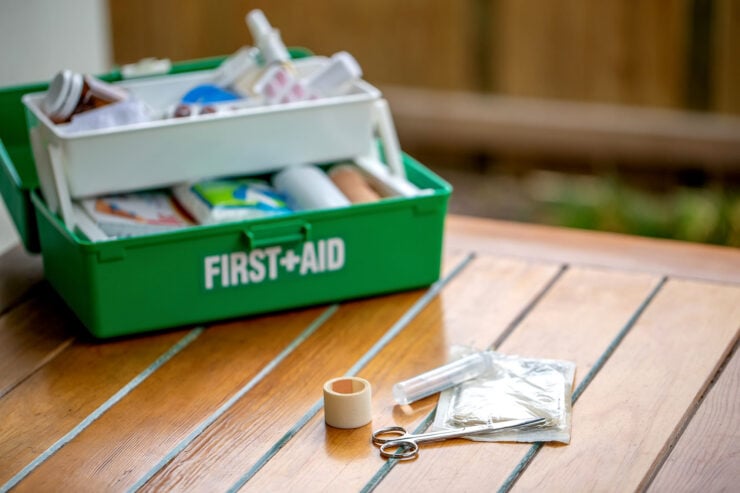
A baseline workplace kit covers the injuries that turn up in most workplaces: cuts, scratches, punctures, grazes, splinters, soft tissue sprains and strains, minor burns, broken bones, eye injuries, and shock. A practical breakdown is:
- various sizes of non-adherent sterile dressings (5x5cm, 7.5x10cm, 10x10cm)
- a large sterile burn dressing, conforming cotton bandages in 5cm and 7.5cm widths
- a couple of triangular bandages for slings and immobilisation
- adhesive dressing strips
- wound cleaning wipes
- saline ampoules
- eye pads
- hypoallergenic tape
- scissors
- tweezers
- safety pins
- two pairs of disposable nitrile gloves
- a resuscitation mask or face shield.
That’s the baseline, and you can learn how to use them all in our first aid course. The contents need to match the actual risks. A workshop where workers are welding, grinding, or using compressed air should carry extra eye pads and saline. A construction site or freight yard where larger lacerations are realistic needs more (and larger) sterile dressings. A bakery should have a couple of additional burn dressings on top of the standard one. Talk to your workers about what they’ve actually used the kit for. If you keep finding the kit needs more of one particular item, that’s the kit telling you what your real risk profile looks like.
Pain relief medication: handle with care
Some workplaces stock paracetamol or aspirin in the kit. If yours does, the rules are specific. WorkSafe says pain relief medicine must be in pack sizes available over the counter as General Sale or Pharmacy Only medicines, kept in the manufacturer’s original packaging so the dose, warnings, batch number and expiry date are all visible. It can only be given by someone medically trained to administer it. Otherwise it must be self-administered: the worker chooses to take it themselves.
The reasoning is straightforward. Aspirin can be dangerous for people on blood thinners, in late pregnancy, or with certain stomach conditions. As a first aider, you’re not qualified to make that call. The one exception covered separately in this course is aspirin in a suspected heart attack, which has specific ANZCOR guidance attached to it.
Where the kit lives
Workers need to be able to reach a kit within minutes during an emergency. If your workplace has more than one building, more than one floor, or distinct work areas with different risks, each of those areas needs its own kit. WorkSafe’s example: a school with both a science laboratory and a carpentry workshop should have a separate kit in each, because waiting three minutes to get to a single central kit can change the outcome of a chemical splash or a saw injury.
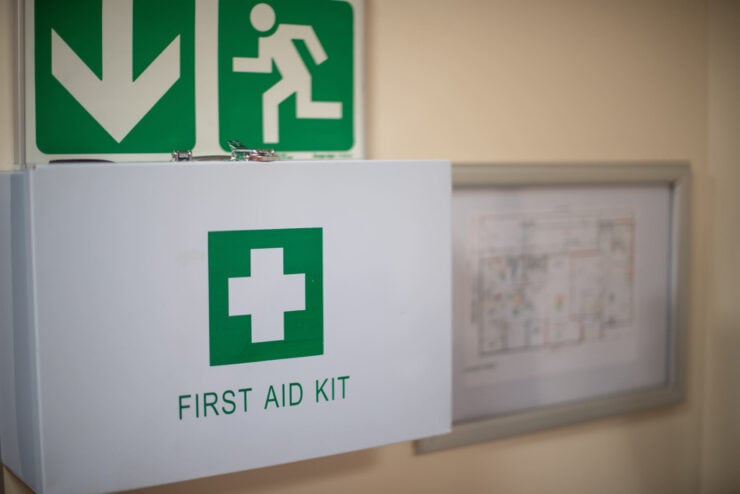
Every kit should be clearly labelled (the standard signage is a white cross on a green background), have a current contents list attached or visible inside, and be made of material that protects the contents from dust, moisture and contamination. Emergency floor plans should show where kits are located. Workers should be told where they are at induction, when they change job or location, when a first aider leaves or starts, and at intervals after that.
Kits in vehicles
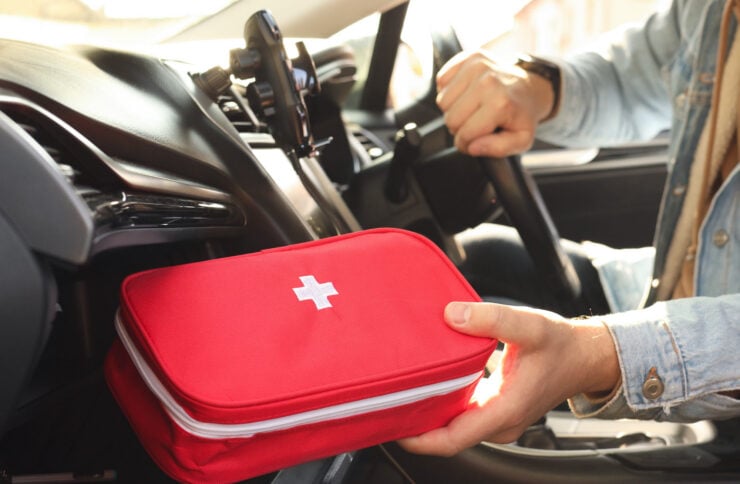
Mobile workers (couriers, taxi drivers, sales reps, bus drivers, line haul drivers, ag inspectors, anyone whose workplace is essentially their vehicle) must have a portable first aid kit in the vehicle. Regulation 13 makes this explicit: their vehicle is their workplace. The kit must be secured so it can’t become a projectile during sudden braking or a collision. A heavy plastic case rolling around a truck cab in a sharp brake is its own injury risk.
For long-distance and rural drivers, a standard kit is the minimum. Consider what happens if you’re an hour from the nearest medical help. A remote-worker kit could add items like a torch, a whistle, a rescue blanket, a wider range of dressings, and a crepe bandage for snake or spider bite first aid (relevant in some regions). A small notebook and pen to record times, observations and equipment used is also a good idea.
A realistic scenario
Consider a yard supervisor at a transport depot at 11pm. A driver doing a pre-trip check has caught their hand on a sharp edge of damaged trailer panelling and has a deep, bleeding gash across their palm. The supervisor knows there’s a kit in the maintenance shed (60 metres away). They send someone for the kit. When it arrives, the large dressings are all gone. The last big incident used them up and no one replaced them. The supervisor improvises with the smaller dressings and a triangular bandage, and the driver gets to the after-hours medical centre with the bleeding mostly controlled. It works out, but only because the supervisor stayed calm. A kit with missing items is a near miss that gets ignored. Treat the empty dressings box as a finding to action, not a story to tell later.
Maintaining the kit
WorkSafe’s good-practice recommendation is to nominate a person (often one of the trained first aiders) to maintain each kit. That person monitors usage, replaces items as soon as practicable after they’re used, checks expiry dates on sterile items, and confirms the case itself is undamaged.
A simple monthly check works for most workplaces. Open the kit. Run through the contents list. Anything missing, anything within three months of expiry, anything damaged: replace it. Record the check (a sheet inside the lid is fine). If you have multiple kits across a site, assign each one to a named person rather than leaving it to whoever notices.
Other workplace readiness items
Beyond the kit itself, a workplace with chemical handling should have emergency eyewash equipment within 10 seconds’ reach of the hazard. A site with significant electrical risk, ambulance delay, or large numbers of public visitors should consider an AED. A workplace with remote or lone workers needs a documented plan for how they call for help if they’re injured or unwell, which may mean a satellite phone or InReach device beyond mobile coverage, and a check-in procedure.
It’s also recommended to run a practice first aid emergency periodically. Not a full evacuation drill, just a walk-through: someone has collapsed in the workshop, who responds, where’s the nearest kit, who calls 111, how does the ambulance find the gate. Doing this once turns up gaps you didn’t know about. Most workplaces discover at least one.


Darren has written over 3000 articles about driving and vehicles, plus almost 500 vehicle reviews and numerous driving courses. Connect with him on LinkedIn by clicking the name above