
Confined space incidents are among the most likely to be fatal in any workplace, and they frequently claim multiple lives when untrained people attempt to rescue the first casualty. The controls for confined space entry are not precautionary measures that can be scaled back when the job looks straightforward; they are the minimum standard, every time.
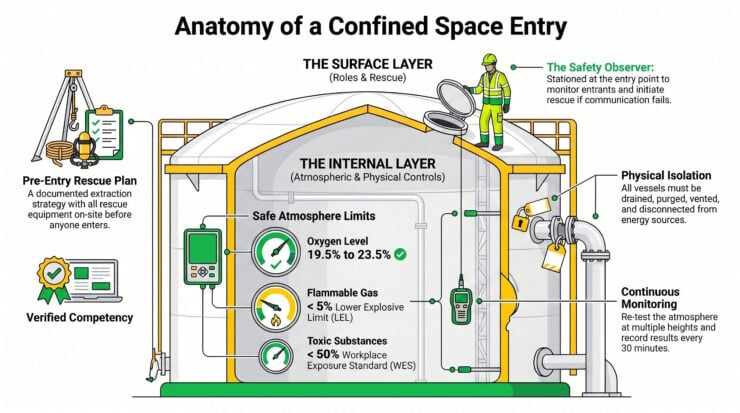
What defines a confined space
A confined space is defined under AS/NZS 2865 as an enclosed or partially enclosed space that is not intended or designed primarily for human occupancy, and that presents a risk from one or more of the following: oxygen levels outside the safe range, airborne contaminants that could cause impairment or loss of consciousness, flammable substances that could cause fire or explosion, or engulfment by a free-flowing solid or rising liquid.
The list of examples is broad: storage tanks, process vessels, boilers, silos, pits, pipes, sewers, shafts, and ducts. But the definition is not limited to these. A crawl space beneath a building may not look like a confined space, but if the work being done inside it could generate fumes in an area with restricted ventilation, it may meet the definition. A ceiling cavity accessed through a small hatch where hot work is planned could fill with welding fumes within minutes. You may classify any space as a confined space at your discretion if the circumstances warrant it.
Some organisations also define a category of restricted spaces that are not formally classified as confined but share some of the same characteristics, such as limited entry and exit or atmospheres that could become hazardous during certain types of work. Where work in a restricted space introduces a risk of atmospheric contamination, consider treating it as a confined space entry.
What you must confirm before issuing
All confined space work must comply with AS/NZS 2865 and WorkSafe guidance on planning entry and working safely in a confined space. Workers entering a confined space must hold the relevant qualifications.
The space must be fully isolated from all process pipework and energy sources before entry. Vessels must be drained, purged, and vented. All hazardous liquids and residues must be removed. Isolation must follow the same lockout/tagout requirements as any other permitted work, and you verify those isolations in the same way: walk the points, check the locks, and confirm the tags.
Internal and external access ways must remain clear throughout the work. If the entry point is a manhole or hatch, confirm it is large enough for a person wearing rescue equipment to be extracted through it. If it is not, the rescue plan must address how extraction will be achieved.
Atmospheric testing
Atmospheric testing must be completed before anyone enters, and the results must be recorded on the Confined Space Entry Certificate. The atmosphere is considered safe for entry when oxygen is between 19.5 and 23.5% by volume, flammable gas or vapour is below 5% of the Lower Explosive Limit (LEL), and toxic substances are below 50% of the Workplace Exposure Standard (WES) or your organisation’s own limit, whichever is lower. Some organisations set tighter standards for specific substances, for example, where relevant, the limits at a specific workplace could be carbon monoxide below 25 ppm, hydrogen sulphide at 0 ppm, and ammonia below 25 ppm.
If readings are outside acceptable limits, no one enters.
Continuous atmospheric monitoring is required for the entire time anyone is inside the space. Readings must be recorded at intervals of no more than 30 minutes. If the atmosphere deteriorates at any point, the Safety Observer withdraws all personnel immediately.
After breaks, the atmosphere must be retested before work resumes. Conditions inside a confined space can change while the space is unoccupied, particularly if ventilation has been reduced or nearby process conditions have shifted.
Hot work in a confined space
No hot work is permitted in a confined space where the atmosphere contains any flammable contaminants above 0% of the LEL. This limit is absolute. Even where the space has been purged and tested clean, hot work introduces its own fumes and gases. Consider the contaminants that the work itself will generate. Welding in a stainless steel vessel produces chromium fumes. Grinding on coated surfaces releases whatever is in the coating. The risk assessment and atmospheric monitoring must account for the work being done, not just the state of the space before work begins.
The Safety Observer
A competent Safety Observer must be stationed at the entry point for the entire duration of the entry. The Safety Observer must not enter the confined space under any circumstances, must not leave the entrant unattended, and must not take on any other task that could distract from their monitoring role.
The Safety Observer controls entry and exit, recording the name and time of every person who enters and leaves. They maintain constant communication with those inside, whether by voice, radio, or pull line. They monitor the atmospheric readings from the continuous monitoring equipment and withdraw personnel if readings deteriorate. They maintain a means of communication with emergency services, and they initiate the rescue plan if communication with those inside is lost or conditions indicate that assisted withdrawal is necessary.
During breaks and at the end of the work period, the entry point must be secured or guarded to prevent unauthorised entry.
The rescue plan
A rescue plan must be documented on the permit before entry begins. It must address all foreseeable scenarios that could require a rescue, specify the PPE and rescue equipment on standby (such as tripods, winches, stretchers, and breathing apparatus), describe how an injured or incapacitated worker will be extracted from the space, and set out how emergency services will be directed to the worksite.
The rescue plan is not theoretical. The equipment it specifies must be physically present at the entry point and ready to use before work starts. If the plan calls for a tripod and retrieval winch but the equipment is locked in a storeroom two hundred metres away, the plan does not work.
Issuing the permit
The permit may only be issued on the condition that work will not start until the named Safety Observer has completed the Confined Space Entry Certificate checklist and signed off that all required precautions are in place. At the end of the work, the Safety Observer must sign the certificate to confirm that all personnel who entered the space have exited and been accounted for. Only then can you close the permit. To understand the whole permit-to-work system, you should do the Permit Issuer course.


Darren has written over 3000 articles about driving and vehicles, plus almost 500 vehicle reviews and numerous driving courses. Connect with him on LinkedIn by clicking the name above