• A TR Group Site
  • Help
  • Cart
Driving Tests DT logo small
Driving tests
  • Learner licence
    • Car
    • Motorbike
    • Heavy vehicle
    • Learner Licence Plus
  • Courses
  • Tourist
  • Resources
  • Learn
  • Resources
  • Learner licence
    • Car
    • Motorbike
    • Heavy Vehicle
    • Learner Licence Plus
  • Your courses
    • Enrolled courses
  • View all courses
  • Tourist
  • Resources home
  • iOS application
  • Android application
  • Contact us
  • Terms and conditions
  • Privacy
  • Home
  • /
  • Resources
  • / Health and safety

Health and safety Resources

Monitoring and closing the permit

Issuing a permit is not the end of your involvement. From the moment work begins until the permit is formally closed, you have ongoing obligations to monitor the work, respond to changes, and confirm the worksite is restored when the…

Read more ›

Issuing a permit to work: conditions, communication and cancellation

Everything up to this point has been planning, checking, and documenting. Now you need to make sure the people doing the work understand the hazards they face, the controls that are in place, and the rules they must follow. This…

Read more ›

Issuing a permit to work: scope, inspection and isolation

The risk assessment is done, the worksite is prepared, the supporting documents are in order and the safety equipment is ready. Now you bring it together with the Permit Receiver, confirm everything face-to-face, and make the decision to authorise the…

Read more ›

PPE, safety equipment and hazardous substances in permitted work

Personal protective equipment sits at the bottom of the hierarchy of controls for good reason. It does nothing to remove a hazard; it only reduces the consequence if a person is exposed. But in high-risk permitted work, PPE is almost…

Read more ›

Atmospheric testing for Permit Issuers as part of the permit to work system

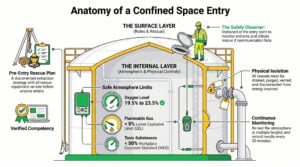
Some work environments have atmospheres that can injure or kill. Confined spaces, tanks, vessels, pipelines, excavations, and areas near chemical processes can all contain air that is unsafe to breathe or that could ignite. You cannot detect most atmospheric hazards…

Read more ›

Preparing the worksite

Before you issue a permit, the worksite must be ready for work to begin safely. Your role as Permit Issuer is to confirm that preparation has been completed. You do not carry it out yourself, but you are the person…

Read more ›

Permit issuer checks a stormwater pipe site with adjacent electrical hazard

Determining whether a task needs a permit

Not every task requires a permit to work. But every task that does require one must have it in place before work begins. Your job as Permit Issuer is to make the right call on which side of that line…

Read more ›

Supporting documents for permit issuers – how to create, assemble and manage them

Issuing a permit to work is not something you do from memory. Before you sign anything, you need to locate, read, and interpret a range of documents that together form the evidence base for your decision. If you cannot find…

Read more ›

Roles and responsibilities in a permit-to-work system

A permit-to-work system only works when every person involved understands their role and stays within it. The system creates clear lines of accountability: who authorised the work, who planned it, who is supervising it, and who is watching over the…

Read more ›

Hazard identification and risk assessment for permit issuers

So you need to issue a permit. First things first: evaluating the hazards and controls proposed by the permit receiver, and cross-checking those against all other hazards at the work site. Every permit decision depends on your ability to identify…

Read more ›

What is a permit to work?

A permit to work is often described as a safety device. It isn’t. A permit is a document describing work that is, in some way, risky. The work is made safe by the controls listed on the permit, by the…

Read more ›

Recent Resources
  • Monitoring and closing the permit
  • Protecting yourself from infection when giving first aid at work
  • Why we judge other drivers more harshly than ourselves
  • Issuing a permit to work: conditions, communication and cancellation
  • Dashcam footage and the Privacy Act 2020: what your employer must do, and what you can ask for
  • Issuing a permit to work: scope, inspection and isolation
  • Interpreting Manufacturer Load Capacity Specifications
  • PPE, safety equipment and hazardous substances in permitted work
  • How to find your real driving triggers (and why most drivers get it wrong)
  • PPE Requirements for Truck Loader Crane Operators and Ground Crew

Licences and Courses

  • Car
  • Motorbike
  • Heavy Vehicles
Car
  • Core
  • Behaviour
  • Parking
  • Emergencies
  • Road position
  • Intersection
  • Theory
  • Signs
Motorbike
  • Bike-specific questions
  • Core
  • Behaviour
  • Parking
  • Emergencies
  • Road position
  • Intersection
  • Theory
  • Signs
Heavy Vehicles
  • Class 2
  • Class 3-5
  • Core
  • Behaviour
  • Parking
  • Emergencies
  • Road position
  • Intersection
  • Theory
  • Signs

Vehicle and workplace training

  • About
  • Resources
DT Driver Training TR Group
About
  • About us
  • Contact us
  • Privacy Policy
  • Terms and Conditions
Resources
  • Homepage
  • Driving Tests Android App
  • Driving Tests iPhone App
  • Getting your learner licence
DT Driver Training TR Group
Copyright 2010-2026 DT Driver Training Ltd, PO Box 12541, Penrose, Auckland, 1642. All rights reserved. Questions and images are used with permission from NZTA; question answers are proprietary.