
• A TR Group Site
  • Help
  • Cart
Driving Tests DT logo small
Driving tests
  • Learner licence
    • Car
    • Motorbike
    • Heavy vehicle
    • Learner Licence Plus
  • Courses
  • Tourist
  • Resources
  • Learn
  • Resources
  • Learner licence
    • Car
    • Motorbike
    • Heavy Vehicle
    • Learner Licence Plus
  • Your courses
    • Enrolled courses
  • View all courses
  • Tourist
  • Resources home
  • iOS application
  • Android application
  • Contact us
  • Terms and conditions
  • Privacy
  • Home
  • /
  • Resources
  • /
  • Dangerous goods and hazardous substances
  • / Can your dangerous goods load go through the tunnel?

Can your dangerous goods load go through the tunnel?

New Zealand’s road tunnels each have their own rules for dangerous goods vehicles, ranging from a complete ban to an escorted run at a set time. These are the questions drivers and managers ask most often. Our dangerous goods pre-trip check includes a route check for tunnels and restricted roads.

Frequently asked questions

Do tunnel restrictions apply to every vehicle carrying dangerous goods?

No. The duty to comply with tunnel prohibition and restriction signs applies only to drivers or operators of dangerous goods vehicles that must display placards under section 7 of the Land Transport Rule: Dangerous Goods 2005. Small quantities carried under Schedule 1 without placards are generally fine. Once you’re placarded, the rules apply.

Can I take a placarded load through the Waterview Tunnel?

No. All dangerous goods vehicles that require a placard are banned from the Waterview Tunnel and must take the signposted detour, marked with a red 16 or 20 shield or an orange triangle. Even emergency service vehicles showing a dangerous goods placard are excluded, including under lights and siren, unless the incident is inside the tunnel itself.

What about the other Auckland tunnels?

The Victoria Park and Johnstones Hill tunnels are less restrictive. Dangerous goods can generally travel through both with the same placarding as on the open road. However, carrying a placarded load into a tunnel signed with a placard load prohibited sign is an offence, so watch for the signs.

Can I use the Wellington tunnels?

No. NZTA prohibits the transit of dangerous goods through all Wellington tunnels. Plan your route around them before you leave the depot, not when you see the sign.

What are the rules for the Lyttelton and Homer tunnels?

Both the Lyttelton and Homer tunnels control hazardous goods through permits, and only at certain times. Lyttelton has its own bylaw, and how it treats your load depends on the class:
Class 1 explosives are banned, except for the articles listed in Table 2.1 of the Rule.
Some restricted goods need special authorisation from the Tunnel Manager for every trip.
Other classes, including 6.2 and 9, need permission from a Tunnel Control Officer, and you must contact one before you approach the tunnel.
The Tunnel Control Officer can require an escort through the tunnel, set any other conditions they consider necessary, or decline permission.

Do lithium batteries count as dangerous goods at Lyttelton?

Yes. Lithium batteries are Class 9, so a placarded load of them needs permission from a Tunnel Control Officer, the same as any other Class 9 goods.

What happens if I drive a load of dangerous goods through a prohibited tunnel?

You face higher penalties than for many other dangerous goods offences. A 2016 amendment to the Rule raised the penalties for breaching dangerous goods prohibitions and restrictions on high-risk routes, mainly because of the risk an incident in Waterview would pose.

Who should be checking for tunnels on the transport route, the driver or the manager?

Both, but it starts with the manager. Tunnel restrictions belong in route planning and job allocation rather than being left to the driver on the day. A placarded load booked onto a Christchurch to Lyttelton port run, or a delivery across the western side of Auckland, needs its route agreed before it’s dispatched.

The approach to Waterview Tunnel heading towards the Northwestern Motorway, Auckland, showing variable speed limits
Variable traffic signs and overtaking restrictions at the entrance of the Waterview Tunnel
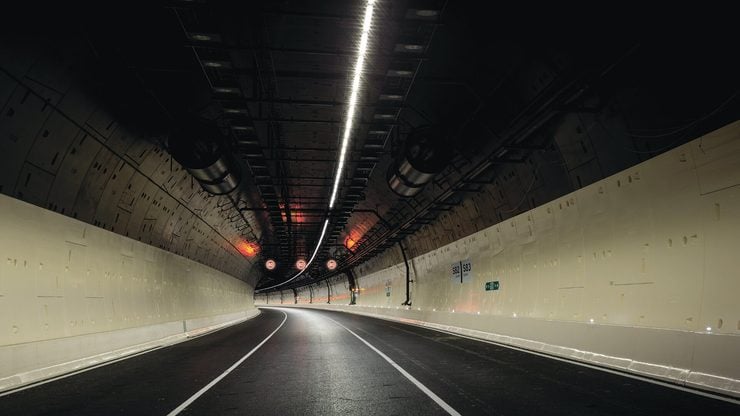
View down Waterview Tunnel, no cars

driver training courses
By Darren Cottingham

Darren has written over 3000 articles about driving and vehicles, plus almost 500 vehicle reviews and numerous driving courses. Connect with him on LinkedIn by clicking the name above

‹ What should you check before leaving the yard with dangerous goods?
Posted in Dangerous goods and hazardous substances
Recent Resources
  • Can your dangerous goods load go through the tunnel?
  • What should you check before leaving the yard with dangerous goods?
  • What do truck drivers need to know about General Access Limits?
  • First aid for burns: thermal, chemical, and electrical
  • How to issue a permit-to-work for excavation
  • Recognising and managing shock using workplace first aid
  • How to control severe bleeding in a workplace incident
  • How to issue a hot work permit in a permit-to-work system
  • How to help someone who is choking: first aid tips
  • Can you be fined for not providing workplace first aid training?

Licences and Courses

  • Car
  • Motorbike
  • Heavy Vehicles
Car
  • Core
  • Behaviour
  • Parking
  • Emergencies
  • Road position
  • Intersection
  • Theory
  • Signs
Motorbike
  • Bike-specific questions
  • Core
  • Behaviour
  • Parking
  • Emergencies
  • Road position
  • Intersection
  • Theory
  • Signs
Heavy Vehicles
  • Class 2
  • Class 3-5
  • Core
  • Behaviour
  • Parking
  • Emergencies
  • Road position
  • Intersection
  • Theory
  • Signs

Vehicle and workplace training

  • About
  • Resources
DT Driver Training TR Group
About
  • About us
  • Contact us
  • Privacy Policy
  • Terms and Conditions
Resources
  • Homepage
  • Driving Tests Android App
  • Driving Tests iPhone App
  • Getting your learner licence
DT Driver Training TR Group
Copyright 2010-2026 DT Driver Training Ltd, PO Box 12541, Penrose, Auckland, 1642. All rights reserved. Questions and images are used with permission from NZTA; question answers are proprietary.