
General Access Limits FAQs
They are the dimension and mass limits a heavy vehicle can operate at on any public road without a permit. They come from the VDAM Rule and cover width (2.55 m including load restraints), height (4.3 m including load and restraints), overall length, individual axle masses, axle set masses and gross mass. Anything over those limits needs a permit or an approved proforma and is restricted to roads and bridges that have been assessed to carry it.
The limit depends on the tyres and how the axles are grouped. A single axle on standard single tyres is good for 6,000 kg, single large tyres 7,200 kg, single mega tyres 7,600 kg (7,200 kg on a steer axle), and twin tyres 8,200 kg. Axle sets are not simply added together. A tandem twin-tyred set spaced 1.3 to 1.79 m apart allows 15,000 kg, but drops to 14,500 kg when the axles are closer than 1.3 m. A twin-steer set is 11,000 kg and a common tri-axle set is 18,000 kg. Axle spacing is on page two of the certificate of loading, and you need it to read the VDAM tables properly.
No. 44,000 kg is the standard ceiling, but since December 2017 a 7-axle combination can run at 45,000 kg and an 8-axle combination at 46,000 kg without a permit, provided the distance from the first axle to the last axle is at least 16.8 m and 17.4 m respectively. Plenty of combinations never reach 44,000 kg anyway because their axle sets add up to less. A 6×2 tractor unit towing a tri-axle semitrailer, for example, tops out at 39,000 kg (6,000 + 15,000 + 18,000).
The lowest one. Your legal maximum is the lowest of the manufacturer’s GVM, GCM and axle ratings on the certificate of loading, the VDAM General Access limits for your tyres and axle spacing, any towbar or drawbar rating, the weight on your RUC licence, and any posted bridge or road restriction on your route. Many imported trucks are rated well above what New Zealand roads allow, so the certificate of loading on its own will often mislead you.
Class 1 is the standard set of axle and gross mass limits that bridge postings are measured against. NZTA describes General Access as having the same mass limits as Class 1, except that the slightly higher gross masses for long 7- and 8-axle combinations are allowed under General Access. Some councils now write “General Access” instead of “Class 1” in their notices. Treat them as the same baseline. Don’t confuse a Class 1 (car) licence with a Class 1 mass limit.
From 6 August 2026, 50MAX vehicles no longer need a permit. Operators instead run under revised 50MAX proforma designs and must comply with every requirement of the design, including mass, dimensions, axle spacing, tyres, lighting and braking. Existing 50MAX and overlength permits have to be replaced by a revised proforma before they expire or by 6 November 2026, whichever comes first. The 50MAX route network has not changed, and General Access and the other HPMV permit pathways are unchanged. HPMVs will also not have to display H plates.
A high productivity motor vehicle exceeds 44,000 kg or the standard length limits (or both) but stays within the standard width and height. It operates on routes that a road controlling authority has assessed as able to carry the extra mass or length. An HPMV cannot go everywhere a General Access truck can. Some bridges are fine for 44,000 kg but not for 50MAX or higher mass vehicles, and those are excluded from the HPMV and 50MAX networks.
Not necessarily. Some overbridges, rail bridges and other structures have less clearance and are signposted with the available height. Know your laden height, including the load and any restraints, and plan around low structures. Vehicles or loads over 4.3 m are overdimension and need to follow the overdimension rules, which include route restrictions. Loads over 25 m long that will cross a rail level crossing need written permission from the access provider, usually KiwiRail.
The driver is in charge at the bridge, but it rarely comes down to the driver alone. The operator plans the route and decides what the vehicle is set up to carry. The loader decides how weight is spread across the axles. Supervisors can make it easier by keeping a current list of posted bridges on regular routes, briefing drivers on them, and making sure trucks are weighed with split axle readings so everyone knows what each axle set carries when the truck is fully loaded.
Everything on the road. Tare weight covers the empty vehicle with its oil, coolant, fuel and the equipment it needs to operate, such as a crane. It does not include you, any passengers, chains, twitches and other load securing gear, or the load itself, and some tare figures assume only a small amount of fuel. That means GVM minus tare is not your payload. The reliable way to find out is to take the truck to a weighbridge empty with a full tank, get split weights for each axle set, and then add everything you carry that isn’t already on the truck.
You shouldn’t plan on being over at all. Police usually allow a tolerance on weighbridge readings: 500 kg on any single axle, a twin-steer set, a single vehicle overall or a combination overall, and 1,000 kg on other axle sets. That tolerance allows for measurement error and is applied at the officer’s discretion. It is not extra legal capacity. Fines are set in Schedule 1A of the Land Transport (Offences and Penalties) Regulations 1999. They start at $350 for being up to 500 kg over on an axle or up to 1,000 kg over on an axle set, and go up to $10,000 for more than 6,500 kg over on an axle or 13,000 kg on an axle set. Each overweight axle or axle set is a separate fine. Onboard load indicators have their own margins of error, so treat their readout as a guide. If you have received a fine, here’s what to do.
The RUC weight is shown in tonnes and rounded up, so a vehicle with a legal limit of 12,700 kg shows 13. RUC labels can also simply be wrong. A two-axle truck on standard single front tyres and twin rear tyres can legally weigh 14,200 kg, yet a label showing 16 would suggest 16,000 kg. Use the RUC weight to check you are paying the right charges, not to work out your load. If a label is wrong, go back to the agent that issued it, or contact NZTA if you bought it online.
This RUC label from a Freightliner Century shows 21 as the RUC weight.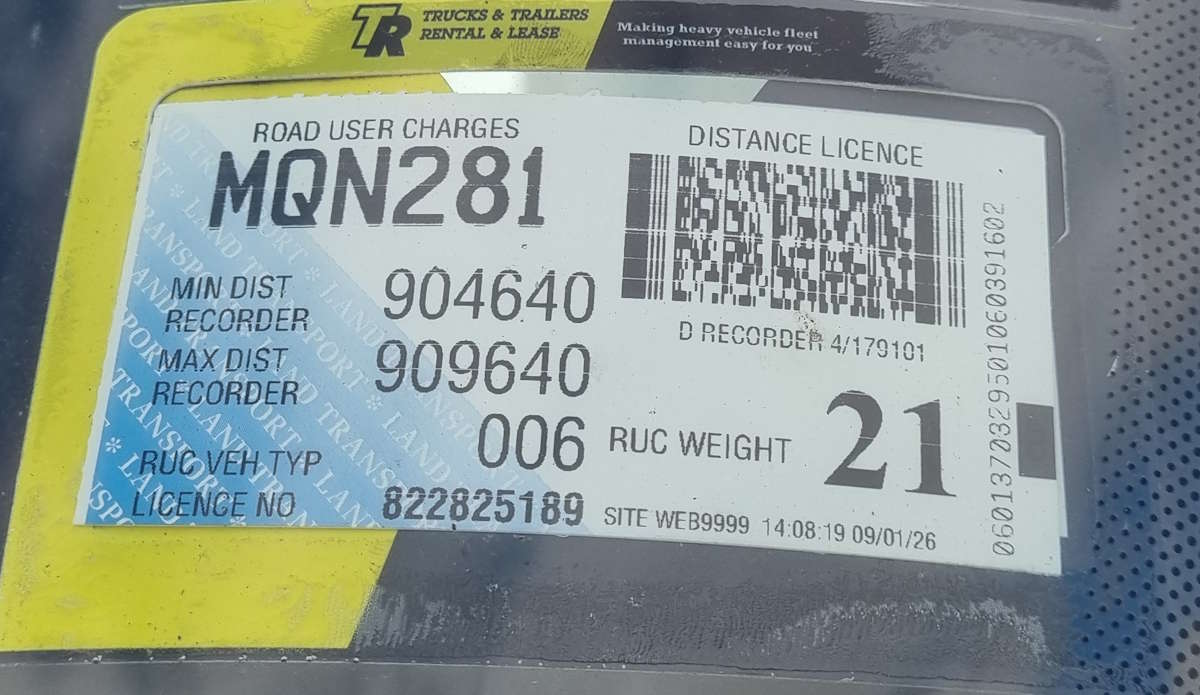
Axle weight limits can be complex. To understand your axle weights and ensure you’re not overloaded, our axle weight limits course teaches drivers how to keep their truck’s weight legal and safe.


Darren has written over 3000 articles about driving and vehicles, plus almost 500 vehicle reviews and numerous driving courses. Connect with him on LinkedIn by clicking the name above