
The hazards below the surface are invisible until they are struck. Ground collapse can bury a person in seconds, with no warning and no time to react. Underground services, including electrical cables, gas lines, water mains, telecommunications cables, and stormwater drains, can be hit by excavation equipment with consequences ranging from electrocution and explosion to flooding and service loss. Deep excavations can present confined space conditions if the atmosphere deteriorates, and vehicles and people can fall into unprotected open ground.
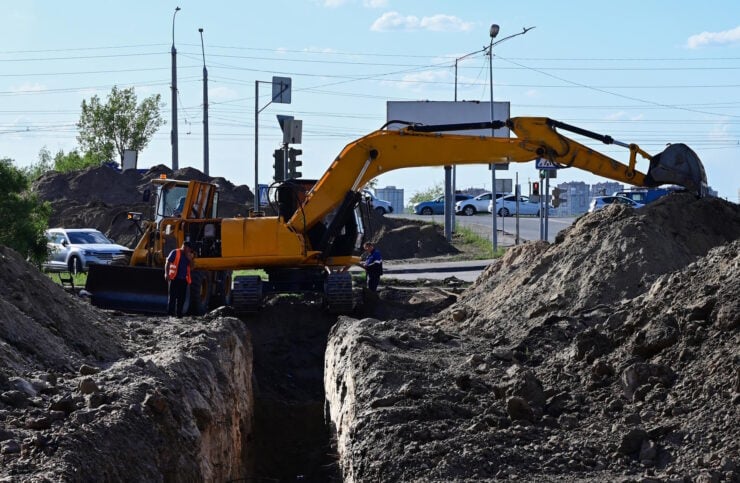
Your role as Permit Issuer is not to supervise the digging. It is to confirm that the right questions have been asked and answered before any ground is broken.
When an excavation certificate is required
Your organisation’s procedures define the trigger. Thresholds vary: some organisations require an excavation certificate for any work breaking ground deeper than 150 mm, others set the threshold at 300 mm or at excavations greater than 30 square metres in surface area. Know which standard applies on your site.
The scope of work that triggers the certificate is broader than most people expect. Trenching for new pipes or cables, levelling ground for foundations, digging holes to locate existing services, and any work involving shafts, drives, or demolition that disturbs the ground all fall within the definition. Some organisations also require a penetrations certificate when work involves drilling into or through a wall or floor, because the same risk of striking concealed services applies.
Identifying underground services
Before any ground is broken, the Permit Receiver must identify all known services from available drawings and records. This is the most critical step in the excavation permit process. A 400-volt cable at 600 mm depth will kill the operator of a mini excavator who puts a bucket through it. A 100 mm gas main will release gas that can accumulate in the trench and ignite.
If there is any doubt about the accuracy of the drawings, services must be located using detection equipment such as cable locators or ground-penetrating radar. Where the location of services remains uncertain after detection, treat the risk as high. Uncertainty about what is in the ground is not a reason to proceed with caution. It is a reason to stop until the uncertainty is resolved.
Confirm that the Permit Receiver understands the hand-digging rules near services. The standard approach requires hand digging within 500 mm in any direction of positively identified (visually confirmed) services, and within 2 metres of indicatively identified services (those shown on drawings or detected by a locator but not visually confirmed). If unidentified services are encountered during the work, all digging stops immediately and you must be notified before work can continue.
Service markings must be on the ground before mechanical excavation begins. Check the markings are present during your site inspection.
Ground stability
Soil type, moisture content, excavation depth, proximity to structures, and any loading from nearby equipment or stockpiles all affect the risk of ground collapse. A trench that was stable in dry clay last month may not be stable in saturated silt after a week of rain.
For excavations deeper than 1.5 metres, shoring, benching, or battering is typically required to prevent collapse. The specific method depends on the soil conditions and the geometry of the excavation. Spoil from the dig must be placed far enough from the edge to avoid loading the excavation face. Heavy equipment operating close to the trench edge can also cause collapse.
A Safety Observer must continually check the excavation face during periods of mechanical digging. Changes in soil colour, the appearance of water seepage, or cracking at the surface near the edge are all signs that the ground may be about to move.
WorkSafe notification
If the excavation meets the criteria for particular hazardous work, WorkSafe New Zealand must be notified at least 24 hours before work begins. The notification triggers include any trench or shaft deeper than 1.5 metres where the depth exceeds the horizontal width at the top, any excavation where workers must work with ground cover overhead, and any excavation where a face has a vertical height of more than 5 metres with a slope steeper than 1 horizontal to 2 vertical.
You must not issue the permit until notification has been made.
Access and egress
Workers in an excavation need a clear way out in an emergency. Secure ladders, steps, or ramps must be provided and positioned so that no worker is more than a defined distance from a means of exit. If the excavation changes shape as work progresses, the access arrangements may need to be updated.
All excavations left unattended must be barricaded or securely covered. During hours of darkness, portable flashing warning lights must be erected in any unlit excavation area.
Confined space conditions
A deep excavation can present confined space hazards if the atmosphere is compromised. Decomposing organic material, chemical contamination of the soil, or proximity to leaking services can all affect air quality in a trench. Waterlogged excavations near industrial sites may have elevated levels of methane or hydrogen sulphide.
An excavation certificate alone does not authorise personnel entry into an excavation. Where any excavation deeper than 1.5 metres requires workers to enter, a Confined Space Entry Certificate must also be obtained, with all the atmospheric testing, Safety Observer, and rescue planning requirements that come with it.
Competency
Workers carrying out excavation work should have appropriate qualifications, e.g. an excavator operator’s certificate. Confirm these qualifications before issuing.
Issuing the permit
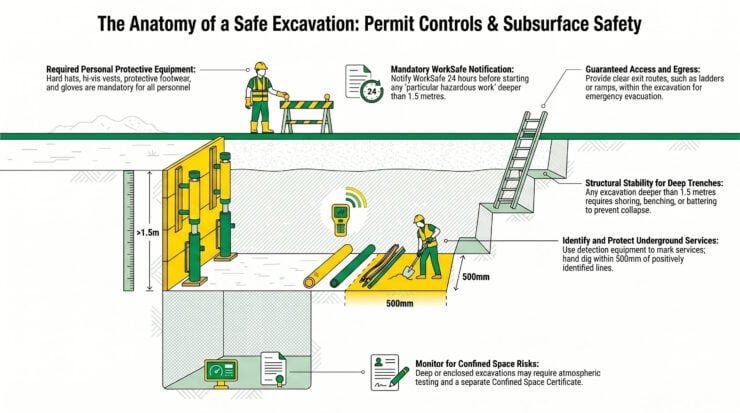
The Excavation Certificate checklist must be completed before work begins. Where a Safety Observer has been assigned, they must sign off the checklist. At some organisations, the maintenance team leader or a responsible manager must also co-sign the permit before it is issued.
The checklist confirms that services have been identified and marked, the ground has been assessed, shoring is in place where required, safe access is provided, WorkSafe has been notified where applicable, and the appropriate PPE has been specified. Your site inspection confirms these controls are in place on the ground, not just on the form. There’s more information about the whole permit-to-work system in our permit issuer course.


Darren has written over 3000 articles about driving and vehicles, plus almost 500 vehicle reviews and numerous driving courses. Connect with him on LinkedIn by clicking the name above