
We couldn’t find any New Zealand prosecution in which inadequate first aid provision was the sole or primary charge. However, first aid deficiencies arise as a contributing or aggravating factor within broader “failure to ensure health and safety” charges. The clearest case where inadequate first aid was an explicit judicial factor is Maritime New Zealand v Genera Limited (sentenced 14 July 2021, Tauranga District Court), prosecuted under HSWA 2015. On 27 January 2019, a New Zealand-employed in-transit fumigation technician “fell approximately two-metres off a log stack” on the Panamanian-flagged logging ship Bunun Justice, suffering a severely broken leg; it took crew nine hours to notice he was missing and three days to get him to hospital in Madang, Papua New Guinea. The Court noted “Genera had also failed to ensure that the Bunun Justice had adequate first aid equipment and supplies, including having pain medication on board.” “Genera was fined $245,000. The Court also ordered the company to pay the victim $60,000 in reparation for emotional harm, $6,089.96 in consequential losses, and half of Maritime New Zealand’s costs ($25,135.75).” First aid was one of several failings (others included inadequate working-at-height controls and no effective at-sea communication).
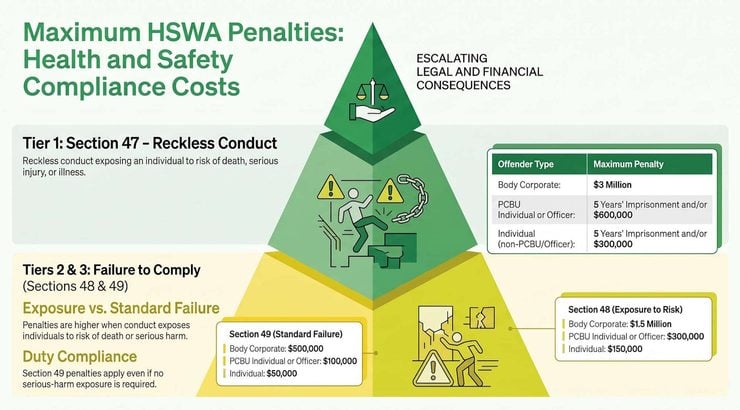
Maximum HSWA penalties for failing a health and safety duty:
- Section 47 (reckless conduct exposing an individual to risk of death/serious injury/illness): up to 5 years’ imprisonment and/or $300,000 (individual who is not a PCBU/officer); 5 years and/or $600,000 (PCBU individual or officer); $3 million (body corporate).
- Section 48 (failure to comply with a duty that exposes an individual to risk of death/serious injury/illness): $150,000 (individual); $300,000 (PCBU individual or officer); $1.5 million (body corporate).
- Section 49 (failure to comply with a duty, no serious-harm exposure required): $50,000 / $100,000 / $500,000 respectively.
It is unlawful in New Zealand to insure against HSWA fines. In practice, courts apply substantial discounts (for guilty pleas, remorse, good record and financial incapacity); WorkSafe’s published court summaries show, for example, a $450,000 starting point reduced to $40,000 for financial incapacity in one matter.
ANZCOR guidelines on first aider responsibilities
ANZCOR (the Australian and New Zealand Committee on Resuscitation), whose guidelines are adopted in NZ via the New Zealand Resuscitation Council, frames the first aider’s responsibilities across its Guideline 2 (Managing an Emergency) and First Aid series (Guideline 9.x):
- Managing an emergency: quickly assess; ensure safety for rescuer, casualty and bystanders; send for help (call 111 in NZ); position an unresponsive-but-breathing person in the lateral recovery position; follow the Basic Life Support flowchart (Guideline 8) if not breathing normally; and prioritise the unconscious person where there are multiple casualties.
- Recognition over diagnosis: “First Aiders are not expected to diagnose medical conditions … but to identify when urgent help is needed and take the right immediate actions.”
- Bleeding (Guideline 9.1.1): firm direct pressure is the primary method; in life-threatening bleeding, control of bleeding takes priority over airway and breathing.
- Heart attack (Guideline 9.2.1): call an ambulance; aspirin 300 mg unless known aspirin anaphylaxis; locate an AED; commence CPR if unresponsive and not breathing normally.
- Consent and legal/ethical issues (Guidance Statements 10.5.1 and 10.5.2): obtain consent where possible; treat without consent under necessity where the person lacks capacity and treatment is in their best interests; respect advance directives and a competent person’s refusal.
The best way to ensure you’re reducing your risk of a fine is to ensure that first aid training is part of your overall suite of risk management systems.


Darren has written over 3000 articles about driving and vehicles, plus almost 500 vehicle reviews and numerous driving courses. Connect with him on LinkedIn by clicking the name above