
WorkSafe published Working at height in New Zealand: Good Practice Guidelines (WSNZ_5049) in August 2026, replacing the 2012 Best Practice Guidelines for Working at Height in New Zealand that most height training in this country has been built on for the past decade. We have already updated our working at heights course.
The regulations themselves have not changed. The Health and Safety at Work (General Risk and Workplace Management) Regulations 2016 still set out the duties, and HSWA2015 still sets the primary duty of care. What has changed is WorkSafe’s published position on how you meet those duties, and in several places it has moved a long way from the 2012 document.
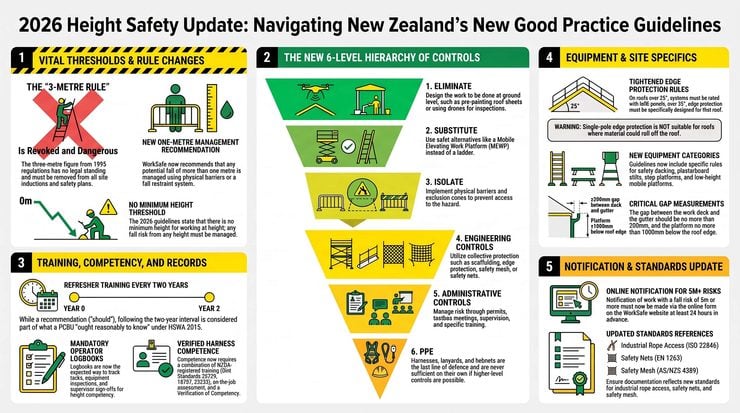
There is no minimum height, and a new one-metre recommendation
The 2026 guidelines state plainly that there is no minimum height threshold for working at height in New Zealand, and that any fall risk from any height must be managed. That was arguably true before. What is new is the number attached to it: WorkSafe now recommends that any potential fall of more than one metre is managed using physical barriers or a fall restraint system.
Alongside that, the guidelines give the “3-metre rule” its own section and call it dangerous and incorrect. The three-metre figure came from Regulation 21 of the Health and Safety in Employment Regulations 1995, which was revoked when HSWA2015 came into force. It has no legal standing now, but it is still quoted on sites and it still appears in site inductions, safety plans and task analysis templates written years ago.
If your paperwork refers to three metres as a trigger for fall protection, that is the first thing to fix. Someone climbing on the back of a trailer or a flat deck is inside WorkSafe’s one-metre recommendation, and the guidance no longer gives you anywhere to hide on that.
The hierarchy of controls now has six levels
The 2012 document worked on eliminate, isolate, minimise. The 2026 guidelines use the six-level hierarchy that matches the GRWM Regulations:
- Eliminate: do the work at ground level. Assemble trusses on the ground, pre-paint roof sheets, mount plant at ground level, inspect with a drone.
- Substitute: a MEWP instead of a ladder, an extendable pole system instead of climbing.
- Isolate: barriers and exclusion zones.
- Engineering controls: scaffolding, edge protection, safety mesh, safety decking, safety nets.
- Administrative controls: permits, toolbox meetings, supervision, training and certification.
- PPE: helmets, non-slip footwear, harnesses and lanyards.
Isolation has not been demoted. It has been correctly placed as one of the five ways of minimising a risk rather than as a step above minimisation. Substitution and administrative controls, which were not distinct steps in the old model, now are.
The guidelines are also blunt about where harnesses sit: edge protection and scaffolding are strongly preferred over harness-based systems, and PPE alone is never sufficient where a higher-level control can be used.
Refresher training every two years
The 2026 guidelines recommend refresher training every two years, and state that untrained workers require supervision by a competent person.
Note that this is a “should”, not a “must”. The guidelines open with a note explaining that WorkSafe uses “must” for legal requirements and “should” for recommended practice, and the two-year interval is a “should”. That does not make it optional in any practical sense. Section 22 of HSWA2015 defines reasonably practicable partly by what you know or ought reasonably to know about the risk and the ways of controlling it, and a published WorkSafe recommendation is exactly that. Depart from it and you need to be able to show your alternative achieves the same outcome.
The guidelines name the unit standard competency routes for the first time:
- Unit standard 23229, Use safety harness system when working at height, for basic work under travel restraint.
- Unit standard 15757, Use, install and disestablish temporary proprietary height safety systems when working at height, for anyone planning, installing or operating fall arrest systems, or supervising staff who do. 23229 is a prerequisite.
- Unit standard 23232, Develop a rescue plan for recovery of a suspended individual after a fall. 23229 is a prerequisite for this one too.
Bear in mind the guidelines quote the older NZQA titles for 23229 and 15757, so if you go looking on the NZQA site you will find slightly different wording. The numbers are right.
Bear in mind that unit standards are optional. You can choose other training that meets or exceeds the same standard.
WorkSafe also now expects harness competence to be verified through a combination of NZQA-registered training, practical on-the-job assessment by a competent supervisor, and a Verification of Competency. A unit standard on its own is no longer presented as the whole answer.
Operator logbooks
Operator logbooks get their own section and did not appear in the 2012 document at all.
WorkSafe presents them as the practical way for both the PCBU and the worker to demonstrate height competency. Entries should record the date, the task, the equipment used, the pre-use inspection, any defects or incidents, and which control system was in use (fall restraint or fall arrest), with supervisor sign-off where needed. For MEWPs, the logbook should be completed before use and again on any change of operator.
The logbook also tracks the gear. Harnesses, lanyards, anchor points, scaffolds and MEWPs all leave a usage and condition history in it.
Fitness for work
This is a new section. Fitness for work means being in a physical and mental condition to do the task safely and competently. Workers must not turn up with severe fatigue or illness, or under the influence of drugs or alcohol, and the PCBU must ensure so far as is reasonably practicable that a worker is fit to carry out the task.
For height work this is critical because the failure mode is not a slow decline in quality. It is one misjudged step.
New equipment guidance
There are four types of equipment they did not have in 2012:
- Safety decking (also called modular work platforms) for filling floor openings, atriums and stairwells. Slower to install than a safety net, but it gives a working surface rather than a catch system.
- Stilts for plasterboard work, with specific rules: hard level surfaces only, openings covered or barriered, work directly over the stilts without leaning, and never on scaffolding or any other elevated equipment.
- Step platforms as a safer alternative to a stepladder, particularly for extended work or work with restricted vision such as welding.
- Low height mobile working platforms, which should not be more than 1 metre above the floor unless a task-specific risk assessment says otherwise, and must be moved slowly, under control, at less than walking pace.
Edge protection has tightened
There are several changes here, and they are specific enough to check by eye on site:
- Above 25° pitch, edge protection should be system-rated and fitted with infill panels, and a roof ladder is needed as well as perimeter guardrails.
- Above 35° pitch, edge protection must be specifically designed for that roof.
- The gap between the work deck and the gutter line should be no more than 200mm, and 100mm or less where reasonably practicable.
- The platform should be no more than 1000mm below the roof edge, and the guardrail within 200mm of the roof projection.
- Edge protection should be continuous to the apex, including at gable ends. Stopping short and relying on a harness is called out specifically.
- Single-pole edge protection gets a boxed warning. It lacks the structural integrity of an engineered system, usually has no toeboard or platform, and often cannot take the force of a person falling against it.
Barriers to restrict access (bump rails) also get a limit they did not have before: they should be at least 2m in from the edge and should not be used on roofs with a pitch over 10°.
Harness systems and rescue
The old three-way split of restraint, positioning and arrest has been replaced with a five-rank hierarchy running travel restraint, restrained fall, limited free-fall, free-fall and restraint technique. Travel restraint sits at the top because it stops you reaching the edge.
Other changes worth knowing:
- Workers using fall arrest systems should never work alone.
- A work positioning system should not allow a fall of more than 600mm.
- Inertia reels should be anchored above head height, with the worker staying within a 30° arc below the reel.
- Fall arrest and abseil anchors should be tagged and recertified annually to AS/NZS 1891.
- WorkSafe now uses suspension intolerance rather than suspension trauma. So does Unit Standard 23229, so expect to see it in assessment material.
Standards references that have changed
If you have a standards list in your safety documentation, check these:
- Industrial rope access has moved from AS/NZS 4488 to AS/NZS ISO 22846.1 and 22846.2.
- Safety mesh is AS/NZS 4389.
- Safety nets are BS EN 1263-1 and 1263-2.
- Forklift work platforms are built to AS 2359.
- Soft landing systems are PAS 59:2004.
- Scaffolding compliance now points to WorkSafe’s Scaffolding in New Zealand guidelines or the AS/NZS 1576 series.
Notification
The notifiable work thresholds have not moved. A risk of falling 5m or more still requires 24 hours’ notice to WorkSafe, with the same four exclusions, though the residential exclusion is now worded as “a residential building up to and including two full storeys” rather than referring to a house.
The method has changed. Notification is now made through the online Notification of Particular Hazardous Work form on the WorkSafe website rather than in writing. For a work-related death, phone WorkSafe on 0800 030 040, which is staffed 24/7, and phone 111 first if it is an emergency.
What to do about it
Pull out your site documents and inductions and check three things: whether they still reference the three-metre rule, whether they still list AS/NZS 4488 or the 2012 guidelines, and whether anyone issuing height permits has been trained against the old material. Those are the three places the change shows up fastest.
As mentioned above, our working at height course has been updated to the 2026 guidelines, and anyone with a current licence gets the new material automatically.


Darren has written over 3000 articles about driving and vehicles, plus almost 500 vehicle reviews and numerous driving courses. Connect with him on LinkedIn by clicking the name above