• A TR Group Site
  • Help
  • Cart
Driving Tests DT logo small
Driving tests
  • Learner licence
    • Car
    • Motorbike
    • Heavy vehicle
    • Learner Licence Plus
  • Courses
  • Tourist
  • Resources
  • Learn
  • Resources
  • Learner licence
    • Car
    • Motorbike
    • Heavy Vehicle
    • Learner Licence Plus
  • Your courses
    • Enrolled courses
  • View all courses
  • Tourist
  • Resources home
  • iOS application
  • Android application
  • Contact us
  • Terms and conditions
  • Privacy
  • Home
  • /
  • Resources
  • / Working at heights

Working at height requirements in New Zealand

There is no minimum height threshold for working at height in New Zealand. WorkSafe’s Good Practice Guidelines for working at height, updated in August 2026, state plainly that any fall risk from any height must be managed, and that the common belief that falls under three metres need no controls is both dangerous and wrong. The guidelines go further than earlier versions: WorkSafe now recommends that any potential fall of more than one metre should be managed with physical barriers or fall restraint.

What the law requires: manage fall risks from any height (HSWA 2015, section 36; GRWM Regulations 2016, regulation 9 for training).

What WorkSafe now recommends: physical barriers or fall restraint for any potential fall over one metre.

Refresher training: recommended every two years.

What five metres means: the trigger for notifying WorkSafe and for requiring a certificated scaffolder. It is not a fall protection threshold.

At what height do you need fall protection in New Zealand?

There is no threshold. WorkSafe’s August 2026 guidelines are explicit: there is no minimum height for working at height, and any fall risk from any height must be managed. Working at height is defined as working anywhere a worker could fall and be hurt if precautions aren’t taken, which includes work above or below ground level, ladders, scaffolds, roofs and anywhere near an unprotected edge. Slipping or tripping on a flat floor isn’t a fall from height. Everything else is a risk assessment, not a measurement.

Is there a one-metre rule now?

Not a rule, but a recommendation, and it’s new. The August 2026 guidelines state that WorkSafe recommends any potential fall greater than one metre should be managed using physical barriers or a fall restraint. That’s guidance rather than law; the guidelines use “should” for recommended practice and “must” for legal requirements. However, it’s the closest thing to a working number WorkSafe has ever published, and it’s a long way below the three metres most of the industry still has in its head.

So what happened to the three-metre rule?

WorkSafe has addressed it directly, in a section titled clarifying the three-metre rule. Their position is that many people believe no control measures are needed for a fall under three metres, and that this belief is dangerous and incorrect. Wherever a person could fall from any height, the general duties under HSWA require reasonably practicable steps to prevent harm. The three-metre figure came from regulations under earlier legislation and never meant shorter falls were acceptable.

What if the work at height only takes a few minutes?

It’s treated the same. The guidelines have a dedicated section on short duration height work, defined as work lasting minutes rather than hours, and the position is that it must be treated like any other work at height. Full edge protection may not be reasonably practicable for a five-minute job, but it still has to be considered in the hazard assessment rather than ruled out, and appropriate fall prevention and a risk assessment are required regardless of how brief the task is. “It was only a couple of minutes” is not a control.

What if workers only work at height once or twice a year?

The duty is identical. Regulation 9 of the General Risk and Workplace Management Regulations requires PCBUs to provide information, training, instruction and supervision to workers, and that applies to any work a worker is expected to do, not just work they do often. Infrequent height work is arguably higher risk, because skills fade and unfamiliar tasks get improvised. Where a worker hasn’t been trained, the guidelines are clear that they require supervision by a competent person.

How often is refresher training needed?

WorkSafe recommends every two years. That’s a change worth noting, because three years has been the industry convention and is still what most providers and site rules specify. The August 2026 guidelines say initial training should happen before the worker starts and during induction, and that regular refresher training may also be required, with two years the recommended interval. It’s a recommendation rather than a legal requirement, but it’s now the benchmark you’d be measured against.

Do you need unit standards for height safety work?

No, but three are specifically named as recommended routes. For workers doing basic work in travel restraint, unit standard 23229, use a safety harness for personal fall prevention when working at height, is a way of achieving competence. For workers planning, installing or operating fall arrest systems and supervising others, unit standard 15757, use, install and disestablish proprietary fall arrest systems when working at height. For rescue planning, unit standard 23232, develop a rescue plan for recovery of a suspended individual after a fall. Unit standard 23229 is a prerequisite for both of the others. In every case an equivalent or higher qualification is acceptable, which is what makes these recommendations rather than requirements.

How do you prove someone is competent for harness work?

The guidelines set a higher bar here than anywhere else. All harness work requires training and competence, only trained and competent workers may install and use harness systems on site, and they should be supervised at all times by another trained and competent person. On verification, WorkSafe names three things in combination: NZQA-registered training (an equivalent non-unit standard training is an alternative), practical on-the-job assessment by a competent supervisor, and a Verification of Competency. Training alone is not presented as sufficient.

Do you always need a harness?

No, and reaching for one first is usually wrong. The guidelines are organised around control measures in order of preference: scaffolding, edge protection, mechanical access plant, safety mesh, safety decking, then harness systems, then temporary work platforms, catch platforms, soft landing systems, safety nets, and finally ladders as a means of access. A guardrail protects everyone on the platform without depending on anyone clipping on correctly. A harness protects one person, only if used properly, and only if someone can get them down.

What are the rescue requirements for fall arrest?

They are stronger than most people assume. The guidelines say that if rescue from a deployed fall arrest system is going to be difficult, you should choose different work equipment — an elevating work platform, for example. That reframes the question: rescue difficulty is a reason not to use fall arrest at all, rather than a problem to solve afterwards. Workers using fall arrest systems should never work alone, rescue plans should be documented with on-site personnel trained in them, and unit standard 23232 is the recommended competency for rescue planning.

When do you have to notify WorkSafe?

At least 24 hours before construction work with a risk of falling five metres or more, and before erecting or dismantling scaffolding with the same fall potential. There are real exclusions: residential buildings up to and including two full storeys, work on overhead telecommunications and power lines, work carried out from a ladder only, and minor or routine maintenance and repair. Other height-adjacent work is notifiable too: excavations over 1.5 metres deep needing shoring, and cranes lifting more than 500 kg over a five-metre vertical distance. Notification is made through WorkSafe’s online form.

When do you need a certificated scaffolder?

Where a worker or object could fall more than five metres, and for all suspended scaffolds regardless of height, the scaffold should be erected, altered and dismantled by, or under the direct supervision of, someone holding an appropriate Certificate of Competence. Below that, scaffolds should still be erected by workers trained and experienced with that type of scaffolding, with trainees working under direct supervision of a competent person. Scaffolds should comply with WorkSafe’s scaffolding guidelines or the AS/NZS 1576 series, be inspected regularly, be checked by a competent person before handover, and have a scaffold register kept on site.

How can you demonstrate height safety competency?

Operator logbooks, and the guidelines devote a section to them. WorkSafe describes them as a practical way for PCBUs and workers to show working at height competency: a verifiable record of a worker’s training, experience and proficiency across harness work, scaffolding, MEWP operation and rope access, showing that operators are competent, supervised where required, and using the right method for the control system in use. Logbooks also track the condition and safe use of the equipment itself (harnesses, lanyards, anchor points and scaffolds).

Does fitness to work apply to height work?

Yes, and it now has its own section. Fitness for work means a worker is in a physical and mental condition to perform their tasks safely and competently without being a risk to themselves or others. Workers must not come to work with severe fatigue or illness, or under the influence of drugs or alcohol. PCBUs must ensure so far as is reasonably practicable that a worker is fit to carry out their tasks, and workers must comply with reasonable PCBU policies on fitness for work. For height work the consequence of a lapse in attention is different in kind from most other tasks.

What it’s also called

Working at height, working at heights, height safety, fall protection, fall prevention, fall arrest, travel restraint, total restraint, harness training, height safety training, edge protection, guardrails, roof safety, scaffolding, safety mesh, safety decking, catch platform, soft landing system, safety net, anchor point, static line, lanyard, inertia reel and self-retracting lifeline. WorkSafe uses the singular “working at height”. Fall prevention and fall arrest are not interchangeable: prevention stops the fall happening, arrest stops it partway, and the guidelines prefer prevention.

Sources

  • Health and Safety at Work Act 2015, section 36
  • Health and Safety at Work (General Risk and Workplace Management) Regulations 2016, regulation 9
  • WorkSafe New Zealand, Working at Height in New Zealand: Good Practice Guidelines for Managing the Risks from Working at Height, August 2026
  • WorkSafe New Zealand, Scaffolding in New Zealand good practice guidelines
  • AS/NZS 1576 scaffolding series; AS/NZS 1891 industrial fall arrest series
  • NZQA unit standards 23229, 15757 and 23232

WorkSafe rewrote its working at height guidelines in August 2026, and two things in the new version will catch most businesses out. The recommendation is now to control any potential fall over one metre, not three. And refresher training is recommended every two years, not the three years most site rules still specify. If your height safety policy was written against the older guidance, it’s worth a look.

Additional resources and reading

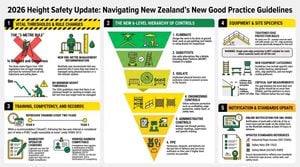
Infographic with working at height updates in the 2026 Good Practice Guide from WorkSafe

What’s changed in WorkSafe’s 2026 working at height guidelines

WorkSafe published Working at height in New Zealand: Good Practice Guidelines (WSNZ_5049) in August 2026, replacing the 2012 Best Practice Guidelines for Working at Height in New Zealand that most height training in this country has been built on for…

Read more ›

Creating permits for working at height

Falls from height are one of the most common causes of serious injury and death in workplaces. Many are caused not by equipment failure but by a failure to plan and organise the work properly. The permit system treats working…

Read more ›

What is a permit to work?

A permit to work is often described as a safety device. It isn’t. A permit is a document describing work that is, in some way, risky. The work is made safe by the controls listed on the permit, by the…

Read more ›

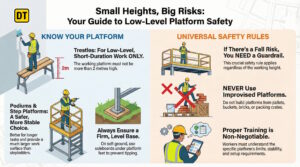
Temporary Work Platforms: Trestles and Podiums Done Safely

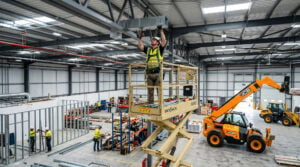
There’s a category of height work equipment that sits in an awkward middle ground: too small to feel like “real” scaffolding, but absolutely capable of causing serious injuries when things go wrong. Trestles, podiums, hop-ups, and folding platforms are the…

Read more ›

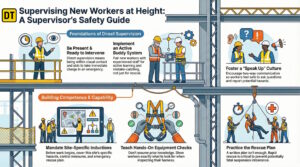
Supervising Workers New to Height Work

It can be nerve-wracking to watch someone work at height for the first time. Even if they’ve completed all the right training courses, there’s a world of difference between a controlled working at heights training environment and an actual job…

Read more ›

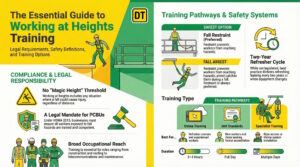
Working at heights (WAH) training

What is working at heights training? Working at heights training is structured learning that equips workers to identify fall hazards, select and use the right equipment, and apply safe work practices when there’s a risk of falling. It covers both…

Read more ›

The Three Metre Myth: Why Every Fall Height Matters

There’s a persistent belief floating around worksites that has been responsible for more injuries than most people would care to admit. It goes something like this: “If the fall is less than three metres, you don’t need to worry about…

Read more ›

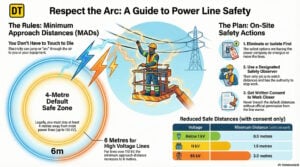
Working Near Power Lines: The Danger You Can’t Always See

Falls aren’t the only thing that can kill workers at height or those using a MEWP. When you’re working anywhere near overhead power lines, you’re dealing with a hazard that’s silent, invisible, and absolutely unforgiving. Electricity doesn’t care about your…

Read more ›

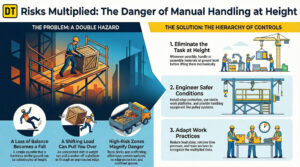
Working at Heights with Heavy Loads: A Double Hazard

There’s a reason experienced workers treat the combination of heights and manual handling with serious respect: you’re dealing with two hazards that can each cause severe injuries on their own, and when you put them together, the risks multiply. Fall…

Read more ›

Recent Resources
  • How to control severe bleeding in a workplace incident
  • How to issue a hot work permit in a permit-to-work system
  • How to help someone who is choking: first aid tips
  • Can you be fined for not providing workplace first aid training?
  • How to use an AED in a workplace cardiac arrest
  • Confined space entry under a permit to work system
  • Adult CPR: technique and what actually matters
  • What’s changed in WorkSafe’s 2026 working at height guidelines
  • When to call 111 from your workplace
  • Workplace First Aid Responsibilities in New Zealand

Licences and Courses

  • Car
  • Motorbike
  • Heavy Vehicles
Car
  • Core
  • Behaviour
  • Parking
  • Emergencies
  • Road position
  • Intersection
  • Theory
  • Signs
Motorbike
  • Bike-specific questions
  • Core
  • Behaviour
  • Parking
  • Emergencies
  • Road position
  • Intersection
  • Theory
  • Signs
Heavy Vehicles
  • Class 2
  • Class 3-5
  • Core
  • Behaviour
  • Parking
  • Emergencies
  • Road position
  • Intersection
  • Theory
  • Signs

Vehicle and workplace training

  • About
  • Resources
DT Driver Training TR Group
About
  • About us
  • Contact us
  • Privacy Policy
  • Terms and Conditions
Resources
  • Homepage
  • Driving Tests Android App
  • Driving Tests iPhone App
  • Getting your learner licence
DT Driver Training TR Group
Copyright 2010-2026 DT Driver Training Ltd, PO Box 12541, Penrose, Auckland, 1642. All rights reserved. Questions and images are used with permission from NZTA; question answers are proprietary.