What is working at heights training?
Working at heights training is structured learning that equips workers to identify fall hazards, select and use the right equipment, and apply safe work practices when there’s a risk of falling. It covers both preventing falls and responding when something goes wrong.
Where can I do working at heights training?
You can choose whether you would like to do it with a training company or online (click here for online WAH training). For refresher training, online is a no-brainer as it’s flexible, multilingual and better value for money. If you are working in a company with experienced people who can show you the ropes, online training also works well. If you are brand new and not working, then you should do unit standards or another type of in-person training.
What counts as “working at heights”?
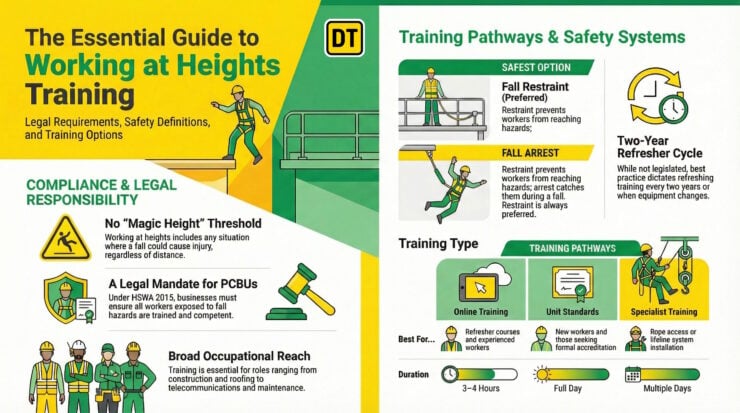
Any work where a fall could cause injury, regardless of how high up you are – a good reason to have workplace first aid training, too. That includes rooftops, scaffolding, ladders, platforms, the deck of a truck, and even floor openings. There’s no magic height threshold; if a fall could hurt you, it counts.
Is working at heights training a legal requirement?
Under the Health and Safety at Work Act 2015 (HSWA), PCBUs must ensure workers are trained and competent for the risks they face. That means if your workers are exposed to fall hazards, training isn’t optional; it’s a legal duty.
Who needs working at heights training?
Anyone who works where a fall hazard exists. That includes workers who work at height directly, supervisors overseeing that work, and managers responsible for planning safe systems of work.
Do you need WAH training if you are using an MEWP, order picker or forklift safety platform (“man cage”)?
Sufficient training should be included within those courses without you having to do a separate working at heights course, unless you are using the MEWP to access other high areas (e.g. you use the boom lift to access a roof). For example, MEWP courses will talk about harness requirements in boom lifts. Order picker and forklift safety platform courses will include harness training and basic heights safety. If you are staying clipped to the machine, additional training is not usually required.
What occupations typically require working at heights training?
Construction workers, roofers, scaffolders, painters, electricians, telecommunications technicians, arborists, window cleaners, maintenance workers and more.
Who can deliver working at heights training?
For competency-based training, online delivery can be done by a training company that creates a course in line with the good practice guidelines.
Training in unit standards, such as NZQA Unit Standard 17600, must be delivered and assessed by an accredited assessor through a recognised organisation.
What topics are covered in working at heights training?
Typically: relevant legislation and duties under HSWA, hazard identification and risk assessment, the hierarchy of controls, fall prevention systems (elimination, edge protection, travel restraint), fall arrest systems, equipment inspection and use, emergency and rescue procedures, and site-specific planning.
What’s the difference between fall restraint and fall arrest training?
Fall restraint training focuses on preventing a worker from reaching a fall hazard in the first place — using anchor points and lanyards to keep them back from an edge. Fall arrest training covers what happens if a fall occurs, such as how a harness system catches the worker. Both are important, but restraint is always the preferred approach.
What equipment is covered in working at heights training?
Training typically covers the selection, use, inspection, and storage of: full-body harnesses, lanyards (including shock-absorbing lanyards), self-retracting lifelines (SRLs), anchor points and anchor devices, connectors and karabiners, temporary horizontal lifeline systems, and rescue and retrieval equipment, scaffolding, platforms, ladders and gantries.
Does working at heights training cover ladders?
Yes. Ladder safety is a core component of most working at heights programmes, covering correct ladder selection, set-up, use, and the situations where a ladder isn’t the right tool for the job.
How long does working at heights training take?
It varies depending on the scope. An online course will be 3-4 hours, including an internal practical assessment. A unit standard programme covering theory and practical assessment is typically a full day. Specialist training, such as for rope access or installing lifeline systems, can take longer.
Does working at heights training expire?
While there’s nothing in legislation, it’s considered best practice to do refresher training every two years, and any time there’s a significant change in work practices or equipment.
What’s the difference between site induction and working at heights training?
A site induction covers the specific hazards and rules for a particular worksite. Working at heights training builds the underlying competency — knowledge and practical skills — that a worker brings to any site. You need both; one doesn’t replace the other.
Who is responsible for ensuring workers are trained?
The PCBU. Under HSWA, the duty to provide adequate training, instruction, and supervision sits with the business. Workers also have a duty to take reasonable care of themselves and others, which includes using their training correctly, but the primary responsibility lies with the PCBU. The PCBU can consider what type of training is most suitable for their team. This might be a mixture of online training, internal assessments and external training, depending on the trainees’ familiarity with working at heights, and the overall risk profile.


Darren has written over 3000 articles about driving and vehicles, plus almost 500 vehicle reviews and numerous driving courses. Connect with him on LinkedIn by clicking the name above