We answer your questions about MEWP courses.
What is an MEWP course?
An MEWP course will give you either unit standards or an operator’s certificate. MEWP training is structured instruction that teaches workers how to safely operate a Mobile Elevating Work Platform (also called an EWP). It covers legal requirements, hazard management, equipment inspection, and emergency procedures.
What machines are MEWPs?
Cherry pickers, scissor lifts, vertical lifts, Aichis, knuckleboom lifts and telescopic boom lifts.
Some machines, such as Crown’s WAV machine, can be considered an MEWP.
Why is MEWP training important?
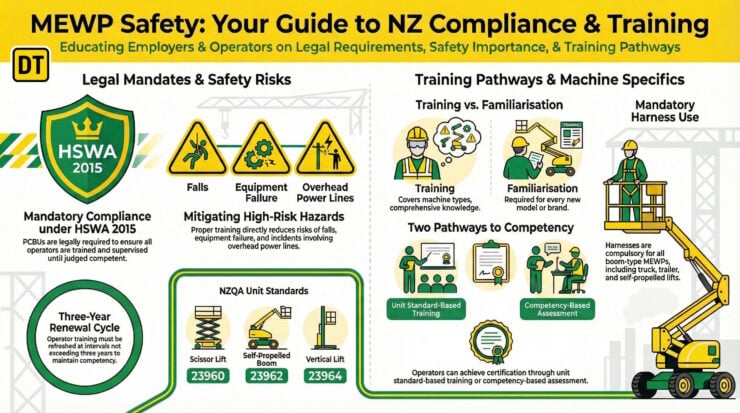
MEWPs are useful but complex pieces of equipment frequently used in hazardous areas. People have been seriously injured and killed in MEWP-related accidents, with inadequate training consistently identified as a key cause. Proper training reduces the risk of falls, equipment failure, and incidents involving hazards like overhead power lines. MEWP training can be paired with first aid training to help MEWP operators manage risk.
Is MEWP training a legal requirement in New Zealand?
Yes. Under the Health and Safety at Work Act 2015, the PCBU is legally required to ensure any operator of a MEWP is adequately trained and can demonstrate competency before using any equipment. Operators must also be supervised until judged competent.
Who needs MEWP training?
Anyone who operates a MEWP in the course of their work requires training specific to the type of machine they will use. This includes operators, as well as supervisors responsible for overseeing MEWP use on site. Employers and principals also need to understand their obligations, even if they are not operating the equipment themselves.
What occupations require MEWP training?
MEWP training is relevant across a broad range of industries including arboriculture, building and construction, bush and forest work, electrical supply and distribution, film and television production, plant and machinery hire, port operations, sign writing and advertising, stock picking, railways, telecommunications, and warehousing.
What types of MEWPs require separate training?
Assessment must be specific to the type of MEWP being operated. The main types are scissor lifts, truck-mounted platforms (also called bucket trucks), self-propelled boom lifts (including knuckle booms and telescopic booms), trailer-mounted boom lifts, and vertical mast lifts.
What topics are covered in MEWP training?
MEWP training covers legal requirements, understanding the operator’s manual, hazard identification and management, equipment and safety features, pre-start inspection, control operation, machine limits (rated capacity, wind rating, and weight), moving and positioning, transporting and loading, working near overhead power lines, harness use, refuelling and battery charging, reporting problems and incidents, emergency retrieval systems, and emergency rescue planning.
What NZQA unit standards apply to MEWP training?
Unit standards are optional. You can do either competency training (an Operator’s Certificate) or unit standards. The NZQA unit standards for MEWPs are 23966 (Types of EWPs and Legislative Requirements, which must be completed first), 23960 (Scissor Lift), 23961 (Truck Mounted EWP), 23962 (Self-Propelled Boom Lift), 23963 (Trailer Mounted EWP), 23964 (Vertical Lift EWP), and 17259 (EWP for Arboriculture). Each operator completes the unit standard that matches the machine they will be using.
Do you need a harness to operate a MEWP?
Harness use is mandatory on boom-type MEWPs, including truck-mounted, self-propelled, and trailer-mounted boom lifts. For scissor lifts, a hazard assessment determines whether a harness is required.
How long does MEWP training take?
The most time-efficient way is to do online theory plus a practical assessment on each machine. Because online training gets the information across quicker, this can be achieved within half a day.
A classroom course will be a day.
How often does MEWP training need to be renewed?
Operators require regular refresher training, and the gap between training sessions should not exceed three years. Refresher training must cover the same general and machine-specific requirements as the original training. Operators should also receive familiarisation training whenever they move to a different model or brand of MEWP, even within the same type.
Who can deliver MEWP training?
Training can be delivered online or by a competent person (someone who has demonstrated knowledge and skill in the safe use of the particular type of MEWP being taught). On-the-job training can only be provided by a competent person, and trainees must remain under supervision until they are assessed as competent.
What is the difference between MEWP training and MEWP familiarisation?
MEWP training delivers the knowledge and practical skills needed to understand how to operate a wide variety of machines safely. Familiarisation is an additional step required whenever an operator uses a new model or brand within a type they are already trained on. Employers are responsible for ensuring operators are familiar with the specific controls, manuals, and safety devices of each machine they use.
What happens if someone operates a MEWP without training?
Operating a MEWP without adequate training puts the operator and others at risk, and places the employer or principal in breach of their legal obligations under the Health and Safety at Work Act. This can result in serious injury, fatality, and significant legal liability. WorkSafe NZ can investigate and prosecute businesses where inadequate training has contributed to harm.

Darren has written over 3000 articles about driving and vehicles, plus almost 500 vehicle reviews and numerous driving courses. Connect with him on LinkedIn by clicking the name above