
Every emergency response starts with the same question: is it safe to approach? Getting that wrong is how first aiders become casualties. DRSABCD is the action plan that puts scene safety first and works through the rest in the order that gives the patient the best chance.
DRSABCD stands for Danger, Response, Send for help, Airway, Breathing, CPR, Defibrillation. It’s the ANZCOR (Australian and New Zealand Committee on Resuscitation) basic life support algorithm. The C can also refer to Circulation when life-threatening bleeding is the bigger problem than breathing.
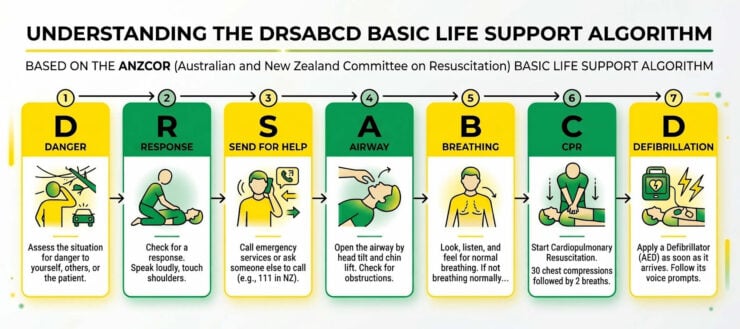
D is for Danger
Before you touch the patient, look at the scene. Obvious hazards first: fire, water, electricity, traffic, unstable structures, weapons. Then the less obvious ones: chemical spills, escaping gas, moving machinery, hot surfaces, sharps. In a workplace, the question is often “what caused this in the first place, and is it still a threat?”
Consider a scenario in a warehouse. A reach truck operator is found slumped at the controls, the truck stopped at an awkward angle in a racking aisle. Your instinct is to rush over. Hold the instinct. Is the truck still powered up? Is the load on the forks stable? Has the operator hit anything that’s now creaking above them? Five seconds of looking can save you from being the second casualty when the load comes down.
If the scene isn’t safe and you can make it safe, do that. Turn off the machine. Isolate the power. Move the person away from a hazard if you can do so without making the situation worse. If you cannot make the scene safe, do not enter. Call 111 and wait for people with the right equipment. Fire and emergency, ambulance, and police all attend workplace emergencies regularly. They have the gear and training to handle scenes you don’t. There is no version of first aid that requires you to put yourself in danger.
R is for Response
Once the scene is safe, check if the patient is responsive. Approach, get down to their level, and ask loudly: “Are you okay? Can you hear me?” Tap their shoulders firmly. A responsive person will react: open their eyes, move, speak, groan, flinch.
If they respond, that’s good news. They’re conscious. Stay with them, find out what happened, work out what help they need. The next module on this site covers the AVPU scale for assessing exactly how responsive a conscious person is. If they don’t respond, the situation is more urgent and you move to the next step.
S is for Send for help
If the person is unresponsive, seriously injured, or seriously unwell, call 111. If you have bystanders, delegate. Point to one specific person: “You in the orange hi-vis. Call 111 now. Tell them we have an unresponsive person at gate 4, Henderson Industrial Park. Come back and tell me when you’ve done it.”
Specificity matters. “Someone call an ambulance” is a request that everyone assumes someone else will fulfil. Pointing at one person and giving them a clear task makes them responsible. Ask them to report back so you know it’s done. If you also need an AED, send a second person to fetch it.
If you’re alone with the patient, the call-first rule depends on age. For an unresponsive adult, call 111 first then begin first aid (adults more often have cardiac problems where early defibrillation matters most). For an unresponsive child or infant, do one minute of first aid first then call 111 (children more often have a breathing problem that responds to immediate intervention).
A is for Airway
In an unconscious person, the muscles relax. The tongue, which is attached to the back of the jaw, can fall back and block the airway. Opening the airway is the priority once the patient is unresponsive.
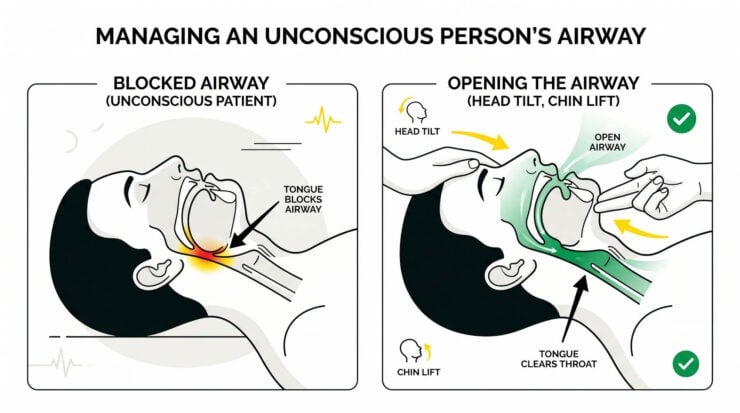
Use the head tilt, chin lift technique. Place one hand on their forehead and gently tilt the head back. Place two fingers of your other hand under the bony part of the chin and lift. This moves the tongue away from the back of the throat. If a spinal injury is suspected, the jaw thrust manoeuvre is preferred because it causes less cervical movement, but in most workplace emergencies the head tilt chin lift is the right call. ANZCOR’s position is that maintaining an airway takes priority over concerns about spinal injury, because a person can survive a spinal injury but cannot survive without breathing.
B is for Breathing
With the airway open, check for breathing. Look at the chest for rise and fall. Listen for breath sounds. Feel for air movement against your cheek. Take no more than 10 seconds.
Normal breathing is regular and relatively quiet. What you’re looking for is the absence of breathing, or abnormal breathing such as occasional gasps (these are called agonal gasps and are common after cardiac arrest). Treat agonal breathing as not breathing. If breathing is normal and the patient is unconscious, place them in the recovery position (covered separately on this site). If breathing is absent or abnormal, move to CPR.
C is for CPR (and Circulation)
If the patient is not breathing normally, start CPR immediately. Adult ratio is 30 compressions to 2 breaths, the same for child and infant in workplace first aid (different ratios apply for two-rescuer paediatric CPR in clinical settings, but 30:2 is standard for lay rescuers). The detailed technique modules cover compression depth, rate, and hand position.
The C also stands for Circulation in life-threatening bleeding. ANZCOR’s guidance is clear: in catastrophic haemorrhage, controlling the bleeding takes priority over airway and breathing, because a person can bleed out in minutes. Direct pressure first, then haemostatic dressings or tourniquets if available and you’re trained to use them. Severe bleeding control gets its own module in our first aid course.
D is for Defibrillation
If an AED is available, get it to the patient and turn it on. AEDs are designed for lay rescuers: they give voice prompts that walk you through every step, and they’ll only deliver a shock if the heart rhythm requires one. The key is speed. Survival from cardiac arrest drops by about 10 percent for every minute defibrillation is delayed, so don’t wait for the ambulance to arrive before fetching the AED. Continue CPR while the AED is being set up, and follow its prompts from the moment it starts speaking.
An example
Mid-morning at a manufacturing site. A forklift operator radios that a colleague has collapsed near the loading bay. You arrive within a minute.
Danger: a forklift is parked nearby, engine running, but a few metres clear. You ask the operator to switch it off and move it before you approach. The bay is otherwise clear.
Response: you kneel beside the man on the concrete. “Can you hear me?” you ask, tapping his shoulders. No response.
Send for help: “Sam, call 111 now. Tell them we have an unresponsive man at the loading bay, 27 Industrial Drive. Come back and tell me when you’ve called. Aroha, the AED is in the office by the door. Bring it here.”
Airway: head tilt, chin lift.
Breathing: you watch his chest for 10 seconds. One ragged gasp, then nothing. Not normal.
CPR: you start compressions, hands on the centre of the chest, pushing hard and fast. Aroha arrives with the AED about 90 seconds later. You turn it on and follow the prompts while continuing compressions between cycles.
That’s DRSABCD. No step skipped, no time wasted on the wrong action. The sequence is what makes it work under pressure.


Darren has written over 3000 articles about driving and vehicles, plus almost 500 vehicle reviews and numerous driving courses. Connect with him on LinkedIn by clicking the name above