
Hot work is any work that generates a source of ignition. That includes anything producing a flame, a spark, or sufficient heat to ignite flammable vapours, gases, or combustible materials. The list is broader than most people assume: welding, cutting, grinding, soldering, brazing, blowtorches, rotary disc cutting, sandblasting, paint stripping with hot air or flame guns, roof repair using bitumen boilers, and the use of any electrical equipment that is not rated for use in a hazardous atmosphere. A battery-powered drill in a powder environment is hot work. An internal combustion engine running in a hazardous zone is hot work.
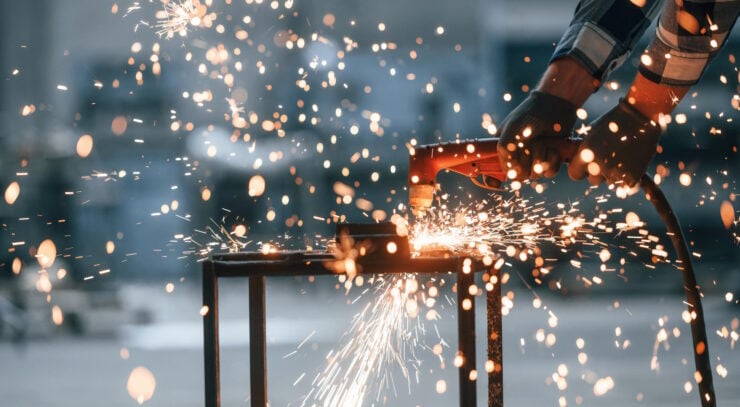
A single spark from a grinder can travel several metres, pass through a gap in a fire blanket, and sit smouldering in a concealed space for hours before finding something to ignite. The consequences range from property damage to multiple fatalities.
The first question
The most effective way to reduce the risk of hot work is to avoid it. Before you issue a hot work permit, ask whether the task can be done another way. If the task can be completed without an ignition source, the hot work certificate is not needed and the fire risk disappears.
Where hot work cannot be avoided, the controls must be thorough.
Clearing the area
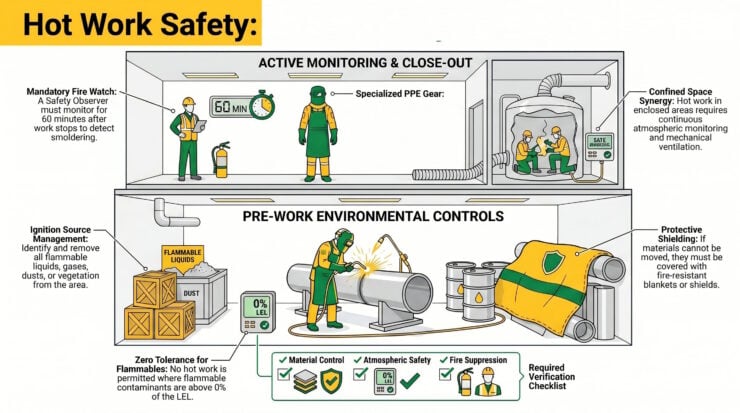
The area around the hot work must be assessed for flammable and combustible materials. Anything that could ignite must be removed or protected. This includes flammable liquids, gases, vapours, dusts, timber, paper, cardboard, insulation, plastic sheeting, vegetation, and any materials with combustible coatings.
It helps to understand hazardous substance safety data sheets, which you can learn about in our dangerous goods handler training.
If materials cannot be removed, they must be covered with fire-resistant blankets or shielded from sparks and heat. All sparks must be contained using fire blankets or screens to prevent them travelling into unprotected areas. Pay particular attention to the building construction in the immediate area. Cavities behind wall linings, cable runs through floors, and polystyrene sandwich panel (polypanel) cladding all present concealed fire paths where a spark can enter and smoulder undetected. There must be no direct welding or cutting onto polypanel cladding.
Where hot work is being done on scaffolding, confirm the scaffold boards are not in contact with the heat source.
Atmospheric testing in hazardous zones
If the hot work is in or near a hazardous zone classified under AS/NZS 60079 (Explosive atmospheres), atmospheric testing must be completed and the area confirmed free of flammable vapours before work begins. No hot work is permitted where flammable contaminants are present above 0% of the LEL. This limit is absolute.
Where work involves equipment that has contained flammable liquids or gases, the equipment must be made inert and certified gas-free by a competent person before any heat or spark is introduced. Methods include steam cleaning followed by filling with an inert gas such as nitrogen or carbon dioxide, or filling with water and leaving a small vented space at the repair point.
Continuous gas testing is required for hot work in hazardous areas. If conditions change during the work, the hot work stops immediately.
Fire suppression equipment
Portable fire extinguishers of the appropriate type must be available at the worksite. These must be in addition to the building’s normal fire protection, not relocated from other locations on site.
Where hose reels are available in the immediate area, they should be run out to the work area and made ready during the hot work.
The fire watch
A fire watch must be maintained for the duration of the hot work and for a defined period after the last hot work activity ceases. The fire watch period varies by organisation but is typically at least 60 minutes. Some sites require longer periods based on a risk matrix that considers the type of work, the area classification, and the materials present.
The person on fire watch must maintain a continuous presence at the worksite. They must not leave the area or take on other tasks while on watch. Their job is to observe for any signs of ignition, smoke, or smouldering, and to respond immediately with the fire-fighting equipment on site.
The risk that drives this requirement is heat transfer into concealed spaces. A spark can enter a wall cavity through a tiny gap in a fire blanket and sit there for well over an hour before igniting insulation, timber framing, or cable sheathing behind the wall lining. By the time smoke is visible from outside, the fire may already be established in the concealed space. The fire watch period exists to catch this, and it must not be shortened or skipped because the immediate area looks clear.
Hot work and fire protection systems
Hot work should not take place at the same time as work that requires the fire protection system for the same area to be disabled. If both must occur simultaneously, additional permits and compensatory controls are required.
Equipment and competency
All hot work equipment must be in good condition and fit for purpose. Gas-cutting equipment requires anti-flash devices, secured gas cylinders, and hoses in good condition. Grinding discs must be suitable for the grinder and the material being cut. Workers must hold the relevant qualifications for the type of hot work being performed and must be wearing the appropriate PPE, including welding-grade eye protection, fire-resistant clothing, and gloves appropriate to the task.
Where welding or cutting produces arc flash, screens must be in place to protect other people in the area from exposure.
Issuing the permit
Hot work must never proceed under a verbal permit – you can learn the restrictions of verbal permits here. A responsible team leader or manager must co-sign all permits requiring hot work certification. The Hot Work Certificate checklist must be completed and signed off before work begins, covering the location, the type of hot work, the combustible materials assessment, the atmospheric testing results where applicable, the fire watch arrangements, and the fire-fighting equipment on site. There’s more information about this in our permit-to-work issuer course.
The permit may only be issued on the condition that work will not start until the Safety Observer has completed the Hot Work Certificate checklist and confirmed all precautions are in place. When the work is finished and the fire watch period is complete, the Safety Observer signs the certificate to confirm, and only then can you close the permit.
Bear in mind that some companies may have specific requirements – check their permit forms as to specific information they need.


Darren has written over 3000 articles about driving and vehicles, plus almost 500 vehicle reviews and numerous driving courses. Connect with him on LinkedIn by clicking the name above