
An automated external defibrillator (AED) is a portable device that analyses the heart’s electrical rhythm and delivers a shock if the heart is in a rhythm that can be shocked back to normal. CPR keeps oxygenated blood moving; an AED is what actually restarts the heart in most cases of sudden cardiac arrest. The New Zealand Resuscitation Council’s Chain of Survival makes the point bluntly: early CPR plus early defibrillation are the two interventions that most influence whether a person survives a workplace cardiac arrest.
The numbers explain why AEDs matter. Without defibrillation, survival from sudden cardiac arrest drops by roughly 10 percent for every minute the rhythm goes untreated. Increased public access to AEDs has lifted survival in adult cardiac arrest from around 10 percent to as much as 60 percent. The machine doesn’t replace CPR; it does what CPR can’t.
What an AED actually does
An AED is designed for any bystander to use, trained or not. Once the pads are attached, it analyses the heart’s rhythm. If it detects a shockable rhythm (most commonly ventricular fibrillation or pulseless ventricular tachycardia), it tells you a shock is needed. If the rhythm isn’t shockable, it won’t deliver one. You cannot shock a healthy heart by mistake; the machine makes that decision.
Modern AEDs are biphasic and self-instructing. They give voice prompts at each step. Some are fully automatic and deliver the shock themselves once everyone is clear. Most are semi-automatic: they tell you to press the shock button. Either way, the prompts walk you through it.
Using one in a real cardiac arrest
When you find someone unresponsive and not breathing normally and have started CPR, an AED becomes the next priority. Send someone to fetch it. There is often signage to help you locate it.
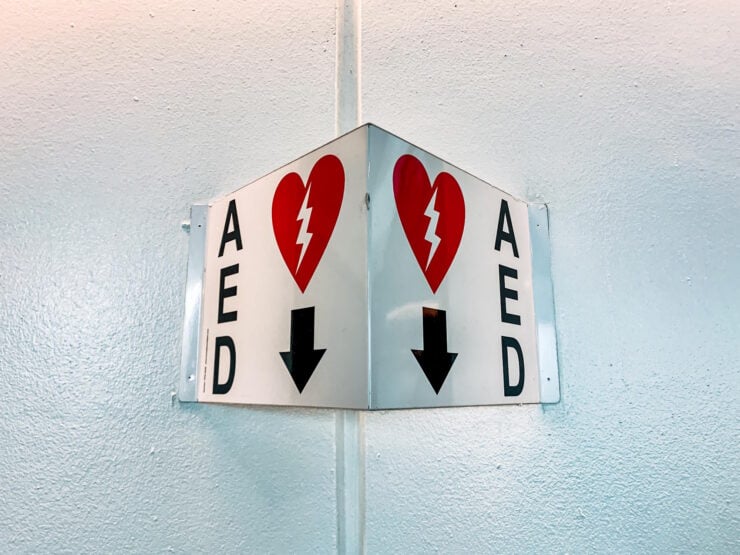
It is usually in a cabinet attached to the wall.
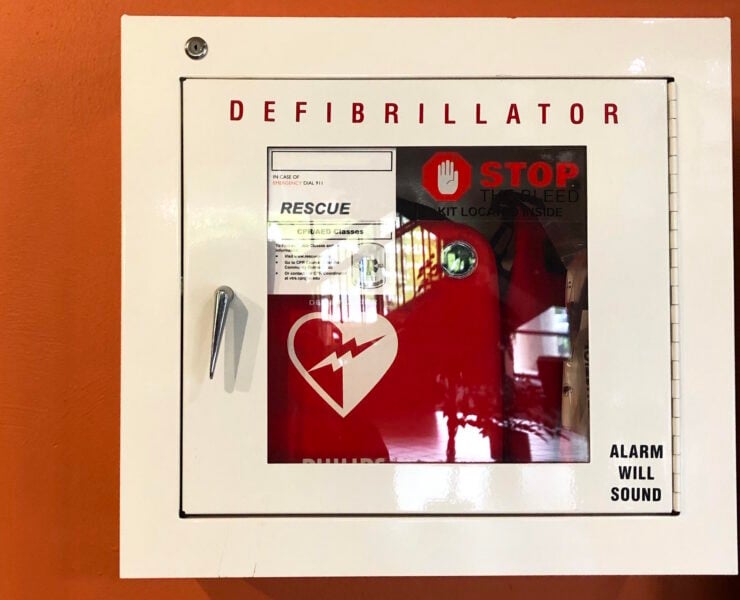
Don’t stop compressions to set it up yourself if you can avoid it; let a second person handle the AED while you keep pumping. If you’re alone and the AED is within sight, leaving briefly to grab it is reasonable. Don’t go hunting for one.
When the AED arrives, open it and turn it on. Some power on automatically when you lift the lid. From that moment, listen. The voice prompts will tell you exactly what to do next.
Expose the patient’s chest. Bra, shirt, anything covering the chest comes off or moves out of the way. If the chest is wet (sweat, water, blood), towel it dry quickly so the pads stick. Excessive chest hair can stop pads adhering: many AED kits include a small razor for shaving the pad sites. Shave fast and keep moving.
Apply the two pads where the diagrams on them show. Standard placement is one on the upper right chest below the collarbone, and one on the lower left side of the chest. If you apply them in reverse positions, leave them. Removing and replacing pads wastes time and the adhesive doesn’t reseat well.
Once the pads are on, the AED will say “analysing rhythm” or “stand clear.” Stop CPR. Make sure no one is touching the patient. Movement interferes with the analysis. If a shock is advised, the machine will tell you to stand clear and press the shock button. Look first. Say it out loud: “Clear.” Then press. After the shock (or if no shock is advised), resume CPR immediately. Don’t check for a pulse. Don’t wait. Back to compressions. The AED will analyse again every two minutes.
Special situations
Implanted pacemakers or defibrillators show as a small lump under the skin, usually below the left collarbone. Place the pad at least 2.5cm away from the device. If you’re not sure whether one is present, place the pads in the standard position.
Medication patches (for nitrate, hormone replacement, pain relief) on the chest can interfere with the shock or cause burns. Remove them with a gloved hand and wipe the area before placing the pad.
Children eight years and older are treated as adults: standard pads, standard placement. For children between one and eight years old, use paediatric pads if the AED has them. If only adult pads are available, use those (adult pads are better than no pads) and place one on the chest and one on the back if there isn’t enough room on the chest for the pads not to touch. For infants under one year, paediatric pads are strongly preferred.
Wet ground, ice, snow, or metal surfaces don’t stop AED use as long as the pads are on dry skin and not touching standing water or metal. Don’t use an AED in standing water or near flammable atmospheres (petrol vapour, high-flow oxygen). Move the patient a short distance if you have to.
Large-breasted patients: place the left pad beside or underneath the breast on the side of the chest wall, not on breast tissue.
Where to find an AED at your workplace
AEDs are commonly in green or yellow wall cabinets near reception, in lunchrooms, or in main corridors. New Zealand’s AED Locations register lists publicly available units; the AED Locator app shows the nearest ones on a map. Many transport yards, manufacturing sites, and remote rural workplaces have their own units because ambulance response can be longer than the critical window. If your workplace doesn’t have one and you have hazards like electrocution risk, large numbers of public visitors, or a long ambulance response time, raise it with whoever manages your health and safety. Cost has dropped substantially in recent years and the case is straightforward.
A workplace scenario
Mid-afternoon at a courier depot. A driver in his fifties collapses in the office while sorting paperwork. A colleague checks for danger, finds him unresponsive and not breathing normally. She shouts to the dispatcher: “Call 111. Tell them cardiac arrest at the depot, 17 Industrial Drive. Then grab the AED off the wall in the lunchroom.”
She starts compressions. About a minute later the AED arrives. The dispatcher opens the lid; voice prompts start. He cuts the driver’s shirt open, towels off some sweat, and applies the two pads. The AED says “analysing rhythm, stand clear.” The colleague lifts her hands off. “Shock advised. Stand clear. Press the shock button.” He looks, says “clear,” and presses. The driver’s body twitches once. The AED says “Resume CPR.”
Two cycles later the driver groans and starts moving. The ambulance arrives a minute after that. Without the AED, that outcome doesn’t happen. Without CPR keeping the heart muscle alive between collapse and shock, the AED has nothing to shock back. Together they work. Neither is optional.
This scenario and others can be found in our workplace first aid training.


Darren has written over 3000 articles about driving and vehicles, plus almost 500 vehicle reviews and numerous driving courses. Connect with him on LinkedIn by clicking the name above