
Falls from height are one of the most common causes of serious injury and death in workplaces. Many are caused not by equipment failure but by a failure to plan and organise the work properly. The permit system treats working at height as a specialist category requiring its own certificate, because the consequences of getting it wrong are severe and the controls must be right before anyone leaves the ground.
What counts as working at height
Working at height means any work where a person could be injured falling from one level to another. That includes work above ground level and below it. A worker replacing a light fitting from a scaffold at four metres is working at height. A worker descending into a pit to inspect a valve at two metres below ground level is also working at height. The direction of the fall does not matter. What matters is the potential for injury.
Under the Health and Safety at Work Act 2015, if there is any potential for a person to fall from any height, reasonable and practicable steps must be taken to prevent it. Construction work where the potential fall is five metres or more is classified as particular hazardous work and must be notified to WorkSafe before the permit is issued.
People who work at height must have undergone working at heights training, and people using EWPs should have an EWP operator’s certificate or unit standards.
The first question to ask
Your first check when reviewing a height permit application is whether the work at height needs to happen at all – we cover this in the permit-to-work permit issuer course. Can the task be done from the ground? Can the equipment be brought down rather than worked on in place? Can a long-reach tool or remote system eliminate the need for a person to be elevated? If the hazard can be eliminated, that is the preferred control and the height certificate is not needed.
Where working at height cannot be avoided, the hierarchy of controls applies. The preferred approach is to isolate people from the fall hazard using guardrails, scaffolding, or an elevated work platform (EWP) with compliant barriers. If isolation is not practicable, fall restraint systems keep the worker physically tethered so they cannot reach an edge. Fall arrest, where a harness and lanyard catch the worker after a fall, is the last resort because it does not prevent the fall; it only limits the consequence.
What you must confirm before issuing
The Job Safety Analysis must specify which type of fall protection is being used. You do not select the method yourself, but you must confirm that a specific method has been identified, that it matches the task and the environment, and that the required equipment and competency are in place.
All fall protection equipment must comply with AS/NZS 1891 and be within its service life. Harnesses must have been inspected within the timeframe your organisation specifies, typically six months. Permanent anchor points must be certified at the intervals required, typically annually, and the certification must be marked at the anchor point itself. A harness clipped to an uncertified anchor point provides false security, not protection.
Unit standards are optional for workers. If they can demonstrate competency through training that is equivalent or better, this is satisfactory under the HSWA.
Where fall arrest is in use, a shock absorber must be part of the system. Consider the pendulum effect when reviewing the anchor point selection: if a worker falls and swings, what will they hit? Many height injuries are not caused by the fall itself but by the worker swinging into adjacent structures after being caught by the harness.
Elevated work platforms
EWPs include scissor lifts, boom lifts (cherry pickers), and truck-mounted platforms. The machine must have been inspected within the past six months, with the inspection displayed on the unit. It must be selected for the task and the ground conditions. A scissor lift designed for hard, flat surfaces will tip on uneven or soft ground.
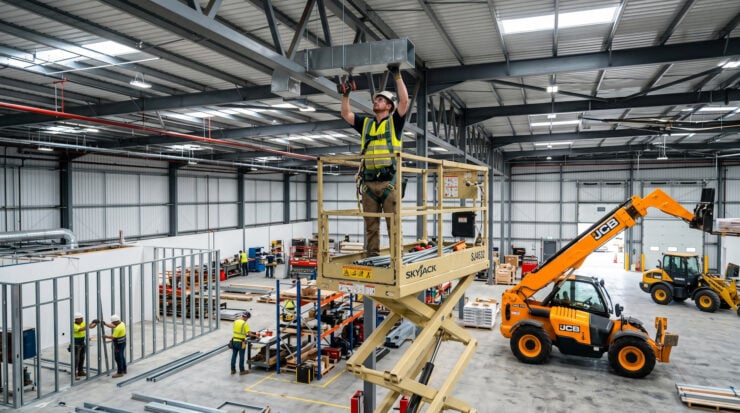
Check for overhead hazards. An EWP must never be operated near overhead power lines. For boom-type platforms, consider the swing arc and what is behind and around the unit. Workers in a boom lift must wear a harness at all times, connected to a certified anchor point within the basket. For scissor lifts, a harness connected to an anchor point should be worn unless there is a documented reason why it is not practicable.
Scaffolding
Fixed scaffolding erected to a height of three metres or more must be erected by a registered and competent scaffolder. Erection or dismantling of scaffolding where a person could fall five metres or more is notifiable work. All fixed scaffolding must be tagged as safe before it is accessed by workers. Before you issue a permit involving scaffolding, confirm the tag is current and the scaffold has not been modified since its last inspection.
Workers erecting or dismantling scaffold who are not within the confines of compliant guardrails must use a harness for fall restraint.
Roof access
Any access to a roof requires a working at heights certificate. The two-metre rule applies: no person may be within two metres of an unguarded roof edge without fall protection in place. Consider the roof pitch as well. A shallow-pitched roof where a person could slide to the edge after a trip negates the two-metre rule and requires edge protection or fall arrest regardless of distance from the edge.
No one works on a roof alone. Workers must operate in pairs at minimum and have a means of communication such as a radio or mobile phone. Check the weather forecast before issuing. Wet, icy, or high-wind conditions make roof work unacceptably dangerous and may require the permit to be postponed.
The rescue plan
Any permit involving fall arrest requires a documented rescue plan before work begins. A person suspended in a harness after a fall faces suspension trauma, which restricts blood flow and can become life-threatening within minutes. The plan must specify how the worker will be reached and lowered to safety, what rescue equipment is on site and where it is positioned, and how emergency services will access the location. If the rescue plan is not documented or the rescue equipment is not physically present, the permit is not issued.
Tools and equipment used at height must be restrained to prevent them from falling on people below. Barriers and signs must be in place to prevent other personnel from entering the area beneath the work.


Darren has written over 3000 articles about driving and vehicles, plus almost 500 vehicle reviews and numerous driving courses. Connect with him on LinkedIn by clicking the name above