
Burns are common workplace injuries: hot exhaust manifolds on trucks, welding sparks, kettle scalds in lunchrooms, hot oil on a fryer, hot bitumen, hot brake discs, chemical splashes, electrical contact. The first aid response is similar across most thermal burns and changes meaningfully for chemical and electrical burns. The cornerstone for any burn is cooling: cool running water for 20 minutes, started as soon as possible.
Cool thermal burns for at least 20 minutes with cool running water, and this remains effective up to three hours after the burn. Even if you can’t start cooling immediately, do it as soon as you can. Twenty minutes feels like a long time when you’re standing at a sink, but it makes a measurable difference to depth of damage, blistering, and healing time.
Thermal burns: the basic response
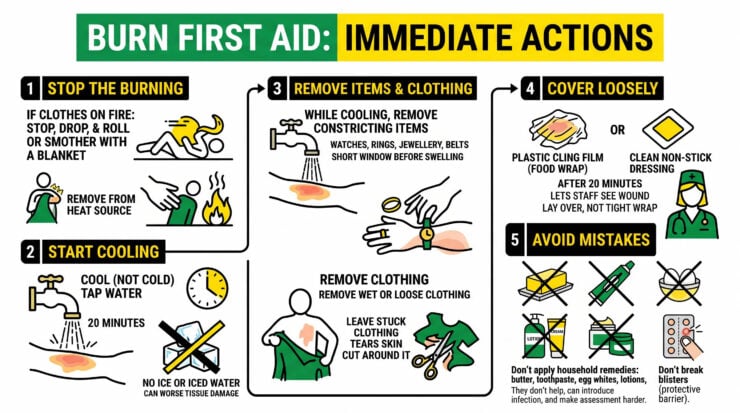
Stop the burning process first. If clothes are on fire, stop drop and roll, or smother with a blanket. Remove the patient from the heat source. Then move to cooling.
Run cool (not cold) tap water over the burn for 20 minutes. Iced water and ice packs are not recommended; they can constrict blood vessels and worsen tissue damage. Cool tap water is exactly the right temperature.
While cooling, remove constricting items from the area: watches, rings, jewellery, belts, anything that will become a tourniquet as the burn swells. Burns swell, often a lot. The window for getting jewellery off is short.
Remove clothing that’s wet from the hot liquid or coming away easily. If clothing is stuck to the burn, leave it. Pulling it off tears skin with it. Cut around it if necessary and keep cooling.
After 20 minutes of cooling, cover the burn loosely with a clean non-stick dressing. Plastic cling film (food wrap) works well for this: it doesn’t stick to the wound, it’s usually to hand, and it lets medical staff see the injury without removing the covering. Lay it over the burn rather than wrapping tightly around a limb; the area will keep swelling for some hours.
Don’t apply butter, toothpaste, egg whites, lotions, creams, ointments, or any of the household remedies that show up on social media. They don’t help, they can introduce infection, and they make assessment harder for the medical team. Don’t break blisters; they’re a protective barrier.
When a burn needs an ambulance
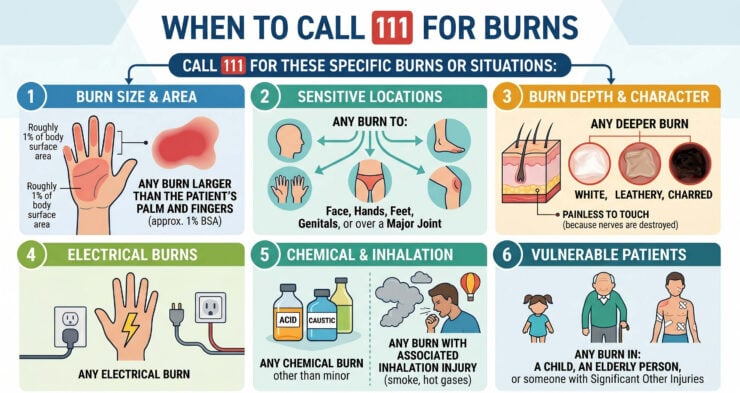
Call 111 for: any burn larger than the patient’s palm and fingers (roughly 1 percent of body surface area is around the size of their open hand); any burn to the face, hands, feet, genitals, or over a major joint; any deeper burn (white, leathery, charred, or painless to touch, because nerves have been destroyed); any electrical burn; any chemical burn other than minor; any burn with associated inhalation injury (smoke, hot gases); any burn in a child, an elderly person, or someone with significant other injuries.
Even for burns that don’t need 111, the patient should see a GP or after-hours clinic if there’s blistering, broken skin, or any concern about depth. The Burn Support Group Charitable Trust (burns.org.nz) has useful patient information for ongoing care.
Inhalation injury: easy to miss
If a worker has been in an enclosed space with hot gases, smoke, or steam, suspect inhalation injury. Signs include burns around the face, singed nasal hair or eyebrows, soot or carbon in the mouth or nose, hoarse voice, coughing up dark sputum, or any breathing difficulty. The airway can swell over several hours after exposure even if the patient initially seems fine, so inhalation injury always means 111 and hospital assessment, regardless of how the patient looks at the scene.
Chemical burns
Chemical burns work differently. The priority isn’t cooling, it’s decontamination: getting the chemical off the skin before it keeps damaging tissue. You can learn about handling dangerous goods in our dangerous goods handler course.
Protect yourself first; gloves and eye protection on. Remove contaminated clothing and brush off any powder before flushing (water can activate some powdered chemicals).
Then flush with copious running water. For most chemicals, 20 minutes minimum, longer for alkalis (caustic soda, lime, cement) which can keep burning for hours and tend to penetrate deeper than acids. For eye splashes, flush continuously while transporting to medical care; eyes need long, gentle flushing.
Your workplace must have Safety Data Sheets for hazardous substances on site. Check the SDS for the specific chemical involved; some have unusual first aid requirements. Hydrofluoric acid (used in some metal cleaning and rust removal products) is a notable case: it penetrates skin and binds calcium, causing pain that can be delayed and damage that can be fatal even from small exposures. Hydrofluoric acid burns need calcium gluconate gel applied as soon as possible, and immediate medical attention regardless of how small the exposure looks.
The National Poisons Centre (0800 764 766) gives 24/7 advice on chemical first aid. If you’re not sure what you’re dealing with, call them while you flush.
Electrical burns
Electrical burns are misleading. The visible burn at the skin is usually a small entry or exit wound; the real damage runs through the body between those points. Internal organs, muscles and nerves along the electrical path can be badly damaged, and the heart’s rhythm can be disrupted. Cardiac arrest after electrocution is a known risk.
Before approaching the patient, make sure the power source is isolated. For mains electricity, switch off and unplug at the source. For high-voltage situations (downed power lines, contact with overhead lines from a tipper or crane), stay at least 8 metres back and call 111. High voltage arcs across distances and through anything that conducts, including wet ground and wooden poles. Don’t try to drag the person clear with a stick or rope; you can’t guarantee what is and isn’t conductive at high voltage. Wait for lines companies to confirm the power is off.
Once it’s safe, run DRSABCD. Be ready to start CPR. Cool any visible burns with running water as for thermal burns. Even if the burn looks small, anyone who has received an electrical shock needs hospital assessment. Heart rhythm disturbances can develop hours after the shock.


Darren has written over 3000 articles about driving and vehicles, plus almost 500 vehicle reviews and numerous driving courses. Connect with him on LinkedIn by clicking the name above