
There’s a persistent belief floating around worksites that has been responsible for more injuries than most people would care to admit. It goes something like this: “If the fall is less than three metres, you don’t need to worry about it.”
It’s wrong. Dangerously wrong. And it’s time we put this myth to bed.
Where the confusion comes from
The three-metre figure isn’t entirely made up: it does appear in the regulations. Regulation 21 of the Health and Safety in Employment Regulations 1995 specifically addresses falls from heights of three metres or more. It requires employers to take all practicable steps to ensure that where any employee may fall more than three metres, suitable means are provided to prevent them from falling.
That’s pretty clear. But here’s what people miss: this regulation doesn’t exist in isolation. It sits underneath the broader Health and Safety at Work Act, which requires that if there’s any potential for a person at work to fall from any height, reasonable and practicable steps must be taken to prevent harm.
The three-metre rule in Regulation 21 is a specific additional requirement for higher falls. It was never intended to be a threshold below which you can shrug your shoulders and walk away. The Best Practice Guidelines for Working at Height in New Zealand couldn’t be clearer on this point: doing nothing is not an option.
The numbers tell a grim story
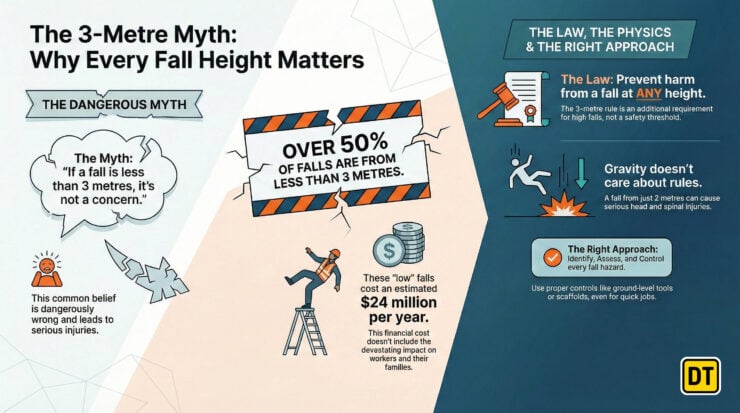
Here’s the reality that should give every site manager pause. Investigations by the Ministry of Business, Innovation and Employment into falls while working at height show that more than 50 percent of falls are from less than three metres. The majority of fall incidents happen at heights where some people still believe no controls are needed.
Approximately 70 percent of falls are from ladders and roofs, often at heights well below the three-metre mark. The cost of these falls has been estimated at $24 million a year, and that’s just the financial cost. It doesn’t capture the broken bodies, the rehabilitation, the time off work, or the families affected.
A fall from two metres onto a hard surface can cause serious head injuries, spinal damage, and broken bones. A fall from just over a metre onto an awkward surface or onto objects below can be catastrophic. The human body doesn’t care about regulatory thresholds; gravity and concrete work the same at any height.
What the law actually requires
Under the Health and Safety at Work Act, PCBUs have a primary duty of care to ensure, so far as is reasonably practicable, the health and safety of workers. This applies to all work at height, regardless of the distance to the ground. This means ensuring workers have appropriate working at heights training, the right equipment, and are empowered to work safely.
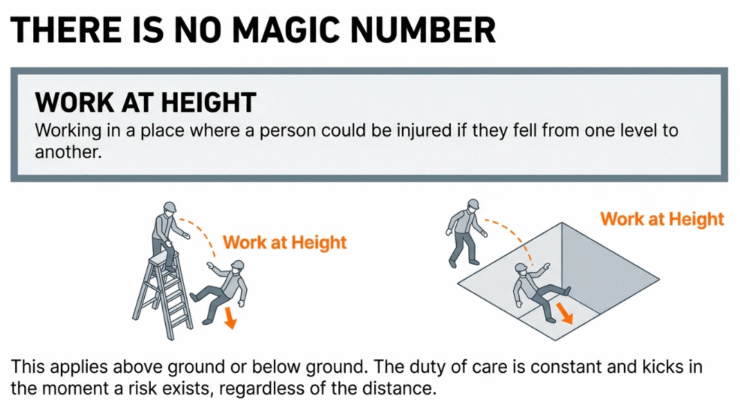
Work at height, by definition, means working in a place where a person could be injured if they fell from one level to another. This can be above or below ground level. There’s no magic number where this duty suddenly kicks in.
The approach required is straightforward. You identify the hazard: someone could fall. You assess the risk – how likely is it, and how bad would it be? Then you control that risk, starting with elimination and working down through the hierarchy: isolation, then minimisation.
For low-level work, elimination might mean doing the task from ground level with long-handled tools. Isolation could be as simple as using a proper mobile scaffold with guardrails instead of a ladder. Minimisation might involve work positioning systems for tasks that genuinely can’t be done any other way.
Short duration doesn’t mean no controls
Another variation of the myth is that quick jobs don’t need the same level of protection. “I’ll only be up there for five minutes” is not a risk assessment.
The guidelines are explicit: short-duration work at height shall be treated the same way as any other activity at height. Appropriate fall prevention controls shall be put in place, regardless of the time duration of the task. Short duration means work that lasts minutes rather than hours—but those minutes can still include a fall.
The time it takes to fall two metres is less than a second. That’s not enough time to catch yourself, react, or do anything useful. Whether you’re up there for two minutes or two hours, if you fall, the outcome is the same.
What this means for your site
If you’re responsible for workers at height, you need to bin the three-metre myth and start from the right place. Every task where someone could fall needs a proper assessment and appropriate controls.
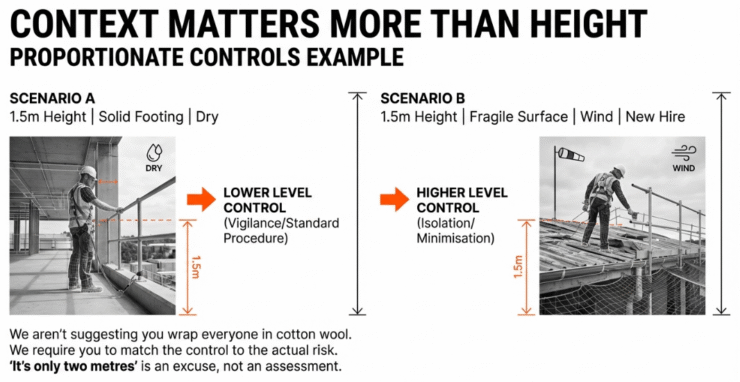
This doesn’t mean wrapping everyone in cotton wool for a quick look at a roof. It means applying proportionate controls based on the actual risk. A task at 1.5 metres with solid footing, good weather, and experienced workers is different from the same height on a fragile surface, in wind, with a new starter.
But “it’s only two metres” or “we’ve always done it this way” aren’t assessments, they’re excuses. And when something goes wrong, “I thought the three-metre rule meant we didn’t need controls” is not going to hold up.
The guidance is clear, the statistics are clear, and the law is clear. Falls from any height need to be controlled. The three-metre myth has injured too many people already. It’s time to stop letting it injure more.


Darren has written over 3000 articles about driving and vehicles, plus almost 500 vehicle reviews and numerous driving courses. Connect with him on LinkedIn by clicking the name above