
Falls aren’t the only thing that can kill workers at height or those using a MEWP. When you’re working anywhere near overhead power lines, you’re dealing with a hazard that’s silent, invisible, and absolutely unforgiving. Electricity doesn’t care about your experience, your confidence, or your deadline. Get too close (or let your equipment get too close) and the result can be catastrophic.
The problem is that many workers underestimate just how far electricity can travel. You don’t have to touch a power line to be electrocuted. Under the right conditions, electricity can arc through the air, seeking the path of least resistance to ground. That path might be the aluminium ladder you’re holding, the scaffold tube you just lifted, or the boom of the MEWP or truck loader crane you’re operating.
In fact, this is covered in MEWP training and truck loader crane training, as well as our working at heights course..
The legal framework
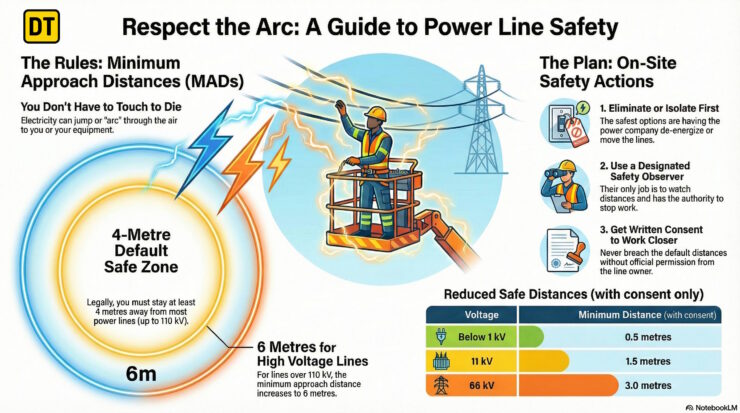
The New Zealand Electrical Code of Practice for Electrical Safe Distances (NZECP 34:2001) sets out the rules for working near power lines, and it applies to anyone working at height. The code establishes what are called minimum approach distances, or MADs. This is the closest you’re legally allowed to get to overhead conductors without specific permission from the line owner.
The default minimum approach distances are four metres for circuit voltages of 110 kV and below, and six metres for anything above 110 kV. These distances apply to every part of the worker and everything they’re holding or operating. That includes scaffold poles, ladder rails, long-handled tools, and any part of a MEWP’s boom or basket.
If you’ve obtained written consent from the power line owner to work closer than the standard four metres, reduced distances apply based on the specific voltage. For lines below 1 kV, the minimum drops to half a metre. For 11 kV lines, it’s 1.5 metres. The distances increase with voltage: 2 metres for 22 kV, 2.5 metres for 33 kV, 3 metres for 66 kV, and 4 metres for 110 kV. For 220 kV and above, the six-metre distance is absolute, and no consent will reduce it.
Planning for electrical hazards
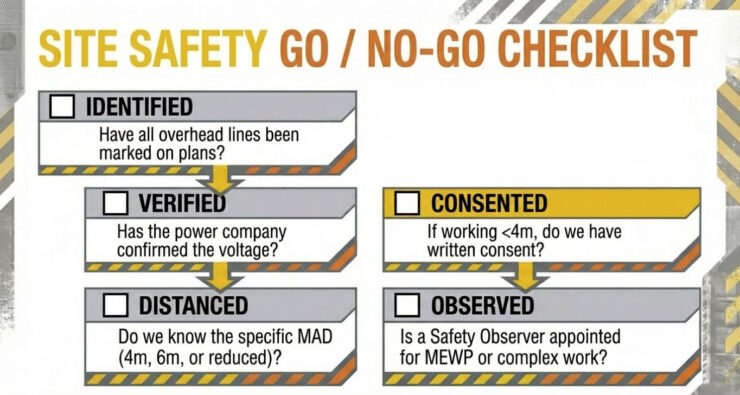
Identifying power lines needs to happen before anyone sets foot on site. The position of any overhead wiring should be noted on your site plans and marked in your hazard management documentation. This isn’t a box-ticking exercise; it’s about ensuring everyone working on the job understands where the danger zones are and how to stay clear of them.
When planning scaffolding work, you need to consider every stage of the job. Could the scaffold or workers come into contact with power lines during the delivery of materials, erection, use, or dismantling? Scaffold tubes can extend unexpectedly when being manoeuvred, and workers carrying components overhead can easily breach safe distances without realising it.
The best approach follows the hierarchy of controls. Elimination is always the first option: can the overhead services be transferred underground before work begins? If that’s not feasible, isolation might be possible. The power company can disconnect conductors from service, but you’ll need written confirmation specifying exactly which areas are isolated and which remain live.
When neither elimination nor isolation is practical, you’re into minimisation territory. This means establishing a safe work plan that ensures the minimum approach distances will not be breached. The plan should account for the means of access, the skill level of your workers, and the specific nature of the work being done.
The role of safety observers
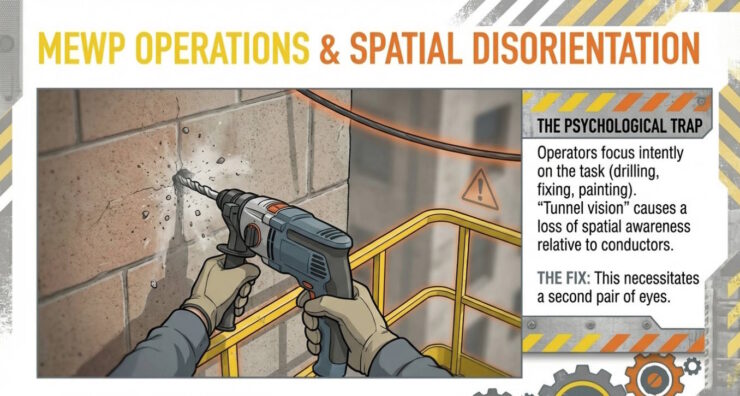
When workers are operating near live lines, a safety observer can be the difference between a close call and a fatality. This is particularly important when using MEWPs, where operators can become spatially disoriented (focused on their work task while losing awareness of their position relative to the conductors above or beside them).
Consider appointing a safety observer whenever there’s potential for someone to forget where they’re positioned relative to live conductors. This is more likely during repetitive or monotonous tasks where boredom sets in, when the work requires frequent repositioning of the platform, when tasks involve complex movements or handling of objects, or when workers are dealing with fatigue from long hours or physically demanding work.
The observer’s job isn’t just to watch, it’s to actively monitor distances and warn workers before they get too close. They need to understand the specific MADs that apply and have the authority to stop work immediately if those distances are at risk of being breached.
Working with the power company
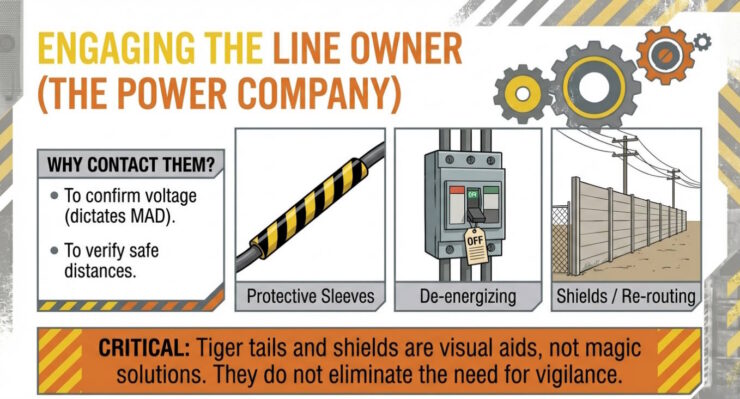
Always contact the line owner before work commences. This applies whether you’re planning to work close to the lines or simply need to verify the safe distances for your particular situation. The power company can confirm the voltage of the lines, which determines the MADs you need to maintain.
In some cases, the power company may be able to help by installing protective sleeves (sometimes called tiger tails) over live parts, de-energising the line for the duration of your work, re-routing the line, or providing shields. These options aren’t always available, but it’s worth asking, especially if the alternative is trying to work within tight tolerances near live conductors.
If work absolutely must happen closer than the standard MADs, you’ll need written consent from the line owner specifying the minimum permissible distances. This consent will also help identify and manage the associated electrical risks. Don’t assume that getting consent makes the work safe; it makes it legally permissible under controlled conditions. You still need a robust safe work plan.
Specialist work near live lines
Some work near live lines requires specialist competencies that go beyond standard height work training. Access using insulated work platforms and insulated tools is considered specialist work that may only be carried out by workers who hold the required electricity industry competencies and are following approved industry procedures.
If your job requires this level of specialist work, you need people with the right credentials. This isn’t the time for improvisation or for stretching the capabilities of your existing team. The risks are too high and the consequences too severe.
The bottom line
Working near power lines demands respect for an invisible hazard that kills without warning. The rules exist because electricity doesn’t give second chances. Maintain your distances, get the proper consents, use safety observers when needed, and never assume that because you can’t see the danger, it isn’t there.
If the work could breach the minimum approach distances, it must not proceed with the line live. That’s not a guideline, it’s a hard stop. No deadline, no cost pressure, no client expectation is worth a worker’s life.


Darren has written over 3000 articles about driving and vehicles, plus almost 500 vehicle reviews and numerous driving courses. Connect with him on LinkedIn by clicking the name above