
Before you issue a permit, the worksite must be ready for work to begin safely. Your role as Permit Issuer is to confirm that preparation has been completed. You do not carry it out yourself, but you are the person who verifies it, and you do not issue until you are satisfied. This training is provided in a permit issuer course.
This is not a paper exercise. It means physically inspecting the site and verifying that what is written on the permit matches what you see on the ground.
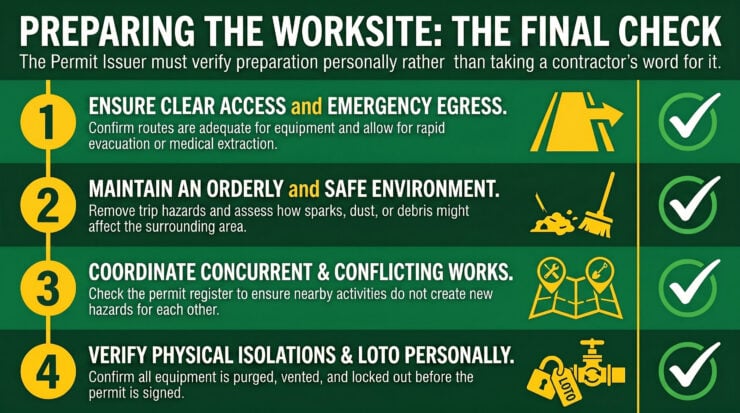
Access and egress
Check access and egress first. The routes into and out of the work area must be clear, safe, and adequate for the number of people and the equipment involved. Think about normal movement and about emergencies. If someone is injured at the bottom of a 2.5-metre trench, how will they be reached and extracted? If a worker needs to evacuate a confined space quickly, is the exit route clear, and is there rescue equipment staged at the entry point?
Where the work is at height, confirm that access equipment such as scaffolding, mobile elevated work platforms, or ladders is in position, inspected, and fit for purpose. If the only access is a ladder and the permit involves carrying tools and materials to the work platform, that may not be adequate.
Consider vehicle and pedestrian traffic near the work area. If the task is beside an active roadway or in a yard where forklifts operate, barriers or traffic management may be needed to protect both the work crew and the people moving through the area.
Housekeeping and site conditions
The work area must be clean, clear, and orderly before work begins. Loose materials, trip hazards, offcuts, and waste from previous work all need to be dealt with. A cluttered worksite is a sign that the last job was not properly closed out, and it introduces hazards that have nothing to do with the task you are about to authorise.
Look beyond the immediate work footprint. If the task could generate sparks, dust, or debris, consider what is nearby. Flammable materials stored within the spark radius of a grinding operation are a fire risk that the housekeeping check should catch. Chemical containers left open near a work area where personnel will be breathing hard from physical effort are an inhalation risk. These are not edge cases; they are the kinds of conditions that exist on real worksites and that a walkthrough is designed to identify.
Weather conditions also matter. High winds affect working at height and craneage. Heavy rain affects excavation stability and electrical safety. Fog or poor visibility affects any task where spatial awareness is critical. If conditions have changed since the permit application was prepared, the risk assessment may no longer be valid.
Other work in the area
Two teams working near each other under separate permits can create hazards for each other without realising it. A crew using a water blaster on a concrete pad may not know that an electrical contractor is working on an exposed distribution board fifteen metres downwind. Neither permit mentions the other, and neither crew has been told about the conflict.
Check the permit register to identify any active permits in or near the proposed work area. If there is a potential conflict, resolve it before you issue. Options include coordinating start times so the tasks do not overlap, establishing physical exclusion zones, or sequencing the work so the higher-risk activity is completed first. This coordination role is one of the most important things a Permit Issuer does.
Equipment preparation
The most substantial part of worksite preparation involves making equipment and plant safe to work on. When work is being done on equipment that normally contains energy, pressure, hazardous substances, or moving parts, that equipment must be made safe before anyone touches it.
The preparation steps depend on the nature of the equipment and the work being done, but they typically include isolation of energy sources (electrical, mechanical, hydraulic, pneumatic, thermal), lockout/tagout to prevent inadvertent re-energisation, draining of liquids from pipework and vessels, purging of gases or vapours, venting of residual pressure, and tagging of isolation points to identify what has been isolated, by whom, and under which permit.
What you need to understand at this stage is that you are responsible for confirming these steps have been completed and that the isolations are in place and effective before you issue. You do not take someone’s word for it. You go to the isolation points and verify that locks and tags are applied, that the equipment cannot be started, and that the isolation matches what is recorded on the permit and isolation certificate.
Where equipment has been drained or purged, consider what happened to the contents. Waste disposal and treatment must be managed in accordance with your organisation’s procedures and environmental requirements. A process vessel that has been drained of a hazardous substance still presents a residual hazard if the drainage was not complete or if residue remains on internal surfaces.
Marking of utilities
For excavation work, underground services must be marked on the ground before digging begins. This includes water, gas, electricity, telecommunications, and stormwater. The marking must be based on current service drawings and, where there is any uncertainty, confirmed by detection equipment such as cable locators or ground-penetrating radar. Hand digging is required within the tolerance zone around any marked service. These requirements are covered in WorkSafe’s Guide for Safety with Underground Services and are reinforced in the excavation certificate checklist.
Documentation
All preparation must be documented on the permit and its associated certificates. When you inspect the worksite before issuing, you are confirming that each step has actually been completed, not just written down. If the isolation certificate says four isolation points have been locked and tagged, you confirm all four. If the excavation certificate says services have been located and marked, you check the markings are on the ground.
The worksite is not ready until you have confirmed it yourself.


Darren has written over 3000 articles about driving and vehicles, plus almost 500 vehicle reviews and numerous driving courses. Connect with him on LinkedIn by clicking the name above