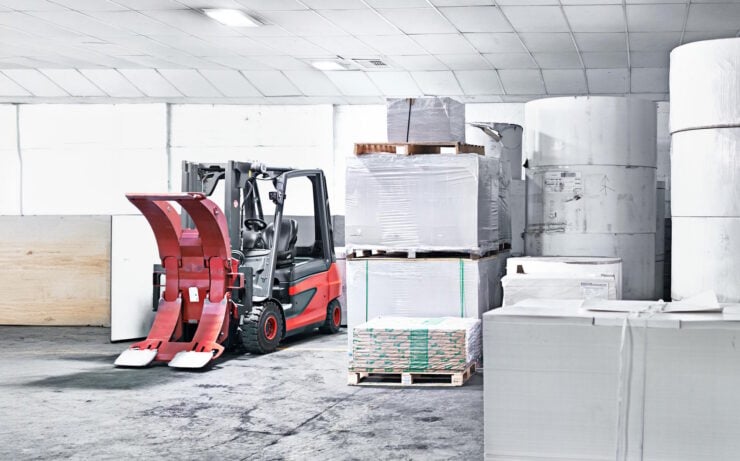
A paper roll clamp is a forklift attachment that replaces the tines with two curved arms that wrap around and grip a cylindrical load by squeezing it. It’s designed for handling paper rolls used in newsprint, kraft paper, tissue, board, and label stock, but the same attachment is widely used for other cylindrical or compressible loads where forks would damage the goods or where there’s no pallet to slide tines under.
The clamp mounts to the forklift’s carriage via a hook-on or bolt-on plate and is powered by the truck’s hydraulic auxiliary circuit. The operator opens and closes the arms with a separate hydraulic lever in the cab, and on most modern units a second function rotates the entire attachment 360 degrees so a roll can be picked up on its end, rotated to lie on its side, and set down horizontally (or vice versa). A third function on higher-spec units side-shifts the clamp left and right to line up with a roll without repositioning the truck (a side-shifter).
The contact pads on the arms are usually shaped to match a paper roll’s curvature, and they’re often fitted with a non-marking, high-friction lining. Clamping force is adjustable, which matters because too much pressure crushes the roll and too little drops it. Most clamps have a pressure regulator the operator or service tech can set for the specific paper grade being handled; a 1500kg roll of soft tissue needs far less squeeze than a 1500kg roll of dense board.
Capacity is rated two ways: the maximum weight the arms can grip, and the maximum diameter they can open to. A typical mid-size clamp will handle rolls up to about 1500–2000kg and diameters up to around 1.6m, but bigger units exist for paper mills handling rolls up to 5 tonnes. Bear in mind that fitting a clamp derates the forklift itself: the attachment is heavy, it moves the load centre forward, and the truck’s rated capacity in relation to its nominal capacity drops accordingly. The data plate must be updated to show the truck-and-attachment combination, and the operator needs to work to the derated figure, not the original fork rating.
Paper mills and converting
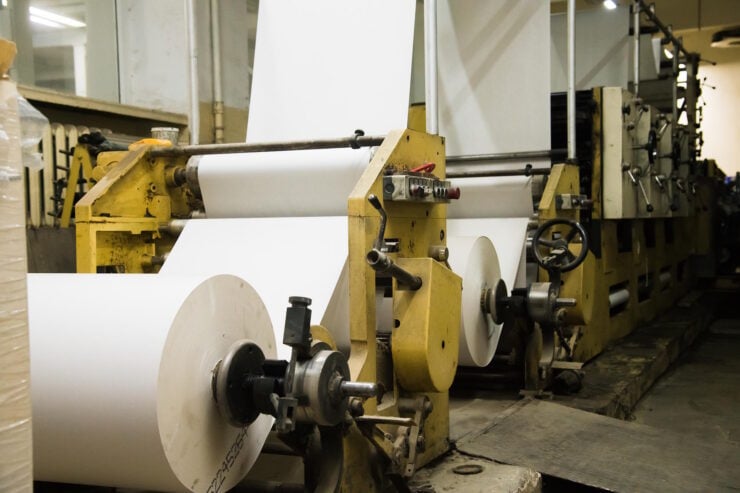
This is the original use case and still the biggest. Paper mills produce rolls straight off the winder and need to move them onto storage racks, into wrapping lines, onto trucks, and into rail wagons. Print plants and converting operations (where master rolls get cut down into smaller rolls or sheets) handle hundreds of rolls a day and rely on clamps to do it without damaging the outer wraps. A damaged outer wrap means the printer has to strip waste off before the roll can run, which costs time and paper.
Tissue and hygiene products
Tissue manufacturers handle very large, very light rolls, sometimes 2.5m in diameter but only a few hundred kilograms, and these are extremely easy to crush. Tissue clamps are usually a longer-arm version of the standard paper clamp, with carefully regulated pressure and softer pads. The same attachment moves rolls of nappy stock, feminine hygiene base material, and similar products through converting lines.
Newsprint and packaging
Newsprint isn’t printed in volume in New Zealand anymore, but packaging operations using kraft and board are common: corrugated box plants, label printers, and flexible packaging converters all run paper clamps. A converting plant typically uses a 1500–2500kg-rated clamp to feed the corrugator or the printing press.
Drums, barrels and bales
A paper clamp with appropriate pads will also handle steel and plastic drums, fibreboard drums, and compressed bales (cotton, wool, recyclable materials). Many recycling operations use clamps to handle bales of cardboard and paper coming off the baler. For drums specifically, a dedicated drum clamp with rotation is more common because the geometry is different, but a general-purpose paper clamp can do the job at lower volumes.
White goods and appliances
A variant of the paper clamp (sometimes called a carton clamp or appliance clamp) uses flat pads instead of curved ones and is used to handle washing machines, fridges, dishwashers, and boxed appliances in distribution centres. It’s the same hydraulic principle, just shaped for square loads. Worth mentioning here because operators trained on one often find themselves running the other.
Bricks and blocks
Some brick yards run clamps with hardened pads to lift banded packs of bricks without pallets. This is a heavier-duty application and uses higher clamping force than paper work.
Things to bear in mind
Operators need attachment-specific training. The unit standard for forklift operation (10851) covers the truck; the clamp is an additional skill that should be signed off separately. The risks are different from fork work: the load can rotate unexpectedly if the clamp isn’t centred, the pressure setting needs to match the load, and the visibility forward is worse because the attachment is bulkier than a pair of tines.
Pre-start checks should include the hydraulic hoses (a burst hose drops a 1500kg roll), the condition of the pads, the rotation stop pins, and the pressure regulator setting. Any visible damage to the arms or the mounting plate is a stop-work issue.
Productivity-wise, a clamp truck is slower per pick than a fork truck because of the extra hydraulic functions, but it’s the only practical way to handle non-palletised cylindrical loads at scale. Operations that try to handle rolls with standard forks end up damaging the product, the truck, and occasionally the operator.
Clamp attachment training and refresher training is part of the F endorsement and operator’s certificate scope at DT Driver Training, and any site using clamps should have records of operator sign-off on the specific attachment fitted to each truck.


Darren has written over 3000 articles about driving and vehicles, plus almost 500 vehicle reviews and numerous driving courses. Connect with him on LinkedIn by clicking the name above