
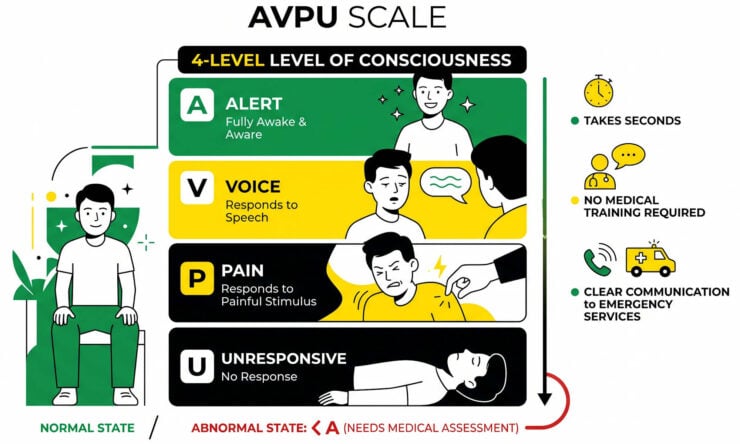
AVPU is a four-level scale for describing a patient’s level of consciousness: Alert, Voice, Pain, Unresponsive. It takes seconds to assess, requires no medical training, and gives you a clear way to communicate the patient’s state to emergency services. Anything less than A is abnormal and means the patient needs medical assessment.
DRSABCD asks a binary question at the R step: are they responsive or not? AVPU is what you use once you need more detail than that. Use it when you’re monitoring a conscious-but-not-quite-right patient, when you’re waiting for an ambulance, and when their condition is changing.
A is for Alert
An alert patient is fully conscious. They know who they are, where they are, and what’s happening. They open their eyes spontaneously, look at you when you speak, answer questions sensibly, and follow simple instructions. If you ask, “What day is it? Where are we? What happened?” and the answers are sensible, they’re alert.
Note that confusion is not alert. A patient who knows their name but can’t tell you what year it is, or who keeps asking the same question every minute, is showing altered mental status even though their eyes are open. Some training materials call this “A with confusion” and treat it as a serious finding. Confusion after a head injury, in particular, is a red flag for concussion or worse.
V is for Voice
The patient doesn’t open their eyes or react until you speak to them. When you say their name loudly or ask “Can you hear me?” they respond in some way: eyes open briefly, a hand moves, they make a sound. The response can be weak. What matters is that there’s a response to a verbal cue and only to a verbal cue.
Conditions that can put someone at V include a diabetic hypoglycaemic episode, a drug overdose, the early stages of stroke, intoxication, a moderate head injury, or simply post-ictal drowsiness after a seizure. None of these are situations to manage at the kerbside without medical help.
P is for Pain
The patient doesn’t respond to your voice but does respond to a painful stimulus. The stimulus is firm pressure, not violence: a sharp tap or squeeze on the trapezius muscle (the meaty bit between neck and shoulder), or a firm squeeze of the earlobe or the bony bit at the back of the jaw. You’re looking for any reaction: a wince, a moan, a hand moving towards the stimulus, eyes opening briefly.
P is a serious finding. The patient is effectively unconscious. The airway is at risk because their swallow and cough reflexes are blunted. Anyone at P needs an open airway maintained, regular checks for breathing, and an ambulance on the way (if it isn’t already).
U is for Unresponsive
No response to voice, no response to pain. The patient is deeply unconscious. Airway management and breathing checks are immediate priorities. If breathing is absent or abnormal, start CPR. If breathing is normal, the recovery position keeps the airway open while you wait for help.
Why monitor over time
AVPU is most useful when you check it repeatedly. A patient who starts at A and stays at A is reassuring. A patient who starts at V and moves to P over five minutes is deteriorating, which tells the paramedics something important about urgency and likely cause. The reverse is also true: a patient at P who improves to V and then to A as the ambulance arrives is responding to whatever’s happening (sugar level coming back up, drug wearing off, brief faint resolving).
Note the time of each check. “09:14, alert. 09:19, responding to voice only. 09:24, only responding to pain.” That hand-over to the paramedic crew is genuinely useful clinical information. It influences how urgently they move and what they think is going on.
You can get more information about this in our online first aid refresher course.
A scenario
A delivery driver pulls into your loading bay looking unsteady. They climb down from the cab, lean against the truck, and slide to the ground. You reach them quickly. They’re sitting up, eyes open but looking through you. You ask their name. They mumble something. You ask again, louder. They look at you and say something that doesn’t make sense. That’s a V response, with confusion.
You call out for someone to ring 111 and you stay with the driver. Two minutes later, when you call their name, their eyes are closed and you have to tap their shoulder firmly to get any reaction. They moan and shift slightly. That’s now P. You note the time. You check their airway is clear and that they’re breathing normally, and you stay with them until the ambulance arrives. When the paramedics get there, you tell them: “He was responding to voice when I got to him at 10:42. By 10:46 he was only responding to pain. Breathing’s been normal throughout.” The crew now know this is a fast deterioration, which changes their working diagnosis (hypoglycaemia, stroke, overdose, head injury from a fall in the cab they didn’t tell anyone about) and the urgency of their treatment.
When to use AVPU instead of the Glasgow Coma Scale
Healthcare professionals often use the Glasgow Coma Scale (GCS), which scores eye opening, verbal response, and motor response separately and totals them out of 15. GCS is more detailed but takes longer and needs practice. AVPU correlates well enough with GCS for first aid purposes: studies have shown A roughly corresponds to a GCS above 12, while P and U correspond to GCS below 8 (the threshold where intubation is typically considered). AVPU is the right tool for workplace first aiders. Use it confidently and don’t feel you need to score people out of 15.


Darren has written over 3000 articles about driving and vehicles, plus almost 500 vehicle reviews and numerous driving courses. Connect with him on LinkedIn by clicking the name above