High-sided vehicles are at risk of being blown over in strong winds, especially if they are empty or light (e.g. caravans, curtainside trucks carrying light loads like toilet paper, etc). Strong winds put tonnes of pressure on the side of a large vehicle.
If you have to drive in high winds, try to avoid:
- Plains and other treeless areas like Desert Road
- Overpasses and exposed bridges, especially over narrow valleys where the wind funnels down the valley
- Coastal roads
- Roads where trees could be blown across the road
The best option is to wait out the winds, if possible, or take low-altitude, inland forested or urban roads to give more shelter.
How do high winds affect your vehicle?
You can find out about how to drive in bad weather with our course, Driving in Difficult Conditions. You’ll find out about vehicle dynamics, which is how your vehicle reacts. High-sided vehicles tend to have large flat areas which can act as a sail and that affects how they behave on the road. It can magnify the forces substantially.
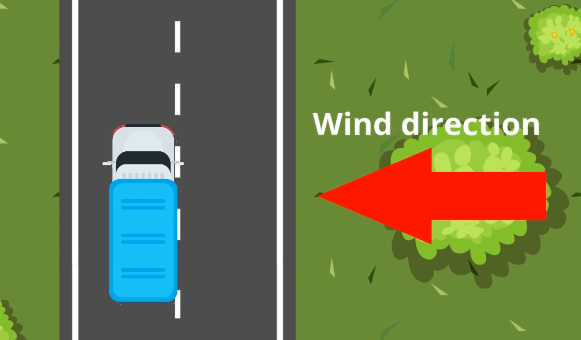
In high winds, the wind acts as a force on the vehicle. If it’s pushing from behind, it will make braking distances longer. If it’s a headwind, it will increase fuel consumption and slow acceleration. If it’s from the side, it will be blowing the vehicle across the lane, which is more problematic if the wind is gusty as it can take a driver by surprise.
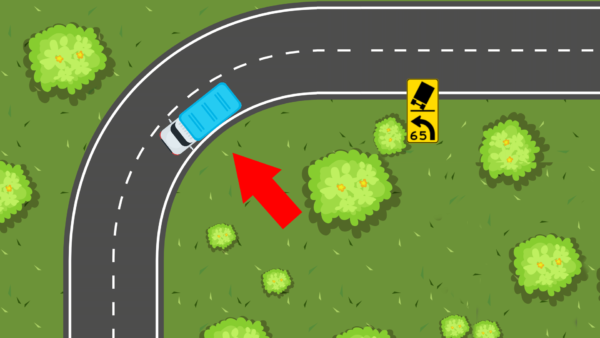
If you are cornering, the g-force created by the cornering could be amplified by the force of the wind, if the wind is coming from the apex (inside) of the curve.
When driving out of a wind shadow, for example from behind a row of buildings, a gust of wind can take a driver by surprise.
Driving techniques for dealing with high winds
The slower you go, the less likely you are to be blown over or be blown too far off-course.
Drivers should be aware of vehicles coming towards them when the wind is blowing from the driver’s side, as it is likely to push oncoming vehicles into their lane. Watch for motorcyclists as they must be even more careful than usual when riding in strong winds.
The road position should anticipate the possibility of a strong gust.
How truck drivers can minimise the impact of strong winds
Curtainsiders
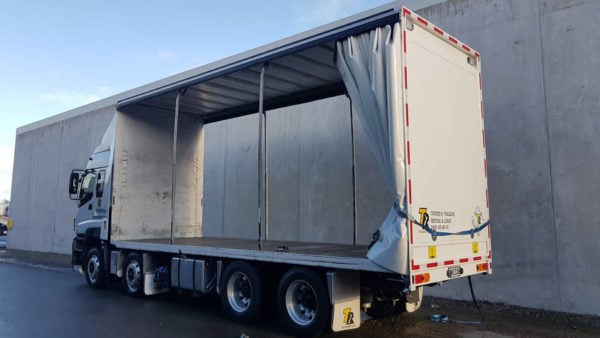
The curtains can be tied back if the curtainsider is empty or if the load is secured and protected from the elements. This allows the wind to blow through the trailer, rather than push on the side.
To do this, open the curtain on the lee side of the truck, i.e. the side that is most sheltered from the wind. Open it from the front and slide it to the back. You can also park with the back of the truck facing the wind.
Now open the curtain on the other side but be especially careful that the wind doesn’t grab the curtain, causing it to flap around as the curtain pole or buckles could hit you and seriously injure you. Keep a firm hold of the curtain pole.
Neatly fold the curtains and tie them both back using a ratchet strap, making sure you’re not covering any lights or reflectors on the rear of the truck.
Throw strops over the top of the truck to hold the curtain rails, side rails and roof in-place; the additional wind pressure on the rear door can bend the rails or cause the side rails to pop out as the roof flexes, so it’s best to put a strop next to each side rail. Don’t over-tighten it otherwise you’ll bend the roof rails.
Truck and trailer
If possible, you can leave your trailer in a sheltered place and continue with your truck. This might not be practical if you will run out of logbook hours before you have a chance to deliver it, or if the load is valuable and you’re worried about the load’s security.
When loading
Ensure that the heaviest items are at the bottom of the load, even if this means that the delivery schedule might be delayed because of reshuffling.
Roll coupling
A semitrailer is roll-coupled to the tractor cab, meaning that to turn the trailer over, you also have to turn the cab over, which makes it more resilient to a side wind than a truck and trailer where the trailer can roll even if the truck stays upright. As the truck has a large, low-height mass (the engine) that helps it, it’s less likely to blow over than a simple trailer.


Darren has written over 3000 articles about driving and vehicles, plus almost 500 vehicle reviews and numerous driving courses. Connect with him on LinkedIn by clicking the name above
 Disqus