Outriggers are the two legs that extend forward from the base of a walkie stacker, reach truck, or stand-up counterbalance forklift. They run along either side of where the load sits. They’re sometimes called straddle legs or stabilising legs. The forks lift the load between them, and the outriggers themselves carry part of the load’s weight back to the truck’s wheelbase.
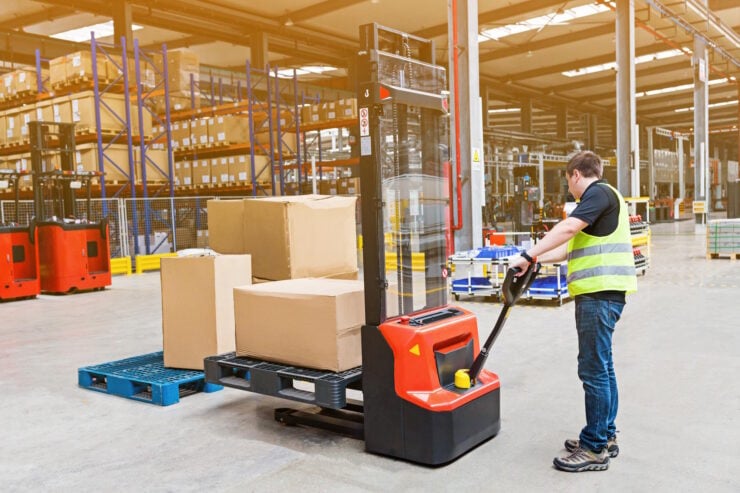
The main point of outriggers is that they let the forklift be shorter, lighter, and narrower than a sit-down counterbalance forklift carrying the same load. A counterbalance forklift handles the physics by putting a huge cast-iron block above the rear axle. The load forward of the front axle tries to tip the truck forward; the counterweight behind the rear axle stops it. That’s why a 2.5-tonne counterbalance is a big, heavy machine; typically 3.5 to 4 tonnes of truck to lift 2.5 tonnes of pallet.
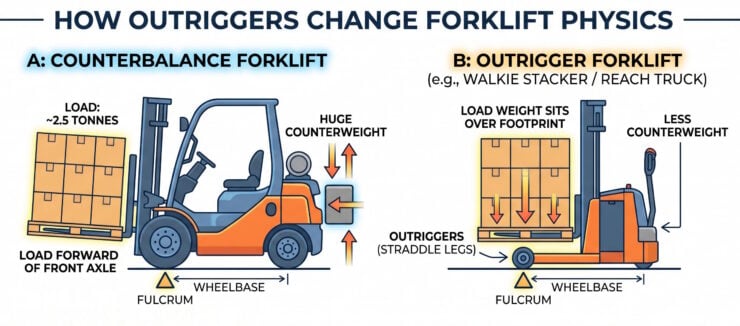
Outriggers change the maths. Because the legs extend under the load, part of the load’s weight sits over the truck’s own footprint rather than out in front of the front wheels. The forks still cantilever forward, but the lifting moment that has to be resisted is much smaller. Less counterweight is needed, so the truck can be much lighter and shorter. A walkie stacker rated to 1,000 kg might weigh only 500–700 kg empty.
How outriggers interact with pallet racking
This is the part that catches people out the first time they see a reach truck working. When the operator lifts a pallet off a racking bay, the outriggers slide under the bottom beam of the racking. The load comes up between the legs, and the legs themselves are below the lowest pallet position on the rack.
That’s why warehouses set up for reach truck operation have a specific bottom-beam height and aisle width. Get the bottom beam too low, or have a kickplate or pallet support across the front of the racking, and the outriggers can’t enter. You then can’t pick that bay with a reach truck, you’d need a counterbalance forklift, which needs a wider aisle to turn.
Aisle width is the trade-off. A reach truck or stand-up straddle truck can work in aisles around 2.7 to 3.0 metres wide because it doesn’t need to swing a tail end. A counterbalance machine handling the same pallet weight typically needs 3.5 to 4.0 metres. In a warehouse, that’s the difference between five aisles and four, which is why outrigger-style trucks dominate inside racked warehouses.
Walkie stackers
A walkie stacker is a pedestrian-operated electric stacker (you can learn how to use a walkie stacker here): the operator walks behind it (or stands on a small platform on the powered models) and steers with a tiller. Most have outriggers. The load capacity is usually 800 kg to 1,500 kg, with lift heights from 1.6 m up to around 3.6 m on the taller models.
Walkie stackers with outriggers are sometimes called straddle stackers. There’s a related machine, the counterbalance walkie stacker, which has no outriggers and a counterweighted body instead. It’s heavier and bulkier but can pick pallets that have closed bottoms or sit on stillages where the outriggers can’t enter. Most operations use straddle stackers because the pallet stock is open-bottom CHEP or Loscam.
Reach trucks
A reach truck is the workhorse of high-bay warehousing. It has outriggers like a walkie stacker, but with two extra features: the mast pantographs forward over the outriggers, so the forks can place a pallet a metre or more in front of the truck without the truck itself moving forward; and the operator sits in a side-facing cab. Reach trucks routinely lift to 8 m or higher, with some models going past 12 m.
In a typical operation, the truck moves down the aisle with the mast retracted and the load tilted back over the outriggers. At the destination bay, the truck stops, the mast pantographs forward, and the forks place the pallet on the beam. The outriggers stay clear because the mast is doing the extending, not the truck.
Reach trucks need flat, smooth floors. The pantograph and the narrow chassis mean they don’t tolerate uneven surfaces; they’re an indoor machine on concrete. They also can’t handle outdoor work in any meaningful way.
Stand-up straddle trucks (order pickers and similar)
Order pickers (the trucks where the operator’s platform rises with the forks so they can pick cases off shelves) are another outrigger machine. The operator stands on a platform between or above the outriggers, and the whole platform travels up the mast. The outriggers do the stability job while the operator is at height.
Some narrow-aisle counterbalance trucks (sometimes called stand-up counterbalances or stand-up riders) also use a partial straddle design. These tend to sit between full counterbalance and full outrigger machines on the size and aisle spectrum.
Use cases where outrigger trucks fit
Outrigger trucks are the right choice when the work is indoors, on flat floors, with open-bottom pallets in racking. The list of fits is short and specific:
- High-bay racked warehousing where aisle width matters more than load capacity. Reach trucks dominate this work.
- Order picking from shelving, where the operator needs to go up with the load.
- Low-bay block stacking and put-away in distribution centres, where a walkie stacker is faster and cheaper than a forklift for moves under about 30 metres.
- Retail back-of-house and supermarket replenishment. Walkie stackers are common because they’re quiet, electric, and small enough to work in tight stockrooms.
- Production line replenishment in food, pharmaceutical, and light manufacturing sites where a counterbalance would be too big.
Use cases where outriggers don’t work
Outriggers limit what the truck can pick. They can’t enter:
- Closed-bottom pallets, plywood pallets with skids running front-to-back, or stillages where the base sits flush to the floor.
- Pallets placed directly on the floor with no clearance under the bottom boards, unless the truck has a specific feature called “initial lift” that raises the outriggers themselves slightly before the main lift engages.
- Containers or trailers being loaded from the dock; the outriggers stop the truck from getting close enough to the load. Loading trucks is a counterbalance job.
- Anything outdoors on rough ground. Outrigger trucks have small, hard wheels and short wheelbases. They don’t tolerate broken yards.
The other consideration is the load itself. Because the load sits between the outriggers rather than out in front, the load width is constrained by the gap between the legs (typically around 800 mm to 1,000 mm internal). An oversized load that sits wider than the outriggers will foul them and can’t be picked off the ground.
A note on terminology
Outriggers on a walkie stacker or reach truck are a permanent structural feature of the chassis. They’re not the same as the deployable outriggers you see on a mobile crane, a truck loader crane (Hiab), or an elevated work platform, which extend hydraulically when the machine is set up and retract for travel. Different concept, same word: the crane outrigger stabilises against tipping during a lift; the forklift outrigger replaces a counterweight in the lift geometry.
If you’re specifying equipment for a new warehouse or pallet store, the outrigger-versus-counterbalance decision is one of the first ones to make, because it drives racking design, aisle width, and floor flatness specification. Get it the wrong way around and you end up either with a warehouse that can’t be picked efficiently, or trucks that can’t reach half the pallets.


Darren has written over 3000 articles about driving and vehicles, plus almost 500 vehicle reviews and numerous driving courses. Connect with him on LinkedIn by clicking the name above