
Not every task requires a permit to work. But every task that does require one must have it in place before work begins. Your job as Permit Issuer is to make the right call on which side of that line a task falls, and to get the permit type right when one is needed.
Get this decision wrong and the consequences can be severe. If the permit is not adequate for the task, the wrong job might be done in the wrong place with the wrong controls. It might conflict with other work. The results could be a serious injury, a fatality, major property damage, or environmental harm.
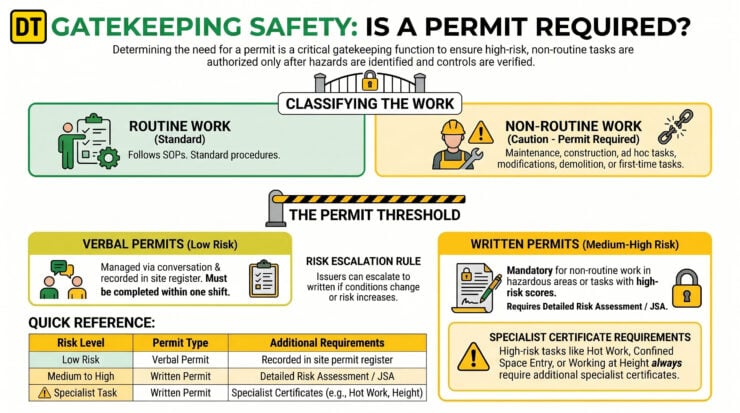
Routine versus non-routine work
The starting point is your organisation’s permit to work procedure. Every organisation that operates a permit system defines the circumstances under which a permit is required. The details vary between organisations, but the underlying principle is consistent: the level of risk determines whether a permit is needed and what type applies.
Work is generally classified as either routine or non-routine. Routine work is carried out regularly by competent people following a documented Standard Operating Procedure. The hazards are well understood, the controls are established, and the task follows the same sequence each time. An operator running a daily filter backwash cycle using a documented SOP is routine work. A permit is generally not required for this type of task, provided the risk level is low to medium and the SOP is current.
Non-routine work is anything outside normal operations. Ad hoc maintenance, construction, modifications, demolition, inspections involving access to hazardous areas, or any task being done for the first time or in unfamiliar conditions. This is where the permit system does its heaviest lifting, because the risks are less predictable and controls must be determined for each specific situation. A contractor replacing corroded bolts on a clarifier walkway three metres above a tank is non-routine work, even if it sounds like a simple mechanical task.
What level of documentation is required
The risk level of the task determines how much documentation is needed – find out about supporting documents for permits here.
A low-risk task may be managed under a verbal permit. As covered in Module 1, a verbal permit is a structured conversation between the Permit Issuer and the Permit Receiver in which the scope, hazards, and controls are discussed, agreed, and recorded on the permit register. A verbal permit is appropriate only where the risk score is low, the task does not require specialist certificates, and the work can be completed within the current shift.
When risk increases, a written permit is required. This typically includes any task with a medium-to-high risk score, any task involving work at height, hot work, confined space entry, excavation, cranage, or isolation, and any non-routine work in a hazardous area.
Specialist certificates
Certain types of high-risk work also require specialist certificates to be attached to the main permit. These certificates contain detailed checklists of controls specific to the hazard type. Common certificate types include hot work, confined space entry, working at heights, excavation, cranage, isolation (lockout/tagout), critical safety systems, and transfer of control.
As a Permit Issuer, you need to determine which certificates apply based on the nature of the work. Sometimes the Permit Receiver will identify the need in their application. Sometimes you will identify it when you review the scope or inspect the site. Either way, confirming that all necessary certificates are in place before you issue is your responsibility.
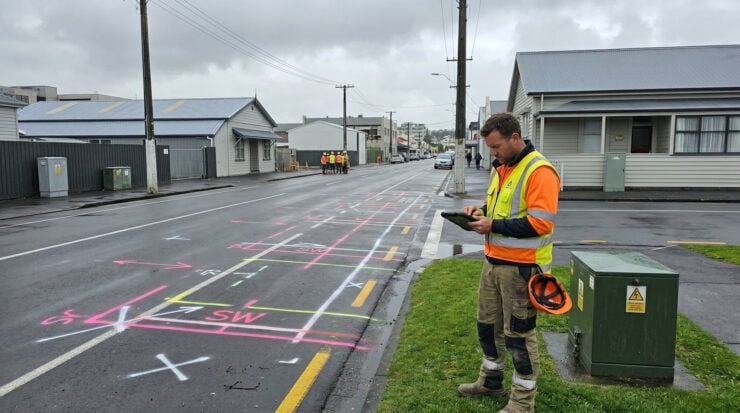
Consider a request to repair a section of stormwater pipe at a depth of 1.8 metres. The Permit Receiver has submitted a cold work permit application with a JSA. They have not requested an excavation certificate. But the work involves trenching to 1.8 metres, which in most organisations triggers the excavation certificate requirement. The fact that the applicant did not request it does not mean it is not needed. You identify the gap and require the certificate before issuing. Plus, this job is right next to an electrical transformer, has power lines running down either side of the street, and will require traffic control for the intersection.
The grey areas
Some tasks sit in territory that is not clear-cut. A task that appears routine but is taking place near other work that changes its risk profile. A piece of maintenance that is normally low risk but happens to be in an area where plant status has recently changed. A job that has been done the same way for years but is now being carried out by a new contractor unfamiliar with the site.
These are situations where you need to apply judgment. If you believe the risk level has been underestimated, you have the authority to escalate it. You can require a written permit where a verbal one would normally apply, or require certificates the Permit Receiver has not requested, if conditions warrant it.
A useful test is to ask: if something went wrong during this task, would I be confident explaining to an investigator why I decided a permit was not required, or why I issued the permit type I chose? If the answer is no, the task needs a higher level of control.
You can learn more about this in our permit issuer course.
WorkSafe notification
Some categories of high-risk work require notification to WorkSafe before the work begins. These are defined as “particular hazardous work” under the Health and Safety at Work Act 2015 and include work such as construction involving a risk of a person falling five metres or more, demolition of load-bearing structures, work involving asbestos removal, and other specified activities. Your organisation’s procedures will identify these thresholds, and the permit should record whether notification has been submitted.
When a permit is not required
When a permit is not required, that does not mean no safety controls are needed. Low-risk routine work still requires hazard identification, appropriate controls, and competent people. The permit system manages the high end of the risk spectrum. It does not replace the general obligation under the Health and Safety at Work Act 2015 to manage all risks so far as is reasonably practicable.
Your role in determining the need for a permit is a gatekeeping function. Get that decision right and the rest of the process builds on solid ground. Get it wrong and the controls that follow will not match the actual risk.


Darren has written over 3000 articles about driving and vehicles, plus almost 500 vehicle reviews and numerous driving courses. Connect with him on LinkedIn by clicking the name above