
If you drive a company vehicle in New Zealand, there’s a fair chance there’s a dashcam pointed at the road, and quite possibly another one pointed at you. The footage isn’t just video. Under the Privacy Act 2020, it’s personal information, and that brings a set of legal obligations for your employer and a set of rights for you.
We’ve created a template you can modify for your business, which you can download here. Continue reading for additional guidance.

Most drivers don’t know what those obligations and rights actually are. Here’s what you should know.
The Privacy Act applies because identifiable individuals appear in the footage. That’s you, other drivers, pedestrians, and anyone else the camera captures. As a PCBU collecting personal information, your employer must meet thirteen Information Privacy Principles. The ones that matter most for dashcams are these.
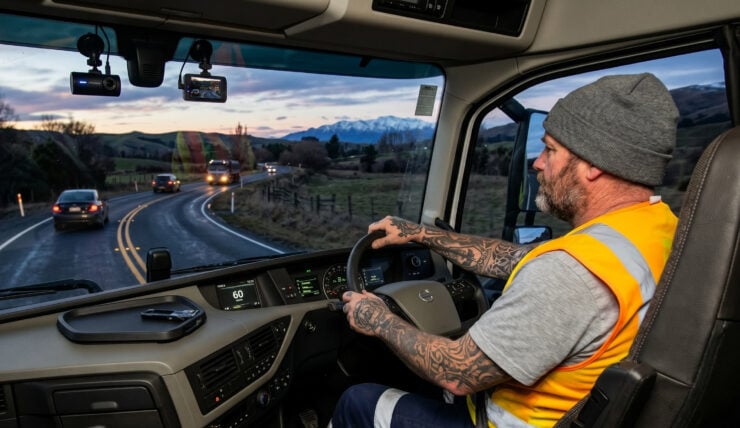
Your employer must have a clear purpose for collecting the footage. “We just film everything” isn’t good enough. Common purposes include fleet safety, incident investigation, insurance claims, and driver training. The purpose has to be specified and your employer should be able to tell you what it is.
They may be able to use the footage to exonerate you in, for example, a road rage incident that wasn’t your fault. Note: if you need to know how to avoid road rage incidents, this course is for you.
You must be told that the dashcam is operating. This is usually done at induction, through a signed acknowledgement, or with a visible sticker in the cab. If you’ve never been told in any of these ways, the collection isn’t compliant. That’s a problem for your employer, not for you.
The footage has to be stored securely. That means access controls, not anyone in the office being able to scroll through cab footage to see what drivers were doing on Wednesday. There should be a defined process for who can pull footage, when, and why.
The footage can only be kept as long as needed. Most dashcams overwrite automatically on a 30 to 90 day cycle, which sits in line with that principle. If a piece of footage is flagged for incident review, it gets preserved for as long as the investigation runs and is then deleted.
You have a right to access personal information held about you. That includes dashcam footage. Under Information Privacy Principle 6, you can ask your employer for a copy of footage that shows you. They have 20 working days to respond. They can refuse only on specific grounds set out in the Act. For example, if releasing the footage would breach someone else’s privacy, like another driver involved in an incident, they might need to blur faces or registration plates before they can release it.
You can request correction of personal information that you believe is wrong. With video, that’s a narrower right than it sounds; you can’t ask them to edit what the camera saw. But you can ask them to attach a written statement noting any context the footage doesn’t capture. If your employer is keeping a record of an incident based on dashcam footage and the footage misses important context, your written statement becomes part of that record.
What your employer can’t do is use the footage in ways outside the original purpose without telling you. If the camera was installed for insurance claims and they start using it for performance management, that’s a use change. They need to update their privacy notice and tell drivers. Drivers in some New Zealand workplaces have successfully challenged the use of dashcam footage as evidence in disciplinary processes where the original collection purpose didn’t include it.
If you think your employer is breaching the Privacy Act in how they use dashcam footage, your first step is to raise it internally. Most issues are resolved at that level. If it doesn’t get resolved, you can complain to the Office of the Privacy Commissioner. The complaint is free and doesn’t require a lawyer.
The Privacy Act isn’t there to make life difficult for fleet managers. It’s there to make sure the information collected about you is used the way you were told it would be. Drivers who know their rights aren’t being difficult; they’re being informed. Most good employers welcome the conversation.


Darren has written over 3000 articles about driving and vehicles, plus almost 500 vehicle reviews and numerous driving courses. Connect with him on LinkedIn by clicking the name above