
When we talk about back injuries in the transport industry, most people think about loading and unloading. The heavy lifting. The awkward angles. The rush to get the job done.
But here’s something that might surprise you: the hours you spend behind the wheel are doing just as much damage to your spine as the manual handling at either end.
Truck drivers, forklift operators and office workers don’t have much in common, except for the fact that they all spend a lot of their working day sitting down. And it turns out that’s a bigger problem than most people realise.
What Happens When You Sit for Hours
Your spine wasn’t designed for prolonged sitting. It was built for movement—walking, bending, reaching, changing position. When you sit in a truck cab for hours at a time, several things start to go wrong.
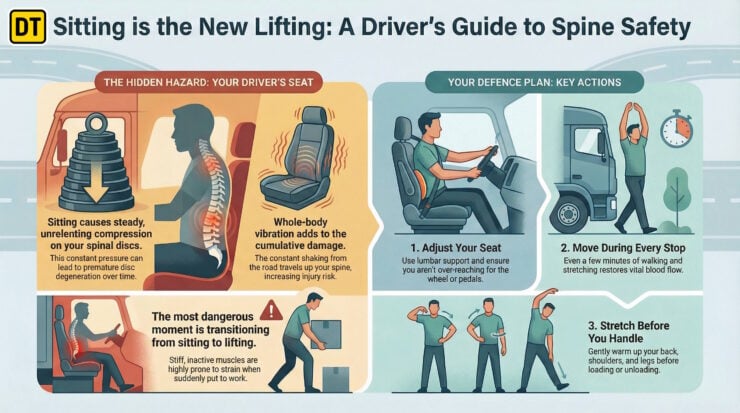
First, there’s the compression. Your intervertebral discs (those gel-filled cushions between your vertebrae) are under constant pressure when you’re seated. Unlike standing or walking, where the load shifts and changes, sitting creates steady, unrelenting compression on the same areas of your spine. Over time, this contributes to premature disc degeneration.
Then there’s the lack of blood flow. Your back muscles need good circulation to stay healthy and responsive. Prolonged sitting slows that circulation down, which means your muscles get less oxygen and nutrients. They become weaker, tighter, and more prone to injury.
The third issue is muscle deconditioning. When you’re not using your back muscles to support movement, they start to lose strength and flexibility. Your back becomes less resilient. And when you finally do get out of the cab and have to handle a load, those weakened muscles are far more likely to pull, cramp, or strain.
The Driver-Specific Problems
Drivers and machine operators face some unique challenges that make the sitting problem even worse.
Your arms and legs are in a constant stretched position: reaching for the wheel, working the pedals. This creates tension in your shoulders, neck, and lower back that builds up over hours of driving.
Then there’s whole-body vibration. The constant shaking and jolting from the road surface and the machine’s movements travels through your seat and into your spine; this is especially bad in smaller excavators. Research has long recognised that long-distance truck drivers and heavy machinery operators have higher rates of back injuries, and vibration is a significant contributing factor. If your seat doesn’t have proper suspension and vibration dampening, every kilometre adds to the cumulative damage.
And unlike office workers, you can’t just get up and walk to the printer or grab a coffee whenever you feel stiff. Your schedule, your load, and the road dictate when you can take a break.
The Dangerous Transition
Here’s where it gets really risky: the moment you climb down from the cab and start loading or unloading.
Your muscles have been essentially dormant for hours. Blood flow is reduced. Everything is stiff and tight. And suddenly you’re asking your body to lift, carry, push, and pull.
This transition from prolonged sitting to heavy manual handling is when a lot of injuries happen. Your back muscles are more likely to pull or strain when they’re stretched suddenly after being inactive. The very first lift of the day, or the first lift after a long drive, is often the most dangerous.
What You Can Do About It
The good news is that there are practical steps you can take to reduce the damage.
Adjust your seat properly. Your seat position matters more than you might think. Make sure you’re not reaching too far for the wheel or pedals. If your truck has adjustable lumbar support, use it. If your seat has suspension or vibration reduction, make sure it’s working properly and maintained.
Move whenever you can. Every time you stop for fuel, for a break, or for a delivery, take the opportunity to move. Even a few minutes of walking and stretching makes a difference. Don’t just sit in the cab during your mandated breaks.
Stretch before you handle. Before you start loading or unloading, take a couple of minutes to stretch out your back, shoulders, and legs. This helps wake up your muscles and restore blood flow before you put them under load. It’s not about doing a full workout; just some gentle movement to transition your body from sitting mode to working mode. Lifting load security equipment (chains and strops), and tightening them, can be a cause of strains and sprains – our Heavy Vehicle Load Security course explains how to do it safely.
Strengthen your core. Your trunk muscles – the ones around your midsection – play a fundamental role in stabilising your spine. Stronger core muscles mean better support for your back, whether you’re sitting in the cab or lifting on the dock. Regular exercise, even just basic core work a few times a week, makes a real difference.
Pay attention to discomfort. When your back starts to ache during a long drive or a long day in the cab, that’s your body’s early warning system. It’s telling you something needs to change. Don’t ignore it and push through. Discomfort leads to pain, and pain leads to injury.
These kinds of tips are covered in our manual handling training.
The Bottom Line
Back injuries don’t always come from a single bad lift. More often, they’re the result of cumulative damage; hours of sitting, years of vibration, repeated strain on tissues that never get a chance to fully recover.
As a driver, you can’t eliminate sitting from your job. But you can be smarter about managing its effects. Understand what’s happening to your spine during those long hours on the road, and take steps to counteract it.
Your back has to last your whole career. Look after it.


Darren has written over 3000 articles about driving and vehicles, plus almost 500 vehicle reviews and numerous driving courses. Connect with him on LinkedIn by clicking the name above