There’s a reason experienced workers treat the combination of heights and manual handling with serious respect: you’re dealing with two hazards that can each cause severe injuries on their own, and when you put them together, the risks multiply.
Fall from height. Musculoskeletal injury. Or both at once, when a lifting task goes wrong and takes you over the edge with it.
This isn’t a theoretical concern. It’s a daily reality on construction sites, in warehouses with mezzanines, on truck decks, on scaffolding or scissor lifts, and anywhere else workers need to handle loads while working above ground level. And it requires a different kind of thinking than either hazard would demand separately.
Why the Combination Is Worse Than the Sum of Its Parts
Manual handling risk assessments typically assume stable footing. The Code of Practice talks about floor surfaces, obstacles, and environmental conditions, but the underlying assumption is that if something goes wrong during a lift, the worst case is a musculoskeletal injury or a dropped load.
Add height to the equation, and that changes fundamentally. A momentary loss of balance that would mean nothing on solid ground can mean a fall when you’re on scaffolding. A load that shifts unexpectedly doesn’t just strain your back; it can pull you off a platform or through an unprotected edge.
The Code of Practice specifically notes that loss of balance is increasingly likely as the weight and height of the load being carried increase. That’s significant even at ground level. When you’re working at height, “loss of balance” stops being about stumbling and starts being about falling.
The Truck Deck Reality
One of the most common height and handling combinations happens on truck decks. Drivers and warehouse workers regularly climb onto vehicles to load, unload, secure, and check freight.
Truck decks present a particular challenge because they’re not designed primarily as work platforms. The surface may be uneven, slippery when wet, or cluttered with freight and dunnage. There’s often no edge protection. And the work itself – handling straps, chains, and tarps, positioning loads, checking securing points – involves exactly the kind of reaching, bending, and force application that creates handling risks.
Add time pressure (drivers have schedules to keep), weather conditions (decks get slippery in rain), and fatigue (this often happens at the end of a loading process), and you’ve got a high-risk situation that happens thousands of times a day across the country.
Scaffolding and Elevated Platforms
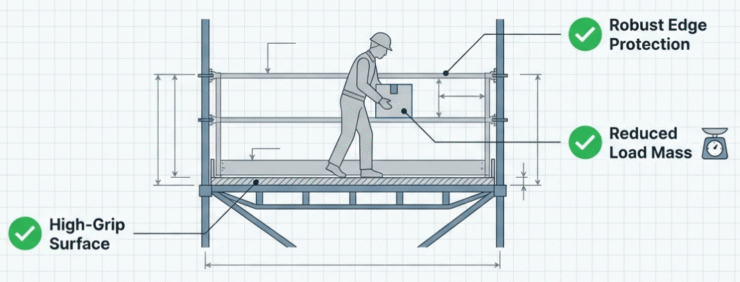
Construction sites present the classic height and handling combination. Workers on scaffolding regularly need to lift materials, position components, and use tools, all while working on platforms that may be narrow, crowded, or exposed to wind.
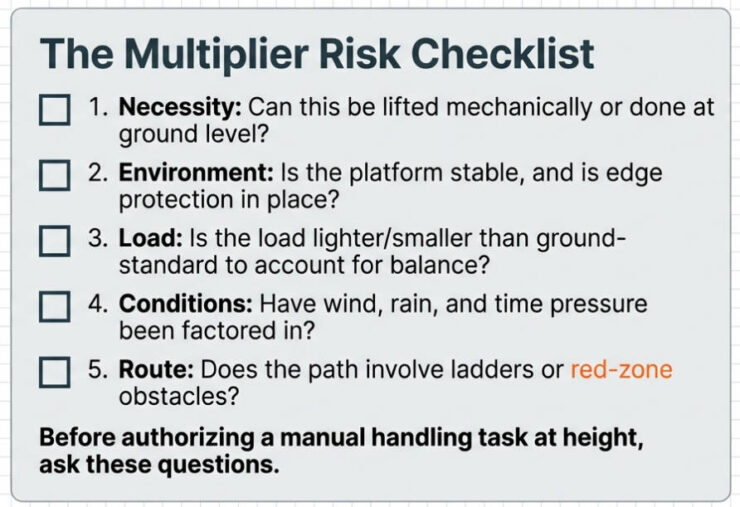
WorkSafe’s NZMAC assessment tool flags using a ladder as a red-zone risk factor for carrying tasks. The same principle applies to any situation where the carrying route involves height: the obstacles aren’t just inconveniences, they’re potential fall hazards. We cover this in our working at heights course.
The confined space issue matters too. Scaffolding and EWPs often restrict movement, which forces workers into awkward postures during handling tasks. The Code of Practice notes that freedom of movement restriction increases risk, and when that restriction is happening at height, the stakes are higher.
Wind deserves special mention. The Code of Practice points out that strong or gusty winds can catch a load, requiring sudden movements and high forces to control it. On solid ground, that’s a handling hazard. At height, it’s a fall hazard too. A load that gets caught by a gust can easily unbalance the person holding it. We cover this extensively in our EWP training course.
The Balance Problem
Your body’s balance system relies on stable reference points. When you’re carrying a load, especially one that’s heavy or awkward, your balance is already compromised. The load shifts your centre of gravity, may block your view of where you’re stepping, and occupies your hands so you can’t easily grab something for support.
Now put that on a platform with limited space, potential edge exposure, and maybe some movement or vibration in the structure itself. Your balance system is working overtime, and any unexpected event – a load shifting, a gust of wind, a foot catching on something – can tip you past the point of recovery.
The Code of Practice notes that tripping is more likely where a load obscures the vision or affects the balance of the carrier. At height, a trip doesn’t just mean a stumble. It can mean a fall.
What Actually Reduces the Risk
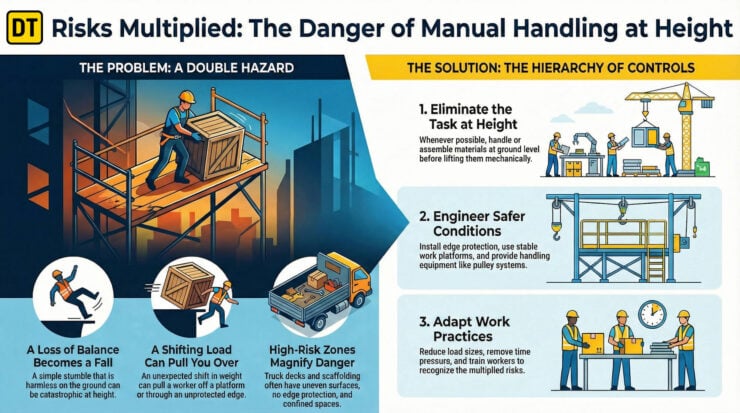
The hierarchy of controls applies here just as it does everywhere else, but with heights involved, elimination and substitution deserve extra emphasis.
Can the handling be done at ground level instead? Materials that need to go up to height could potentially be lifted mechanically rather than carried up manually. If workers need to work at height, can the materials be pre-positioned before they get there?
The Code of Practice specifically recommends eliminating carrying loads on steps and ladders, or reducing the weight and size of the load and improving the ability to grasp. It also suggests providing handling equipment like pulley systems. These aren’t just nice-to-haves when height is involved; they’re essential risk controls.
Where manual handling at height can’t be eliminated, the focus shifts to making it as safe as possible. That means adequate edge protection, stable work platforms with good footing, loads that are sized and weighted appropriately for the conditions, and enough space to handle loads without awkward postures.
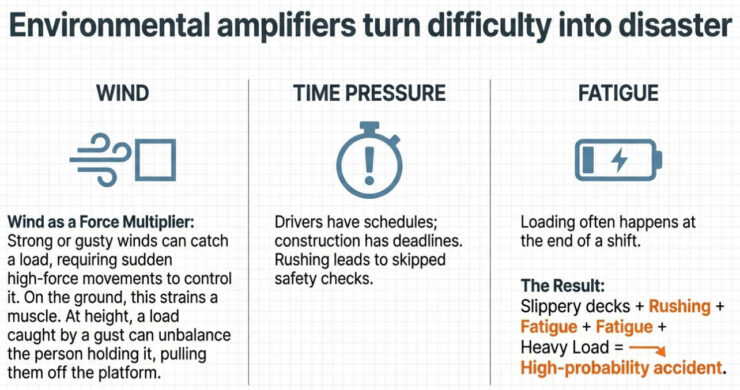
It also means not adding time pressure to an already risky situation. The Code of Practice recommends removing incentives or motivation to rush or take risks, and that applies doubly when height is involved.
Training matters too. Workers need to understand that the combination of height and handling requires different judgments than either hazard alone. A load that would be fine to carry across a warehouse floor might be too risky to carry up scaffolding. The threshold for “too heavy” or “too awkward” shifts when you add height to the equation.
The Bottom Line
Working at height is a significant hazard. Manual handling is a significant hazard. Put them together and you don’t just add the risks; you multiply them.
Every time a worker carries a load up a ladder, handles materials on scaffolding, secures freight on a truck deck, or lifts something on an EWP, they’re managing both hazards simultaneously. That deserves recognition in your risk assessments, your controls, and your training.
The goal isn’t to make workers afraid of these tasks. It’s to make sure everyone understands why the combination demands extra care, and what that extra care actually looks like in practice.


Darren has written over 3000 articles about driving and vehicles, plus almost 500 vehicle reviews and numerous driving courses. Connect with him on LinkedIn by clicking the name above