
• A TR Group Site
  • Help
  • Cart
Driving Tests DT logo small
Driving tests
  • Learner licence
    • Car
    • Motorbike
    • Heavy vehicle
    • Learner Licence Plus
  • Courses
  • Tourist
  • Resources
  • Learn
  • Resources
  • Learner licence
    • Car
    • Motorbike
    • Heavy Vehicle
    • Learner Licence Plus
  • Your courses
    • Enrolled courses
  • View all courses
  • Tourist
  • Resources home
  • iOS application
  • Android application
  • Contact us
  • Terms and conditions
  • Privacy
  • Home
  • /
  • Resources
  • /
  • Advice
  • / How does your suspension and tyre pressure contribute to rollover risk?

How does your suspension and tyre pressure contribute to rollover risk?

Many drivers have suffered a rollover and even more have lifted an axle or two, unaware that it happened. These drivers are frequently driving their trucks on the limit without realising it because most drivers never get rollover prevention training. Many things contribute to a rollover – the primary ones are the height of the centre of gravity and the speed of the vehicle – but there are other factors that come into play. These are suspension and tyres.
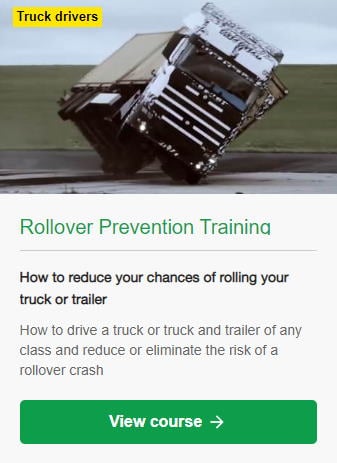
Suspension soaks up bumps on the road. If it’s two hard, it’s uncomfortable to drive with and can damage goods in transit. If it’s too soft, the truck or trailer will lean towards the outside of the bend. If the truck leans too far, the centre of gravity can move outside the limits of the suspension and the vehicle will tip.

The suspension is optimised to dampen movement. Airbags help with suspension rebound to help prevent scenarios where a truck might lean one way because it hits a bump and then tilts back the other way as it corrects. Trucks have been known to overturn on straight roads simply because of dips and bumps that cause the truck to rock side to side. This could be something as innocuous as a railway level crossing that is diagonal to the direction of the road. If there centre of gravity is high enough and the frequency of the dips and bumps matches the natural sway of the truck, it will tip.

Tyres play their part, too. If the tyres are too soft, they will compress more, exacerbating the lean. If they are too hard, they don’t provide enough grip or cushioning (more air pressure means less tyre in contact with the road.)

If one tyre in a dual set is low, the remaining tyre on that side is compressed more, causing a slight lean. This is why it’s important that a truck’s tyre pressures must be checked every day as part of the pre-start inspection. While the actual pressure won’t be taken every day, the driver can use a metal bar or a mallet to hit to tyres and listen for a change in the tone in comparison with the rest.

By Darren Cottingham

Darren has written over 3000 articles about driving and vehicles, plus almost 500 vehicle reviews and numerous driving courses. Connect with him on LinkedIn by clicking the name above

‹ How to prevent overloading on a truck’s axles by sliding the fifth wheel
What jobs can you do if you’ve been a truck driver? ›
Posted in Advice
  • DisqusDisqus
Recent Resources
  • How to find your real driving triggers (and why most drivers get it wrong)
  • PPE Requirements for Truck Loader Crane Operators and Ground Crew
  • Atmospheric testing for Permit Issuers as part of the permit to work system
  • The pre-drive routine: why the first few minutes of your driving shift matter most
  • What are outriggers or straddle legs on a forklift or electric pallet jack?
  • Preparing the worksite
  • What is a forklift paper roll clamp, and how does it work?
  • Manual vs Automatic: Which Works Best in Rural Driving
  • Determining whether a task needs a permit
  • What happens to your licence and insurance after a careless or dangerous driving conviction?

Licences and Courses

  • Car
  • Motorbike
  • Heavy Vehicles
Car
  • Core
  • Behaviour
  • Parking
  • Emergencies
  • Road position
  • Intersection
  • Theory
  • Signs
Motorbike
  • Bike-specific questions
  • Core
  • Behaviour
  • Parking
  • Emergencies
  • Road position
  • Intersection
  • Theory
  • Signs
Heavy Vehicles
  • Class 2
  • Class 3-5
  • Core
  • Behaviour
  • Parking
  • Emergencies
  • Road position
  • Intersection
  • Theory
  • Signs

Vehicle and workplace training

  • About
  • Resources
DT Driver Training TR Group
About
  • About us
  • Contact us
  • Privacy Policy
  • Terms and Conditions
Resources
  • Homepage
  • Driving Tests Android App
  • Driving Tests iPhone App
  • Getting your learner licence
DT Driver Training TR Group
Copyright 2010-2026 DT Driver Training Ltd, PO Box 12541, Penrose, Auckland, 1642. All rights reserved. Questions and images are used with permission from NZTA; question answers are proprietary.