
When accessing worksites in remote or challenging terrain, considering your vehicle’s approach and departure angles means you won’t inadvertently create an entrance that is impassible to certain vehicles.
What are approach and departure angles?
Approach and departure angles are measurements that define how steep an incline your vehicle can tackle without making contact with the ground. The approach angle refers to the maximum angle between the ground and the front of your vehicle that you can drive up without scraping the front bumper. Similarly, the departure angle indicates the maximum angle your vehicle can descend without the rear bumper or tow bar making contact with the ground.
How these angles affect worksite access
From forestry tracks to construction sites and rural properties, approach and departure angles can significantly impact your ability to access remote locations safely.
When approaching a steep driveway entrance, for example, a vehicle with a poor approach angle may scrape its front bumper or bullbar. Likewise, when exiting a dip or depression in the terrain, a limited departure angle might cause the rear of your vehicle to drag, potentially damaging components like the exhaust, tow bar, or rear bumper, or causing you to become beached.
The types of places you need to consider the approach and departure angles are:
- Temporary fords (stream or river crossings)
- Ramps into borrow pits or quarries
- Stockpile loading areas
- Logging access roads
- Farm paddock entries
- Temporary site ramps at roadworks
- Bridge or culvert approaches (for temporary installations)
- Access to remote facilities such as wind turbines
- Driveway crossings where the road is steeply cambered
- Flood or disaster response
- Off-road film sets
Measuring your vehicle’s angles
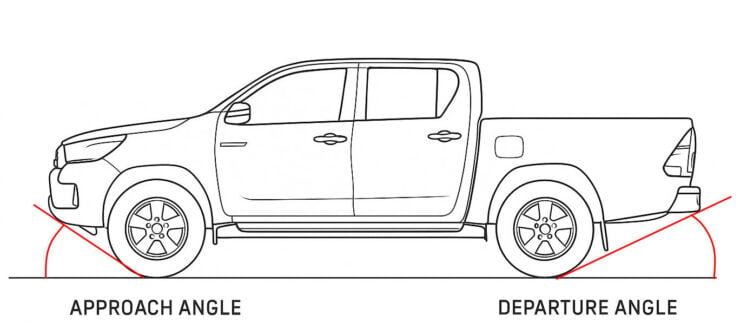
To determine your vehicle’s approach angle, visualise a straight line drawn from the front tyre’s contact point with the ground to the lowest part of your vehicle’s front end. The angle formed between this line and the horizontal ground is your approach angle.
For the departure angle, the measurement is taken from the rear tyre’s contact point with the ground to the lowest point at the rear of the vehicle. This measurement will be affected by any accessories mounted at the rear, such as tow bars or spare tyre carriers.
Modifications that impact these angles
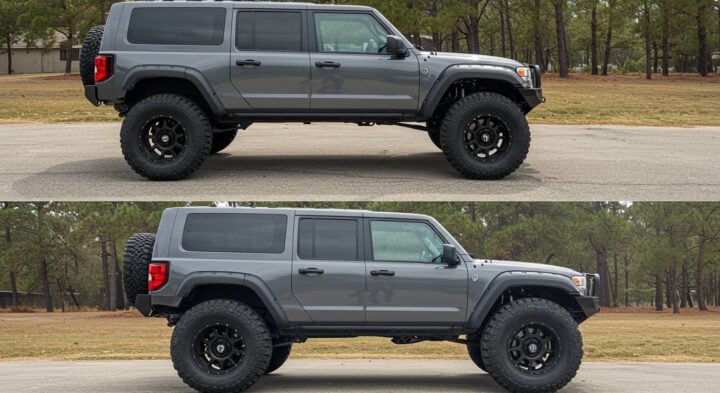
Several factors can affect your vehicle’s approach and departure angles:
Front and rear bumpers: Aftermarket bull bars or rear bars may decrease your angles if they extend further than factory equipment.
Suspension height: Raising your vehicle’s suspension can improve both angles by providing more clearance between the body and the ground.
Tow bars: A protruding tow bar can significantly reduce your departure angle, often becoming the first point of contact when navigating uneven terrain.
Tyre size: Larger diameter tyres effectively raise the entire vehicle, improving both approach and departure angles.
Spare wheel: A spare wheel on the rear door or mounted under the vehicle at the rear, can reduce the departure angle
Improving worksite access safety
Understanding and working within your vehicle’s approach and departure angle limitations can prevent costly damage and ensure safer worksite access. When planning routes to remote locations, consider:
Site assessment: Where possible, conduct a preliminary visit to assess challenging entry points before bringing heavy equipment or larger vehicles.
Alternative routes: Identify multiple access paths to worksites, selecting those that accommodate your vehicle’s limitations.
Driver positioning: Approaching obstacles at an angle rather than head-on can sometimes overcome limitations in approach angle, though this technique requires experience and careful execution.
Vehicle selection: For regular access to challenging terrain, select vehicles with better approach and departure angles or consider appropriate modifications.
Driving techniques are covered in our off-road driver training course.
Real-world applications
In practical terms, vehicles with better approach and departure angles can handle a wider range of terrain. For instance, a standard ute might struggle with steep farm tracks that a properly equipped 4WD vehicle can handle with ease.
On construction sites, the ability to navigate temporary access ways with ruts, humps, and steep transitions often depends on these critical angles. Similarly, in emergency services or utility work where accessing remote locations is essential regardless of conditions, having adequate approach and departure angles can be the difference between completing a job and being forced to find alternative solutions.
By understanding and accounting for these fundamental measurements, you can better prepare your fleet for the demands of accessing challenging worksites, potentially saving time, money, and frustration in the process.


Darren has written over 3000 articles about driving and vehicles, plus almost 500 vehicle reviews and numerous driving courses. Connect with him on LinkedIn by clicking the name above