
Gantry cranes come with different control systems, with the two most common being pendant controls and radio controls. Each system has distinct characteristics, advantages, and limitations that operators and businesses should consider when selecting the most appropriate option for their specific operational requirements.
Pendant controls
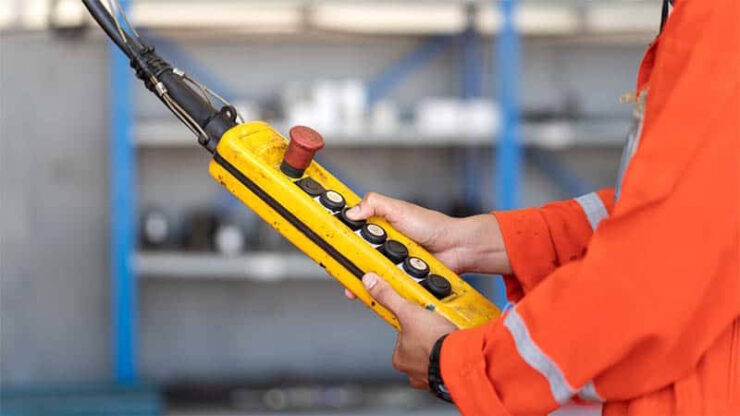
Pendant controls, also known as push-button stations, are handheld control panels that hang from the crane on a cable. These traditional control systems have been used for decades and remain popular in many workplaces.
The pendant control contains clearly marked buttons for all crane functions, including bridge travel (forwards and backwards), trolley travel (left and right), and hoist movement (up and down). A critical safety feature of these controls is the emergency stop button, which is prominently located and allows for immediate shutdown of all crane movements in case of an emergency.
One of the primary advantages of pendant controls is their reliability. Since they are directly connected to the crane’s electrical system via a cable, they are not susceptible to signal interference or battery failures that can affect wireless systems. This hardwired connection ensures consistent operation and reduces the risk of communication failures during critical lifting operations.
Pendant controls are also generally less expensive than radio control systems, making them a cost-effective option for many applications. Their simplicity makes them easy to use and maintain, with fewer components that could potentially fail or require replacement.
However, pendant controls do have limitations. The operator must move with the crane, following the load while maintaining a safe distance. This requirement can restrict visibility in certain situations and may increase the risk of the operator being in proximity to the load or other hazards. The pendant cable itself can become a hazard if not properly managed, potentially becoming tangled or creating trip hazards in the workplace.
Radio control systems

Radio control systems allow operators to control the gantry crane remotely without being tethered by a cable. These wireless remote controls provide greater freedom of movement for the operator, who can position themselves for optimal visibility of the load and the surrounding area.
Modern radio control systems are designed with numerous safety features. They typically include a key switch or equivalent security device on the transmitter to prevent unauthorised use. The system should provide visual indication on the crane when it is under radio control, and automatically de-energise when the transmitter signal is lost or experiences interference. Additionally, in accordance with New Zealand’s Approved Code of Practice for Cranes, radio-controlled cranes must have a mechanism that brings the crane to a complete stop with brakes applied when the transmitter range is exceeded.
One of the significant advantages of radio controls is increased operator mobility and positioning flexibility. Operators can move to the most advantageous location to observe the load and its path, improving safety and precision during lifts. This mobility is particularly valuable when handling large or awkwardly shaped loads where visibility from a fixed position might be compromised.
Radio controls also eliminate the potential hazards associated with trailing cables, such as entanglement or tripping. They are especially useful in congested work environments where movement may be restricted or in situations where the operator needs to maintain a safe distance from the load.
However, radio control systems have their own set of considerations. They are generally more expensive than pendant controls, both in terms of initial purchase and potential maintenance costs. They rely on battery power, which necessitates regular charging and replacement procedures to prevent operation interruptions. Signal interference can also be a concern in environments with other radio frequency devices, although modern systems are designed to minimise this risk through dedicated frequencies and interference protection mechanisms. They are also prone to being misplaced or lost – it’s best to have a dedicated place that they are returned to, and having a spare unit just in case you can’t find the main unit.
Operational considerations
When choosing between radio and pendant controls, several operational factors should be considered. The working environment plays a crucial role in this decision. In confined spaces or areas with numerous obstacles, radio controls offer better flexibility for operator positioning. Conversely, in open areas with clear sightlines, the advantages of radio controls may be less significant.
The frequency and duration of crane operations also influence the choice. For intensive, continuous operations, the reliability of pendant controls might be preferable, whereas intermittent use scenarios might benefit from the flexibility of radio controls.
Safety requirements are paramount in any lifting operation. The Approved Code of Practice for Cranes requires that radio control equipment for cranes in New Zealand include specific safety features. The transmitter should be constructed to withstand rough handling, and the system must be designed to prevent operation if the signal is lost or if interference occurs. Additionally, the system must automatically de-energise when the emergency stop button is activated.
For high-risk areas, operators using radio controls should operate from a predetermined safe area, which might involve a viewing platform or controls programmed to work only within designated safe zones. These requirements help ensure that radio-controlled cranes maintain safety standards equivalent to those of traditionally controlled cranes.
Communication Protocols
For radio-controlled cranes, a dedicated radio frequency should be selected for the duration of the crane operations to prevent interference with other radio equipment being used in the vicinity. A “constant talk” method is recommended, requiring radio users to communicate continuously so that all involved personnel remain aware of the progress of the task at all times.
Work should cease immediately if any loss or deterioration of radio communication occurs. Mobile phones are not recommended for directing mobile crane operations due to potential distractions and reliability issues.
Maintenance and inspection requirements
Both control systems require regular maintenance and inspection to ensure safe operation. For pendant controls, this includes checking the condition of the support cable and ensuring that it is properly insulated from the crane structure. The control buttons should be examined for proper function and clear labelling, and the emergency stop button must be tested regularly.
Radio control systems require additional maintenance considerations, including battery management and signal testing. Regular checks of the controlled range feature are necessary, particularly at the beginning of each shift or when there is a change in the crane operator, to ensure that it operates within the specified limits.
Which should you choose?
The choice between radio control systems and pendant controls for gantry cranes depends on various factors including the specific operational requirements, environment, budget, and safety considerations. Pendant controls offer reliability, simplicity, and cost-effectiveness, while radio controls provide enhanced operator mobility, better visibility, and reduced cable-related hazards.
In New Zealand, both systems must comply with the relevant safety standards and regulations outlined in the Approved Code of Practice for Cranes. Regardless of the control system chosen, proper gantry crane training, regular maintenance, and adherence to safety protocols are essential for ensuring safe and efficient gantry crane operations.


Darren has written over 3000 articles about driving and vehicles, plus almost 500 vehicle reviews and numerous driving courses. Connect with him on LinkedIn by clicking the name above