The Invisible Spark
Most forklift operators understand the obvious fire risks associated with LPG: open flames, hot surfaces, and electrical faults all warrant caution. However, one of the most underestimated hazards is also one of the most common in everyday life: static electricity. That tiny shock you feel when touching a door handle or taking off a fleece jumper carries enough energy to ignite LPG vapour, potentially causing a catastrophic fire or explosion.
Understanding why static electricity poses such a significant risk when working with LPG requires us to look at the science behind both phenomena and how they interact in a forklift environment.
What Makes LPG So Flammable?
LPG is classified as a Class 2.1.1A flammable gas under New Zealand’s dangerous goods regulations, carrying the GHS hazard statement “Extremely flammable gas.” The properties that make LPG such an efficient fuel also make it exceptionally dangerous around ignition sources.
LPG has an extraordinarily low flash point (typically around -81°C for the propane-butane blend commonly used in forklifts). This means the gas will ignite at virtually any temperature encountered in normal working conditions. The flammability range of LPG sits between approximately 2% and 10% concentration in air. Within this range, any spark or flame will cause ignition. Below 2%, there isn’t enough gas to sustain combustion; above 10%, there isn’t enough oxygen. This flammable range might sound narrow, but it represents the precise conditions that frequently occur during cylinder changeovers and near any minor leak.
Perhaps most significantly, LPG vapour is considerably heavier than air – approximately 1.7 times denser. This means that when LPG escapes from a cylinder or fitting, it doesn’t simply disperse upward and away. Instead, it sinks and pools in low-lying areas, in depressions in the floor, around the operator’s feet, and in the spaces beneath the forklift. An invisible pocket of flammable gas can accumulate undetected, waiting for an ignition source.
The Science of Static Electricity
Static electricity builds up when certain materials rub against each other, causing electrons to transfer from one surface to another. One material becomes positively charged whilst the other becomes negatively charged. When this charge imbalance becomes significant enough and finds a pathway to equalise – typically through a conductive material like metal – the electrons jump across the gap as a spark.
In a warehouse or industrial setting, static electricity can build up through numerous everyday activities. Sliding in and out of the forklift seat, particularly when wearing synthetic clothing, generates charge through friction. Walking across certain floor surfaces, especially in rubber-soled boots, accumulates charge in the body. The flow of LPG itself, whether liquid or gas phase, generates static as it moves through hoses and fittings. Even the simple act of removing and replacing a cylinder can create friction that builds charge.
The energy required to ignite LPG is remarkably small, measured in fractions of a millijoule. By comparison, a static discharge from the human body, which you might barely feel or not notice at all, typically releases between 1 and 10 millijoules. This means even imperceptible static discharges carry more than enough energy to ignite LPG vapour.
Where Static Meets LPG in Forklift Operations
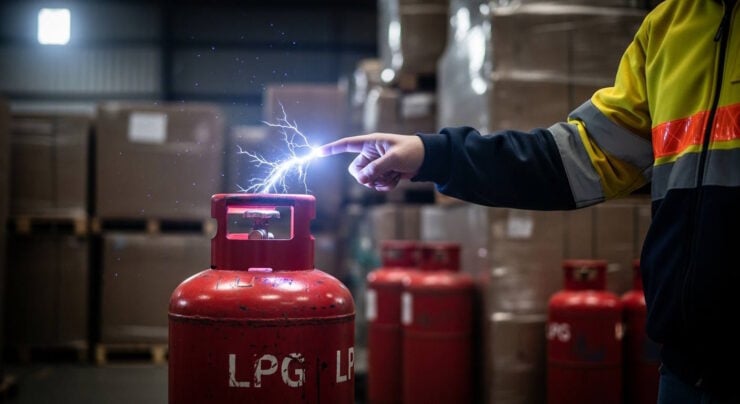
The cylinder changeover process represents the highest-risk moment for static ignition. When disconnecting a cylinder, a small amount of LPG almost always escapes, creating a localised flammable atmosphere around the connection point. At this precise moment, the operator is typically touching metal fittings with their hands and may have built up a static charge from climbing on and off the forklift or from their clothing.
The Safety Data Sheet for LPG specifically recommends wearing “reduced static full body cover, cotton or other material with equivalent static and flame resistant properties” when there is a possibility of LPG liquid release. This guidance exists precisely because synthetic fibres are notorious static generators, whilst natural fibres like cotton dissipate charge more effectively.
Equipment in hazardous atmosphere zones must be effectively electrically bonded and earthed to prevent static accumulation. Under New Zealand regulations, the maximum resistance to earth for components must be kept low enough to safely dissipate any static charge before it can build to dangerous levels. For most components, this means a maximum resistance of 10 ohms to earth for effective static dissipation.
Common Static Ignition Scenarios
Consider these realistic scenarios where static electricity could ignite LPG in a forklift environment.
An operator finishes a shift and parks the forklift. Wearing a polyester high-visibility vest, they slide off the vinyl seat, building a significant static charge. They notice the fuel gauge is low and decide to change the cylinder. As they reach for the metal coupling to disconnect the nearly empty cylinder, they inadvertently create a spark just as residual gas escapes from the connection.
In another scenario, a cylinder changeover is performed in a poorly ventilated corner of a warehouse. There is no obvious spark, but static has built up on the cylinder itself through the repeated connection and disconnection process. When the operator makes contact whilst positioning the new cylinder, a spark jumps at precisely the wrong moment.
Both scenarios are entirely preventable with proper awareness and procedures.
Protecting Against Static Ignition
Effective protection against static-related LPG incidents involves several complementary strategies.
Proper grounding and bonding of equipment ensures that static charges have a safe pathway to dissipate before they can accumulate to dangerous levels. All permanently fixed equipment in areas where flammable gases are present should be properly earthed.
Personal protection involves wearing appropriate clothing (preferably cotton or other natural fibres rather than synthetic materials). Before touching any LPG fittings, touching an earthed metal surface away from the cylinder connection allows any personal static charge to dissipate safely.
Intrinsically safe practices include using only approved equipment in areas where LPG may be present. The LPG Safety Data Sheet explicitly warns against bringing mobile phones, radios, cameras, and other non-intrinsically safe electrical equipment into potential hazardous atmospheres.
Good ventilation is essential. Performing cylinder changeovers in well-ventilated areas reduces the likelihood of flammable concentrations accumulating. Even small air movements help disperse LPG before it can pool.
Finally, awareness and training ensure that operators understand not just the procedures but the reasons behind them. Knowing that static electricity is a genuine ignition source, not merely a theoretical concern, encourages compliance with safety protocols.
The Takeaway
Static electricity might seem trivial compared to other industrial hazards, but when working with LPG, it becomes a serious threat. The combination of LPG’s extreme flammability, its tendency to pool invisibly at ground level, and the ease with which static charges build up during normal activities creates conditions where a barely perceptible spark can trigger a devastating fire.
Every forklift operator handling LPG should understand that the static shock they might casually dismiss in other contexts could, in the presence of escaping gas, become an ignition source. This understanding should inform clothing choices, work practices during cylinder changeovers, and the vigilance required when working around this highly flammable fuel.
The goal is not to create fear but to foster respect: respect for the properties of LPG, respect for the physics of static electricity, and respect for the procedures designed to keep them safely apart.
It’s a legal requirement for you to provide forklift LPG training to your team. View the forklift LPG training course here.


Darren has written over 3000 articles about driving and vehicles, plus almost 500 vehicle reviews and numerous driving courses. Connect with him on LinkedIn by clicking the name above