
Familiarity breeds comfort. Comfort breeds shortcuts. Shortcuts, when you’re handling a Class 2.1.1A flammable gas, breed incidents.
The worker who changes an LPG cylinder for the hundredth time doesn’t approach it with the same care as the first time. That’s human nature. It’s also where most LPG incidents originate; not from ignorance, but from experienced workers whose vigilance has quietly eroded.
Why Experience Becomes a Liability
WorkSafe guidance puts it plainly: “It’s easy for bad habits to slip into work practices.” The more routine a task becomes, the more our brains automate it. We stop consciously checking because we’ve done it so many times without incident that checking feels redundant.
But LPG doesn’t care about your track record. A worn seal that developed last week will leak regardless of the thousand successful changeovers before it. The static charge on a worker’s fleece doesn’t know they’ve been doing this for fifteen years.
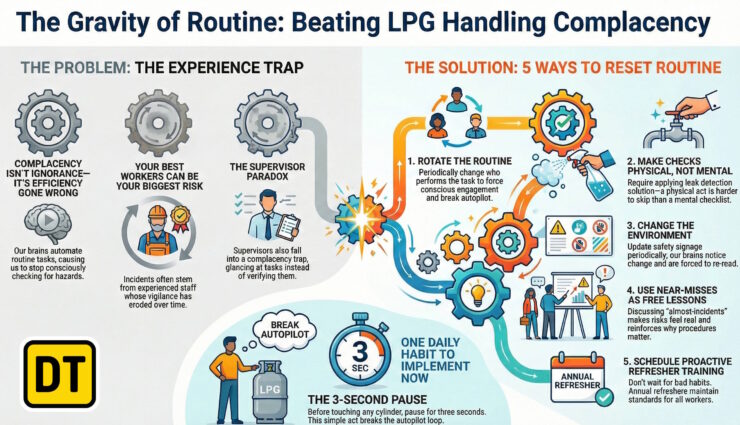
Complacency isn’t stupidity; it’s efficiency gone wrong. Our brains are wired to conserve cognitive effort. The problem is that LPG handling requires sustained attention to details that rarely matter, until the one time they do.
Five Practical Interventions
1. Rotate the routine
When the same person performs the same task daily, autopilot takes over. Periodically rotating who performs cylinder changeovers or equipment checks forces workers to stay consciously engaged. A task that’s routine for one person is still relatively fresh for someone who does it weekly rather than hourly.
2. Make checks physical, not mental
Mental checklists get abbreviated. Physical actions don’t. Instead of asking workers to “check for leaks,” give them a specific action: apply leak detection solution to every connection, every time. The physical act anchors attention in a way that a mental tick-box cannot.
3. Change the environment periodically
Our brains notice change. When cylinder storage locations, signage, or procedures remain identical for years, they become invisible. Periodically updating safety signage. Even just refreshing the same message with a different design forces the brain to actually read it rather than pattern-match and ignore.
4. Use near-misses as teaching moments
Every gas smell that turned out to be nothing, every connection that was slightly loose, every moment someone noticed something “a bit off”. These are free lessons. Create a culture where reporting near-misses is valued, then use them in toolbox talks. Near-misses are warnings the universe provides before incidents; don’t waste them.
5. Schedule refresher training before you think you need it
WorkSafe requires that “all workers, no matter how experienced they are, need to remain competent on an ongoing basis.” Don’t wait for bad habits to appear before scheduling refreshers. Build them into your calendar annually. When workers know a refresher is coming, they’re more likely to maintain standards in the interim. You can quickly refresh your forklift LPG training here, or your dangerous goods handler training here.
The Observation Test
Here’s a quick diagnostic: Watch your most experienced LPG handler perform a cylinder changeover without telling them you’re assessing their technique. Compare what they actually do against your documented procedure.
If there are gaps (steps skipped, checks abbreviated, PPE not worn) you’ve found your complacency indicators. These gaps didn’t appear overnight; they accumulated through hundreds of “nothing went wrong” repetitions.
The fix isn’t disciplinary. It’s systemic. If experienced workers are cutting corners, examine whether your procedures are realistic, whether time pressures are creating incentives to rush, and whether your supervision has become as routine as the task itself.
The Supervisor Paradox
Supervisors face their own complacency trap. When you’ve observed a hundred cylinder changeovers without incident, your observation becomes less rigorous. You glance rather than watch. You assume rather than verify.
WorkSafe notes that supervision needs vary based on worker experience, but it also warns that “supervision is important when there are changes in the workplace,” including subtle changes like roster adjustments or seasonal shifts that alter lighting and temperature. The moment supervision becomes perfunctory is the moment it stops serving its purpose.
One Daily Practice
If you implement nothing else, implement this: require every worker handling LPG to pause for three seconds before touching any cylinder or fitting. Not to do anything specific, just to pause.
That pause breaks the autopilot loop. It creates a micro-moment of conscious attention. It’s the mental equivalent of taking a breath before speaking.
Three seconds won’t slow your operation meaningfully. But those three seconds, repeated across every interaction, rebuild the habit of deliberate engagement that complacency steadily erodes.
The goal isn’t to make workers afraid of LPG. It’s to maintain the respect it deserves: the same respect they had on day one, sustained through day one thousand.


Darren has written over 3000 articles about driving and vehicles, plus almost 500 vehicle reviews and numerous driving courses. Connect with him on LinkedIn by clicking the name above