
Stability, moments, and tipping points
Every year, a couple of hundred single-vehicle rollovers happen on New Zealand roads. That figure doesn’t count forestry trucks in the bush, excavators on building sites, or quad bikes on farms. These are vehicles on public highways. Rollovers account for roughly 30% of heavy vehicle crashes, and New Zealand’s winding, hilly road network makes the problem worse than in most other developed countries. We have more bridges, corners, and hills per 100 km of highway than nearly anywhere else.
This article covers the physics that determines when a loaded truck stays upright and when it doesn’t. The same principles apply to a block on a table, a building in a wind storm, or a shipping container on a wharf, but the consequences are most immediate when you’re behind the wheel of a Class 2 or heavier vehicle on the Kaimai Range or approaching a roundabout in South Auckland.
Forces and moments
A moment is the tendency of a force to rotate an object about a point. The calculation is simple: multiply the force by the perpendicular distance from its line of action to the point of rotation. M = F × d, where M is the moment, F is the applied force, and d is the perpendicular distance.
When you load a pallet onto the right-hand side of a truck deck, you create a moment about the vehicle’s centreline. The force is the weight of the pallet (mass × gravity), and the distance is how far that pallet sits from the centre of the truck. Load one side heavier than the other and you’ve created a net moment that tilts the vehicle. The suspension absorbs some of this, but there’s a limit to what it can handle.
Moments also explain what happens in a corner. As a truck turns, centrifugal force pushes the vehicle’s mass toward the outside of the curve. That sideways force, acting at the height of the centre of gravity, creates a moment about the outer wheels. If that moment becomes large enough to overcome the restoring moment of the vehicle’s weight acting through its base, the truck tips.
Equilibrium: when things stay put
An object is in static equilibrium when all forces acting on it sum to zero and all moments about any point also sum to zero. No net force means no acceleration. No net moment means no rotation.
A loaded truck parked on level ground is in equilibrium. Its weight pushes down, the road pushes back up, and those forces are balanced across the axles. The moments about any point cancel out, so the vehicle just sits there.
Disturb either condition and things start to move. Park on a slope with soft ground on one side, and the equilibrium changes. The ground gives way, the vehicle leans, the centre of gravity shifts, and if it shifts far enough, the truck is going over. This is why road shoulders next to drainage ditches are a common location for parked-vehicle rollovers.
Centre of gravity
The centre of gravity is the single point where you can treat all of a vehicle’s mass as concentrated for the purpose of calculating how gravity acts on it. A truck’s stability depends almost entirely on where this point sits relative to the base of support — the rectangle defined by the contact patches of the tyres.
As long as the vertical line through the centre of gravity falls inside that rectangle, the vehicle stays upright. Once it moves beyond the edge, the vehicle tips.
This is why a loaded truck behaves nothing like a car. A typical car has a wide track relative to the height of its centre of gravity. It won’t roll until lateral forces reach about 1.2G, and most cars can corner at 0.8G without any drama. A loaded truck, with its narrow track and high centre of gravity, can roll at 0.4G. That’s a third of the force.
Several things cause the centre of gravity to move while you’re driving. Live loads such as bulk liquids and livestock shift with the vehicle’s motion. Bumps, changes in gradient, and road camber all have an effect. When you brake, the centre of gravity moves forward, loading up the front axle and unloading the rear. When you corner, the suspension compresses on the outside of the turn, the vehicle leans, and the centre of gravity shifts toward the outer edge. If it moves far enough beyond what the suspension can manage, the truck tips.
The critical angle
For a uniform rectangular block, you can calculate the maximum tilt before it topples: θ = arctan(w / 2h), where w is the width of the base and h is the height of the centre of gravity. Shorter, wider objects can lean further. Tall, narrow objects cannot.
A truck isn’t a uniform rectangular block, but the same relationship holds in principle. The wider the track and the lower the centre of gravity, the more lateral force the vehicle can absorb before rolling. Every pallet stacked on top of another pallet raises the centre of gravity and reduces the margin. Loading heavy items low on the deck and keeping the overall load height down are the most direct ways to protect yourself.
New Zealand law reflects this. Every goods service vehicle with a gross vehicle mass over 12 tonnes, and every trailer with a GVM over 10 tonnes, must have a static roll threshold (SRT) of at least 0.35G. Some vehicle categories require 0.45G. The SRT means that when loaded to the manufacturer’s specifications, the vehicle must not roll until lateral acceleration reaches at least that figure. The SRT appears on the Certificate of Loading alongside height-to-weight restrictions, and drivers must load within those limits. If you have a trailer where the body or load height can exceed 2.8 metres from the ground, you must also have an SRT Compliance Certificate endorsed on the Certificate of Loading.
But just because your vehicle doesn’t need an SRT certificate doesn’t mean you can’t roll it. Construction vehicles used off-road are exempt, and they’re at high risk. The physics doesn’t care about paperwork.
Advisory speeds and the margin that isn’t as wide as you think
The yellow advisory speed signs before corners on New Zealand highways are set so that a vehicle taking the corner smoothly at the posted speed will experience lateral forces of about 0.22G. Against a minimum SRT of 0.35G, that looks like a comfortable buffer of 0.13G.
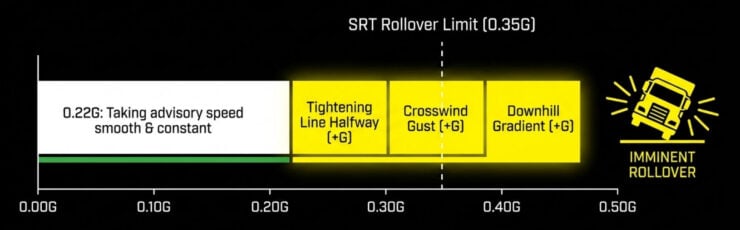
It isn’t. That 0.22G figure assumes you hold a clean, constant-radius line through the entire corner at a steady speed. Tighten your line halfway through, and you can double the lateral force. A crosswind blowing from the inside of the corner adds to it. A downhill gradient adds more, because a component of gravity now reinforces the centrifugal force pushing the vehicle outward. Stack two or three of these together and you’re at or past your SRT without ever feeling like you were going too fast.
The advisory speed is also set for cars, not trucks. A truck driver should aim to take advisory-speed corners 10 km/h below the posted figure. On downhill corners, slower again.
Roundabouts and roll resonance
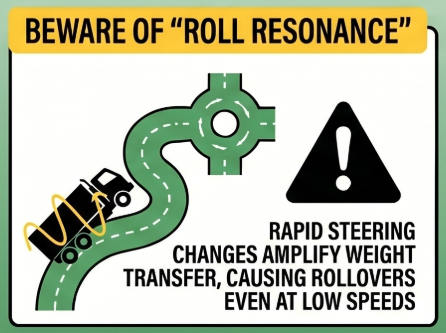
Roundabouts are where a disproportionate number of truck rollovers happen, often at speeds that seem far too low to be dangerous. The physics involves something called roll resonance, and it can catch experienced drivers off guard.
Picture a loaded truck approaching a roundabout and intending to go straight through. On a New Zealand road, the driver first steers left to enter. The vehicle rolls to the right. The driver then steers right to follow the curve, and the vehicle rolls back to the left. But it doesn’t just return to level. It rolls further to the left than it did to the right on entry, because the timing of the direction change matches the vehicle’s natural roll frequency. If the load shifts during this second roll, the centre of gravity moves further toward the tipping edge. The driver then steers left to exit, and the vehicle rolls to the right again, this time more violently. A truck can roll on a roundabout at less than 10 km/h if the direction changes are sharp enough and the timing is wrong. Rollover prevention training can help you understand these risks.
The lateral forces in each individual turn might sit well below the SRT. But the cumulative effect of rapid weight transfer from side to side can exceed it. This is the same principle as sloshing water in a tub: each swing adds energy to the next. If the load isn’t properly restrained and begins to move independently of the vehicle, it gathers its own momentum, and that makes everything worse.
S-bends produce the same effect. So do sudden swerves to avoid obstacles on the road, where a sharp correction one way followed by an over-correction back the other way creates exactly the same pattern of escalating weight transfer.
Dynamic stability: why trucks and bicycles have something in common
Static stability describes objects at rest. Dynamic stability describes systems in motion, and the two don’t always agree.
A parked bicycle falls over immediately; it has terrible static stability. A moving bicycle stays upright, though the reasons are more complex than most people assume. Research published in 2011 by Kooijman, Meijaard, Papadopoulos, Ruina, and Schwab showed that the old explanation of gyroscopic effects from spinning wheels isn’t sufficient. A bicycle with no gyroscopic contribution and no trail could still be self-stable. The actual mechanism involves geometry, mass distribution, and steering response working together.
A truck is different. It has reasonable static stability when parked and loaded properly, but its dynamic stability degrades under the wrong conditions. Cornering forces, road camber, wind gusts, load movement, and suspension compression all interact in ways that can reduce the effective roll threshold below the static figure. Modern trucks are smooth enough that you often won’t feel the trailer wheels lifting off the ground. If you notice the rev counter spike as the drive wheels lose traction, you’re already past the point where you can do anything about it.
Dynamic stability in trucks depends on the driver’s ability to manage inputs smoothly. Sudden steering, harsh braking in a corner, or rapid direction changes all generate dynamic forces that exceed what the static numbers would predict. Reading the road 10 to 12 seconds ahead, completing all braking before entering a corner, and making smooth, progressive steering inputs are the practical applications of everything in this article.
Practical applications in engineering
The same physics governs the design of structures. A cantilever beam must resist the moment created by its load, or it fails. A retaining wall must resist the moment from lateral soil pressure; engineers slope the wall face (a batter) or add counterforts to shift the resultant force to a more favourable position relative to the base. Bridge designers calculate moments to determine where to place supports.
Aircraft achieve dynamic stability through control surface placement and weight distribution. Modern aircraft add electronic stability augmentation that detects deviations and applies corrections many times per second.
For a truck driver, the engineering has already been done. The vehicle has been designed with a certain SRT and certain suspension characteristics. What the driver controls is the load placement, the speed, the steering inputs, and the ability to read what’s coming. The physics is always the same. The margin for error is just narrower than most people think.
Where can you get training?
Excavator training will teach you how to avoid rolling an excavator
Off-road training will teach you how to avoid rolling a ute or other 4WD on surfaces other than roads.


Darren has written over 3000 articles about driving and vehicles, plus almost 500 vehicle reviews and numerous driving courses. Connect with him on LinkedIn by clicking the name above
 Disqus