Here’s an uncomfortable truth about workplace safety: sometimes the gear designed to protect you actually makes certain tasks harder. And when it comes to manual handling, that “harder” can translate directly into “more likely to injure yourself.”
Personal protective equipment is essential. Nobody’s arguing otherwise. But if you’ve ever tried to grip a slippery load while wearing thick gloves, or bent down to pick something up in a high-vis vest that rides up and restricts your movement, you know exactly what we’re talking about.
The Code of Practice for Manual Handling flags this directly: special clothing or footwear may influence the ability to handle objects. It’s a risk factor that gets overlooked because people assume PPE is always protective, full stop.
The reality is more complicated.
When Gloves Work Against You
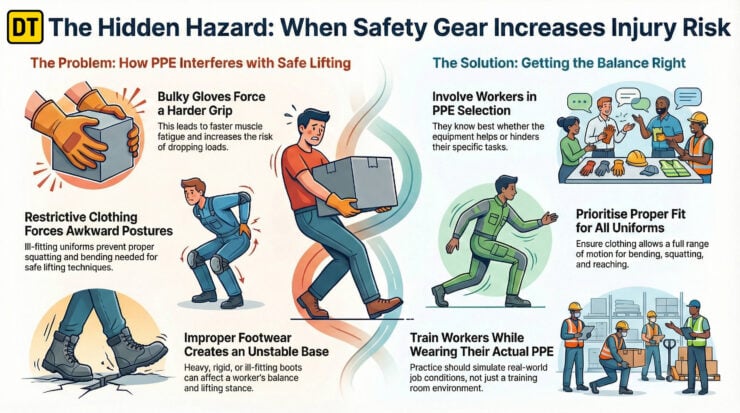
Gloves are the most obvious example. The Code of Practice notes that gloves may make it more difficult to handle loads if extra muscle force is required. That makes intuitive sense: a bulky pair of work gloves reduces your tactile feedback and can make it harder to get a secure grip.
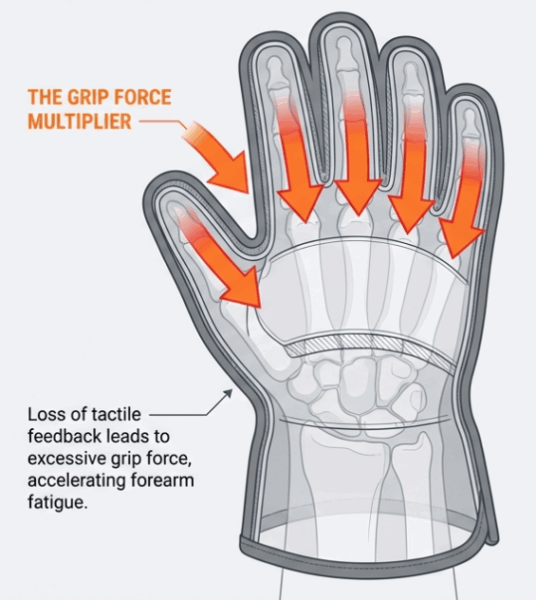
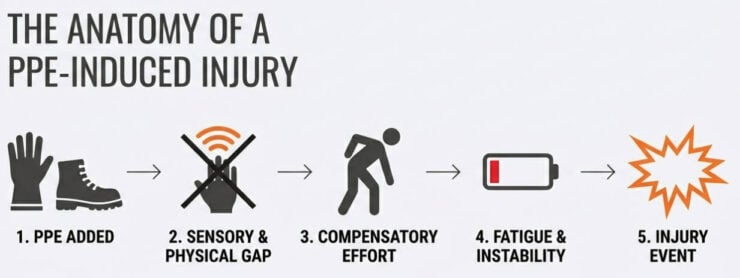
When you can’t feel what you’re holding properly, you compensate by gripping harder. That extra muscle force doesn’t just tire your hands and forearms more quickly; it changes how you lift. Fatigued grip muscles mean you’re more likely to shift the load mid-lift, adjust your posture awkwardly, or (worst case) drop the load entirely.
For workers handling oily, cold, or rough materials, gloves are non-negotiable. But the type of glove matters enormously. A glove that’s excellent for chemical protection might be completely wrong for manual handling tasks. Getting the balance right between protection and dexterity is one of those decisions that deserves more thought than it usually gets.
Clothing That Restricts Movement
WorkSafe’s assessment tools identify restricted movement as a specific risk factor. When clothing forces workers to modify their postures, risk increases. If you can’t get into the position you need for a safe lift, you’ll end up in a compromised position instead.
Think about overalls that are too tight across the shoulders or back. Work trousers that don’t allow you to squat properly. High-vis vests that bunch up when you bend forward. Even something as simple as a tucked-in shirt can restrict how far you can bend at the waist.
The Code of Practice makes a specific recommendation here: overalls should have sufficient room to bend the back and knees easily, stretch and reach up. That sounds obvious, but how often do workers get issued standard-sized uniforms without anyone checking whether they can actually move properly in them?
This is particularly relevant for tasks that require a full range of motion—reaching above shoulder height, lifting from floor level, or working in confined spaces where you’re already dealing with postural constraints.
Footwear: The Foundation of Every Lift
Your feet are the foundation of every manual handling task you perform. Get the footwear wrong, and everything built on top of that foundation becomes unstable.
Non-slip footwear is essential for obvious reasons: slips, trips and falls associated with manual handling cause serious back injuries. But footwear can create handling problems in other ways, too.
Safety boots that are too heavy add to overall fatigue. Boots that don’t fit properly affect your balance and stability. Steel-capped boots that are too rigid can make it uncomfortable to adopt a proper lifting stance with bent knees.
Then there’s the issue of ankle support. Some safety footwear restricts ankle mobility so much that workers struggle to maintain a stable base when lifting. Others provide so little support that ankles are vulnerable to rolling when carrying loads across uneven surfaces.
Working in Challenging Environments
Environmental conditions add another layer. When it’s hot, humid, or dusty, workers often need to wear additional protective equipment, which can interfere with handling tasks.
Respiratory protection, for example, can affect breathing rhythm during physical exertion. Hearing protection can reduce awareness of verbal warnings from team members during coordinated lifts. Eye protection can limit peripheral vision, making it harder to navigate around obstacles while carrying a load.
The Code of Practice notes that working in very hot or cold temperatures can affect physical and mental capability, and may also mean that personal protective equipment is needed. There’s often a compounding effect: the environment creates hazards, the PPE addresses some of those hazards but introduces handling challenges, and those challenges create new risks.
Cold conditions are particularly relevant. Working in chillers or freezers, or outdoors in winter, typically requires insulated gloves and layered clothing. Both reduce dexterity and restrict movement.
Getting the Balance Right
None of this means workers should skip the PPE. What it means is that manual handling risk assessments need to account for the gear workers are wearing, not just the loads they’re handling.
A few practical considerations:
The PPE selection process should involve input from the people who actually do the handling. They know better than anyone whether the current gear makes their job harder. If workers are routinely removing gloves to get a better grip, that’s a sign the current gloves aren’t fit for purpose.
Consider whether mechanical aids could reduce the need for physical handling in situations where PPE significantly compromises dexterity or movement. If the combination of required PPE and manual handling creates unacceptable risk, changing the task might be more effective than trying to find perfect PPE.
Training should specifically address how to handle loads while wearing the required protective equipment. Workers need practice doing lifts in the actual gear they’ll be wearing, not just in their regular clothes during a training session.
Make sure uniforms and work clothing are properly fitted. A few extra minutes during sizing, or offering a proper range of sizes, can make a meaningful difference to how well workers can move.
Finally, review the situation whenever PPE requirements change. New gloves, different footwear, additional respiratory protection; any change to what workers wear should trigger a fresh look at whether manual handling tasks are affected.
The Bottom Line
PPE is there to protect workers, and it does. But protection against one hazard shouldn’t create an uncontrolled risk of another. The reality is that many work uniforms are poorly designed for the tasks that employees are expected to undertake. That’s not an argument against PPE, it’s an argument for thinking more carefully about how all the different pieces of workplace safety fit together.
Manual handling training can be paired with a workplace first aid course to give a broader ability to both prevent and deal with hazards.
Your workers are going to wear what they’re told to wear. The question is whether anyone has thought about what that means for the other things they need to do safely.


Darren has written over 3000 articles about driving and vehicles, plus almost 500 vehicle reviews and numerous driving courses. Connect with him on LinkedIn by clicking the name above