
You’re heading to a job. Traffic is moving. Then someone cuts across two lanes without indicating, clips in front of you, and dawdles away. Your jaw tightens. Maybe you mutter something. Maybe you lean on the horn. That flash of anger? That’s completely normal. It happens to almost every driver, from couriers to truck drivers, from bus drivers to pensioners. The question is never whether you feel it. The question is what happens next.
Road rage has become a catch-all term that gets applied to everything from a rude gesture to a violent assault. But those things are not the same, and treating them the same causes problems, especially if you’re a professional driver who needs to understand exactly where the lines are and what the consequences of crossing them look like.
A spectrum, not a single thing
Think of driver behaviour as a spectrum. At one end, you have everyday frustration. You’re behind someone crawling in the fast lane. You feel irritated. You exhale loudly and carry on. That’s it. No harm done. It’s just part of sharing the road with other human beings who don’t always do what you’d like them to do.
Move along that spectrum and you reach aggressive driving. This is where frustration converts into action. Tailgating. Cutting in front of someone to make a point. Holding the horn down. Flashing your lights repeatedly at a driver who’s doing nothing wrong. These aren’t just bad habits. They’re deliberate choices that put other people at risk, and they carry penalties.
At the far end of the spectrum is road rage. This is the point where behaviour becomes criminal. Using a vehicle as a weapon. Deliberately forcing someone off the road. Getting out to confront or assault another driver. Threatening someone with violence. Road rage is not just dangerous driving with a label on it. It is a crime, and the consequences are serious.
“Road rage is defined as an incident in which an angry or impatient motorist intentionally injures or kills another road user, or attempts or threatens to do so.” — AAA Foundation for Traffic Safety
That distinction matters enormously for professional drivers.
Why the label is so confusing
Part of the problem with road rage is that the term gets used loosely. A 2025 systematic review of road rage research found that people define it in different ways. Some drivers use it to describe any angry feeling behind the wheel. Others reserve it for physical violence. In research, the most common responses centred on losing control, acting irrationally, and retaliating for perceived wrongdoing.
That last one is worth pausing on. Retaliation. The research consistently shows that a major feature of road rage incidents is that drivers feel they are responding to something the other person did first. The other driver cut them off. The other driver was disrespectful. The other driver deserved it. But when the situation is reconstructed, the original offence is often minor, accidental, or not even directed at them personally.
A courier driver in Christchurch described being tailgated aggressively for several kilometres before the other vehicle finally overtook and cut sharply in front of him. The driver who had been tailgating him? They were late for something, felt he was going too slowly, and had convinced themselves he was doing it deliberately.
The brain plays tricks in these situations. Discourtesy feels personal even when it is not. An unintentional merge, a slow take-off at the lights, a lane change that was misjudged; the brain interprets these as disrespect, which triggers anger faster than almost anything else.
What happens in your body
When you perceive a threat or an injustice on the road, your body does not wait for your brain to think things through. It goes straight into fight-or-flight mode. Heart rate rises. Muscles tense. Breathing speeds up. Blood flow is redirected to your arms and legs. Vision narrows. Your body is preparing you to either fight or run.
Your peripheral awareness shrinks. Your judgement is impaired. You are more likely to make risky decisions. You are, in short, more dangerous, regardless of whether the person who triggered your anger is still anywhere near you.
The issue is never whether you feel frustration. The issue is the space between the feeling and what you do with it.
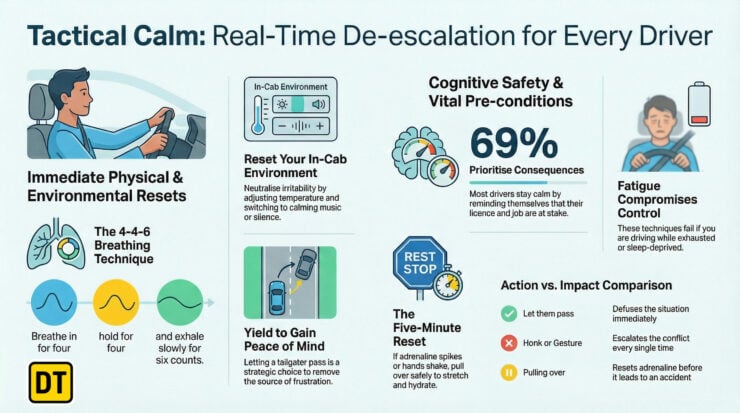
Why professional drivers need to take this seriously
If you drive for a living, you spend more time on the road than most people. A private driver doing ten hours a week and a professional driver doing forty are not exposed to the same volume of potential conflicts. More hours means more encounters with difficult drivers, more congestion, more time pressure. That is simply mathematics.
There are also the consequences specific to your job. A branded vehicle means your employer is visible in every incident. A dashcam means your behaviour may be recorded.
Retaliation while driving a work vehicle does not just risk a fine or a criminal charge. It risks your job, your employer’s reputation, and in the most serious cases, someone’s safety or life.
What to do with this
Understanding road rage starts with understanding the spectrum. Frustration is normal. Aggressive driving is dangerous and costly. Road rage is criminal. Knowing where you are on that spectrum at any given moment is the first step in managing where you end up.
This article is a starting point. The Road Rage Awareness for Professional Drivers course goes deeper: into the psychology of what happens before and during an incident, the specific strategies that work when you are already angry, how to de-escalate a situation that is going sideways, and what your legal rights and obligations are when someone else loses control. It is designed for working drivers, and it is built around practical, real-world situations.
If you drive for a living, this is not optional knowledge. It is professional knowledge. And the best time to develop it is before you need it.
Research references
AAA Foundation for Traffic Safety (2025). Aggressive Driving Research. Washington, DC.
Brewer, N. (1998). Road Rage. Institute of Transport Studies, Monash University.
Easa, S.M. et al. (2025). The Expanding Landscape of Road Rage: A Systematic Review. Ergonomics International Journal, 9(4).
Mizell, L. (1997). Controlling Road Rage: A Literature Review and Pilot Study. AAA Foundation for Traffic Safety.


Darren has written over 3000 articles about driving and vehicles, plus almost 500 vehicle reviews and numerous driving courses. Connect with him on LinkedIn by clicking the name above