
Trucks are often classified in according to the class of licence required to drive them. A class 2 truck can have gross laden weight of 18000kg, a class 4 truck is 18000kg and over without a trailer and a class 5 truck is 18000kg and up with a trailer. This isn’t technically how NZTA classifies them, but many drivers do.
Class 2 trucks often have a similar number of gears as a car – 5 or 6 forward gears and 1 reverse gear. It’s when you get to class 4 (heavy rigid) and class 5 (heavy combination) where the number of gears increases.
The most common configuration you’ve probably heard of is an 18-speed gearbox. This was typically a Roadranger gearbox (you can get Roadranger training here). Roadrangers came with 9, 13, 15 or 18 gears and up to 4 reverse gears. More commonly nowadays, gearboxes are automatic with 8, 12 or 14 forward gears.
Automatic gearboxes are now sophisticated enough to provide excellent fuel economy while intelligently choosing the right gear for the right amount of torque, even based on the driver’s GPS position (e.g. changing down in readiness for a hill).
But why all the gears?
To understand the need for all those gears, we need to look at what the engine has to do and how it revs. A truck engine has a large amount of torque or turning force (measured in Nm), but only over a range of around 400rpm before it drops off rapidly.
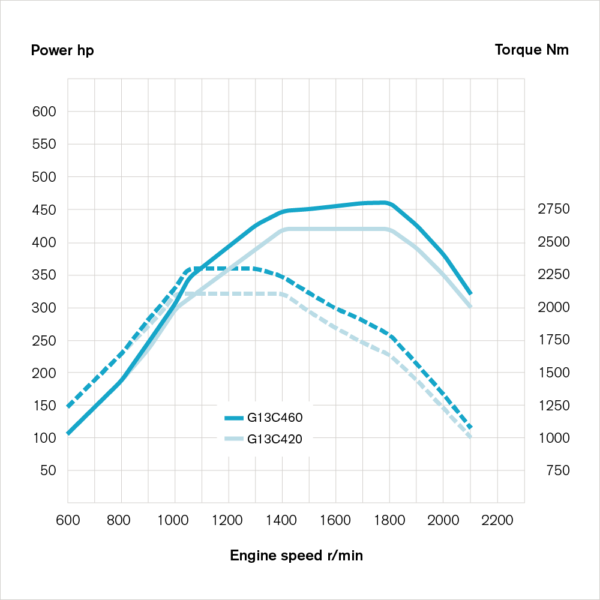
The torque starts at low revs, but the engine is not capable of revving to high revs – a truck engine will rev to around 2500rpm. A car, on the other hand, will rev to around 6500rpm, but the torque (which is typically around 200Nm) builds over a wider rev range. A truck engine might have to move 50,000kg, whereas a car engine has to move 1800kg.
Putting all this together, we need a strong engine that will pull heavy loads, work within the restricted rev range of a diesel engine, but not have diabolical fuel consumption. A truck uses a lot of fuel compared to a car, so maintaining an optimal rev range for the best fuel economy is important. This is why we have a lot of gears. Each time a truck driver in an 18-speed truck changes up a gear, the revs might only drop 200-250rpm, vs a car that will drop over 700rpm.
Therefore, when accelerating while pulling a heavy load, what we are saying is that a truck engine is only able to muster enough torque in a narrow rev range of 300-400 rpm. The driver accelerates, runs out of torque quickly and has to change up, accelerates then runs out of torque quickly again and has to change up, and so on. Because the truck is geared lowly, it doesn’t pick up speed like a car does. At 50km/h, an 18-speed truck will likely be in 7L gear, which equates to the 15th actual gear available to the driver as the sequence is Lo (direct and overdrive), 1 (direct and overdrive), 2 (etc). 7th direct or low gear split is often called ‘town gear’.
The gearing also favours the torque and rev range. Lo direct gear is good enough to get the vehicle moving at less than walking pace. In the lower gears, the truck does not pick up much speed between gears. If’s not until the truck gets to 5th gear (the 10th ratio), that the truck actually begins to pick up any speed. 3rd direct (the 7th ratio) is often used to start off when the truck is unloaded.
So, in the lower gears, the truck does not add much speed before the rev range is exhausted. If the gears were any taller or longer (the term used for when the truck picks up more speed in each gear), the truck wouldn’t have enough torque to get moving under its heaviest loads.
When a truck is carrying a lighter load, the driver won’t use all the gears – they’ll ‘block shift’ or ‘skip shift’, but the option is always there to utilise the best number of gears to cope with the weight of the load.
Why do automatic trucks have fewer than 18 gears?
Most automatic trucks are used for line haul work that doesn’t require the extreme low-range performance that you would get from an 18-speed ‘box with two crawler gears. Those low gears are used when doing heavy haulage. In fact, in logging scenarios, where 18-speed Roadrangers have been common in the past, an automatic gearbox with fewer revs (as few as six) is often used. Computers are proving better than humans at detecting which gear to be in.


Darren has written over 3000 articles about driving and vehicles, plus almost 500 vehicle reviews and numerous driving courses. Connect with him on LinkedIn by clicking the name above
 Disqus