
• A TR Group Site
  • Help
  • Cart
Driving Tests DT logo small
Driving tests
  • Learner licence
    • Car
    • Motorbike
    • Heavy vehicle
    • Learner Licence Plus
  • Courses
  • Tourist
  • Resources
  • Learn
  • Resources
  • Learner licence
    • Car
    • Motorbike
    • Heavy Vehicle
    • Learner Licence Plus
  • Your courses
    • Enrolled courses
  • View all courses
  • Tourist
  • Resources home
  • iOS application
  • Android application
  • Contact us
  • Terms and conditions
  • Privacy
  • Home
  • /
  • Resources
  • /
  • Dangerous goods
  • / Are shipping containers dangerous for trucks to carry?

Are shipping containers dangerous for trucks to carry?

Shipping goods around the world is made easy by the use of shipping containers which have standard sizes and can fit on ships, trains and trucks. It makes it possible for goods to be packed at the manufacturer, sealed for security and delivered to their final destination without ever being devanned (opened and changed to another transport mode). This allows sensitive loads to be transported without risk of tampering or theft.

Because the driver doesn’t know what’s in the container or how it’s been packed, this creates a risk.

How is a container attached to a truck?

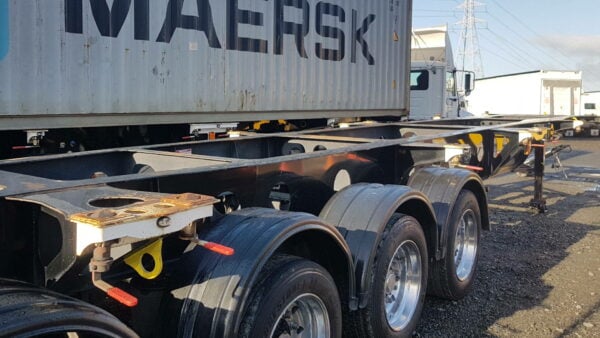
A container has four cast slots, one in each corner. An ISO twistlock on the truck or trailer fits into each one of these locks, and the driver pushes the handle flush with the body to lock it.
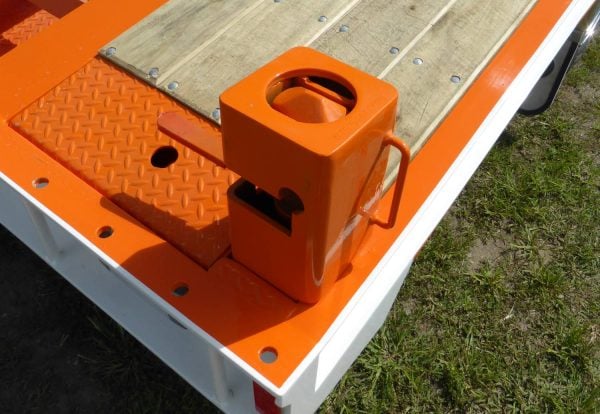
ISO container lock on the rear-most position of a flat deck trailer.
Skeletal trailer with multiple twist lock positions for different configurations and sizes of containers. The red handles are perpendicular to the trailer, meaning they are unlocked.

Loading and the container’s centre of gravity

As ISO container locks are easy to operate and sturdy, the main risk to truck drivers is that they have no idea how the load has been loaded and whether it is still secured within the container. While they can specify which direction the container faces and (if the truck supports it), choose the best position for optimum axle loading, there is no way that the driver can tell where the centre of gravity is on the trailer and whether it will move.

A load with a high centre of gravity or one that can move around makes the truck much more at risk of rolling over while cornering. It’s advisable for drivers to do rollover prevention training so that they understand what techniques are required to reduce the risk.

Drivers also have to rely on the shipping documentation to be accurate in terms of the weight. This is not always the case, so a visit to a weighbridge is the only way to tell, and this costs the driver time and money, and delays delivery of freight.

What should drivers do when carrying containers?

  • Full containers should be treated with caution
  • If the truck or trailer doesn’t have scales (many sideloaders do), a visit to the weighbridge can establish axle loadings.
  • Keep speeds in corners 10km/h below the posted advisory speed limit (the limit shown on the yellow signs)
  • Leave additional distance when following vehicles to avoid having to make sudden manoeuvres.

driver training courses
By Darren Cottingham

Darren has written over 3000 articles about driving and vehicles, plus almost 500 vehicle reviews and numerous driving courses. Connect with him on LinkedIn by clicking the name above


‹ Can you drive everywhere in reverse?
Is it safe to drive with your car’s interior light on? ›
Posted in Dangerous goods
Recent Resources
  • Issuing a permit to work: scope, inspection and isolation
  • Interpreting Manufacturer Load Capacity Specifications
  • PPE, safety equipment and hazardous substances in permitted work
  • How to find your real driving triggers (and why most drivers get it wrong)
  • PPE Requirements for Truck Loader Crane Operators and Ground Crew
  • Atmospheric testing for Permit Issuers as part of the permit to work system
  • The pre-drive routine: why the first few minutes of your driving shift matter most
  • What are outriggers or straddle legs on a forklift or electric pallet jack?
  • Preparing the worksite
  • What is a forklift paper roll clamp, and how does it work?

Licences and Courses

  • Car
  • Motorbike
  • Heavy Vehicles
Car
  • Core
  • Behaviour
  • Parking
  • Emergencies
  • Road position
  • Intersection
  • Theory
  • Signs
Motorbike
  • Bike-specific questions
  • Core
  • Behaviour
  • Parking
  • Emergencies
  • Road position
  • Intersection
  • Theory
  • Signs
Heavy Vehicles
  • Class 2
  • Class 3-5
  • Core
  • Behaviour
  • Parking
  • Emergencies
  • Road position
  • Intersection
  • Theory
  • Signs

Vehicle and workplace training

  • About
  • Resources
DT Driver Training TR Group
About
  • About us
  • Contact us
  • Privacy Policy
  • Terms and Conditions
Resources
  • Homepage
  • Driving Tests Android App
  • Driving Tests iPhone App
  • Getting your learner licence
DT Driver Training TR Group
Copyright 2010-2026 DT Driver Training Ltd, PO Box 12541, Penrose, Auckland, 1642. All rights reserved. Questions and images are used with permission from NZTA; question answers are proprietary.