
• A TR Group Site
  • Help
  • Cart
Driving Tests DT logo small
Driving tests
  • Learner licence
    • Car
    • Motorbike
    • Heavy vehicle
    • Learner Licence Plus
  • Courses
  • Tourist
  • Resources
  • Learn
  • Resources
  • Learner licence
    • Car
    • Motorbike
    • Heavy Vehicle
    • Learner Licence Plus
  • Your courses
    • Enrolled courses
  • View all courses
  • Tourist
  • Resources home
  • iOS application
  • Android application
  • Contact us
  • Terms and conditions
  • Privacy
  • Home
  • /
  • Resources
  • /
  • Excavators, Loaders and Construction Equipment
  • / Pedestrian safety on construction sites with excavators and loaders: alert and exclusion zones

Pedestrian safety on construction sites with excavators and loaders: alert and exclusion zones

Excavators and loaders are large machines with blind spots that make it dangerous for pedestrians when they are working in the same area. Loaders and wheeled excavators are capable of moving quickly, so it’s important that everyone on the worksite understands where the potential points of impact are.

Pedestrians approaching machinery

Three zones should be considered when pedestrians and machinery are working on-site.

Safe zone

Pedestrians and machinery are sufficiently far away from one another that there is no danger. Pedestrians are unlikely to come into contact with moving plant, and there could be separation such as barriers.

Alert zone

Pedestrians and machinery are working in the same area. Care is required. Use the horn, shout out, hand gestures, eye contact, radios, etc.
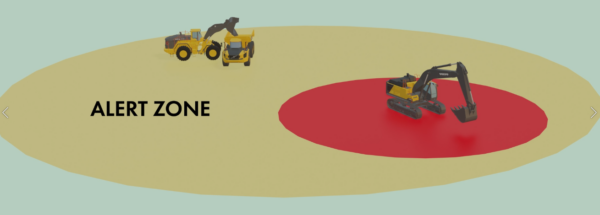
Exclusion zone

If a pedestrian enters this zone, the machine operator much stop the machine.

The exclusion zone is where the pedestrian is close enough that they could be hit by the counterweight or bucket as the excavator is slewing, could be run over if the excavator or loader moves, or could be injured by falling materials.
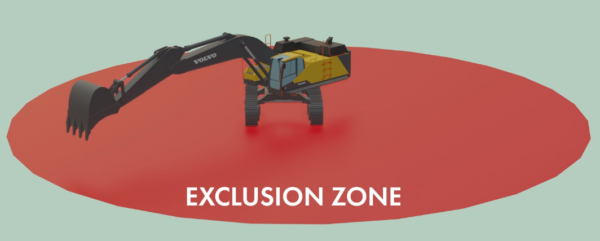
The size of the exclusion zone depends on the size and reach of the machine, and what the machine is working on. The exclusion zone might not be a circle, as shown, because it could extend to hazards the machines are working with, such as conveyer belts. Each machine on the site has its own exclusion and alert zones, and they will intersect from time-to-time.

Additional information is available in our excavator operator’s certificate course.

Getting workers to the site

Use a designated car parking area for workers’ vehicles and cone off a walkway so that people are not simply randomly making their way to the site, and vehicles know that it is a dedicated walkway. These paths should avoid alert and exclusion zones.

Ensure good visibility and lighting

Tight corners and areas where operators need to reverse are scenarios where blind spots are created. Prevent pedestrians from entering these areas. Use convex mirrors to help operators see around their vehicle.

Ensure crossing points are clearly visible with no obstructions. Anywhere a pedestrian may come near to equipment operating, lighting should be good.

By Darren Cottingham

Darren has written over 3000 articles about driving and vehicles, plus almost 500 vehicle reviews and numerous driving courses. Connect with him on LinkedIn by clicking the name above


‹ Can you use your private car, ute or van for work?
How do power dividers work on a truck? ›
Posted in Excavators, Loaders and Construction Equipment
Recent Resources
  • Creating permits for working at height
  • Using SAMPLE to gather patient information for a first aid assessment
  • The recovery position: when and how to use it
  • Isolation and lockout/tagout explained
  • How to check responsiveness using the AVPU scale in first aid
  • Scene safety and the DRSABCD action plan
  • Auditing permits for high-risk work
  • What actually happens when you call 111 about a road rage incident
  • First aid kits and workplace readiness
  • Managing concurrent and conflicting works

Licences and Courses

  • Car
  • Motorbike
  • Heavy Vehicles
Car
  • Core
  • Behaviour
  • Parking
  • Emergencies
  • Road position
  • Intersection
  • Theory
  • Signs
Motorbike
  • Bike-specific questions
  • Core
  • Behaviour
  • Parking
  • Emergencies
  • Road position
  • Intersection
  • Theory
  • Signs
Heavy Vehicles
  • Class 2
  • Class 3-5
  • Core
  • Behaviour
  • Parking
  • Emergencies
  • Road position
  • Intersection
  • Theory
  • Signs

Vehicle and workplace training

  • About
  • Resources
DT Driver Training TR Group
About
  • About us
  • Contact us
  • Privacy Policy
  • Terms and Conditions
Resources
  • Homepage
  • Driving Tests Android App
  • Driving Tests iPhone App
  • Getting your learner licence
DT Driver Training TR Group
Copyright 2010-2026 DT Driver Training Ltd, PO Box 12541, Penrose, Auckland, 1642. All rights reserved. Questions and images are used with permission from NZTA; question answers are proprietary.