For businesses involved in manufacturing, construction, warehousing, and logistics, gantry cranes are essential equipment for lifting and moving heavy loads. The decision to purchase, lease or rent gantry cranes represents a significant strategic choice with substantial financial implications.
When purchasing, there are two options: buy it outright or finance it.
Renting would tend to imply a short-term tenure – perhaps days to weeks.
Leasing would imply a longer-term investment. It might even be a lease-to-buy scenario.
Initial Capital Investment

For the company’s financial controller, the decision to finance, rent, lease or purchase a gantry crane hinges on capital allocation and long-term financial efficiency.
Purchasing a crane requires a significant up-front capital expense, which can be justified when the asset will be used consistently over many years and depreciation can be leveraged. It may be considered an asset to the building if the tenant is also the landlord, as it can be sold with the building. Ownership gives the company the ability to modify the crane, integrate it deeply into operations, and avoid long-term financing costs. However, a purchase draws down capital that might otherwise be deployed into higher-return projects or growth initiatives.
Financing it will preserve cash on the balance sheet, and the interest is tax-deductible.
Leasing also preserves cash flow and keeps debt off the balance sheet depending on the lease structure. Operating leases can allow expenses to be treated as OPEX rather than CAPEX, smoothing budget impacts and maintaining financial flexibility. For companies with variable or project-based workloads, leasing provides scalability: cranes can be upsized, downsized, or returned as operational needs change. This reduces the financial risk of owning an asset that may be underutilised during slower periods.
Renting is suitable for shorter-term projects, and only really viable for smaller gantry cranes that don’t need to be installed into the structure of the building.
Operational Costs and Maintenance
Regardless of whether the crane is leased or purchased, maintenance and compliance obligations will play a role in the calculations. If the lease agreement is with the crane supplier, these might be bundled in. If the crane is purchased, they will need to be negotiated separately (beyond any normal warranties).
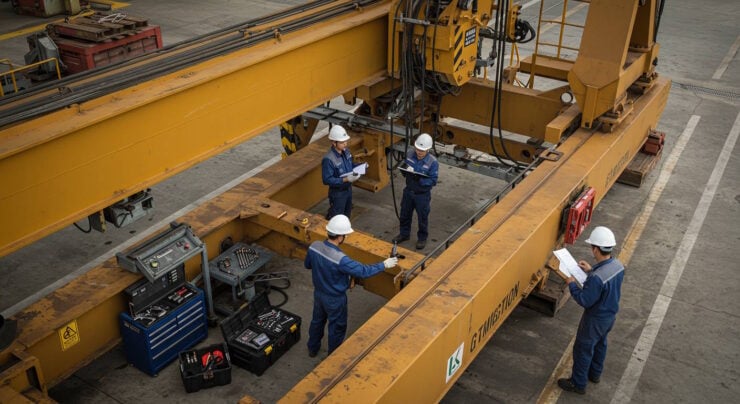
Maintenance costs encompass labour, replacement parts, lubricants, and other consumables. Additionally, owners must budget for unexpected repairs, which can be substantial if major components fail. The Approved Code of Practice for Cranes requires controllers (owners or lessees) to maintain comprehensive records of all inspections, maintenance, and repairs.
With leasing arrangements, maintenance responsibilities may fall to the leasing company, depending on the agreement. This transfers the risk of unexpected repair costs to the supplier and ensures that specialised maintenance expertise is available when needed. However, rates incorporate these maintenance costs, potentially making long-term leasing more expensive than ownership if the crane is well-maintained or infrequently used.
For rental unit, ‘wear and tear’ type maintenance should be covered in the rental price.
Utilisation Rate and Return on Investment
The main factor in the ownership versus lease/finance/rent decision is how frequently the gantry crane will be used. For facilities with continuous or near-continuous lifting requirements, ownership often provides a better return on investment (ROI). The break-even point (where the cost of ownership equals the cumulative cost of renting) varies depending on the specific crane.
Depreciation and asset management

From an accounting perspective, purchased gantry cranes are capital assets that depreciate over time. In New Zealand, depreciation can be claimed as a tax deduction, reducing the taxable income of the business. The Inland Revenue Department provides guidelines on depreciation rates for different categories of assets, including various types of cranes.
While this depreciation offers tax advantages, the asset’s value decreases over time due to wear and technological obsolescence. Modern gantry cranes incorporate advanced safety features and operational capabilities that may not be present in older models.
The Approved Code of Practice for Cranes outlines requirements for controllers, including obtaining certificates of inspection, maintaining documentation, and ensuring operator competency.
Crane owners must budget for periodic inspections and certification costs. Equipment inspectors must be employed or engaged by an inspection body accredited by International Accreditation New Zealand (IANZ). The costs associated with these mandatory inspections continue throughout the crane’s operational life.
Check who is responsible for this if you are leasing the crane.
Flexibility and Scalability
Business needs evolve over time. However, a large gantry crane is not like a piece of mobile plant which can be easily returned and replaced. Any changes will be a significant project, so whether it’s leased or purchased does not have much impact.
Selling used cranes can be challenging, often resulting in significant value loss compared to the purchase price, especially for specialised equipment.
Transportation and Installation Costs
For non-permanent installations or projects at multiple sites, transportation and installation costs become significant. Moving a large gantry crane between locations involves disassembly, transport, and reassembly, often requiring specialised equipment and expertise.
Rental companies frequently include these services in their packages, distributing the costs across multiple clients. For businesses that own their cranes, each relocation represents an additional expense that must be factored into the total cost of ownership.
Training and Operator Certification
New Zealand regulations require gantry crane operators to have appropriate training.
Businesses that own cranes need to invest in training their staff to meet these requirements. In contrast, some rental arrangements include certified operators, particularly for complex or specialised cranes, reducing the training burden on the hiring business.
Conclusion
The decision to obtain a gantry crane depends on a careful analysis of numerous economic factors. Businesses with consistent, long-term lifting needs generally benefit from ownership, particularly when they have the capital, maintenance capabilities, and operational expertise to manage the equipment effectively.
Conversely, companies with intermittent lifting requirements, those undertaking short-term projects, or those seeking to preserve capital and maintain financial flexibility may find other arrangements more economical. The rental option eliminates concerns about maintenance, certification, obsolescence, and disposal.
Each business must conduct a thorough cost-benefit analysis based on their specific operational requirements, financial situation, and strategic objectives. This analysis should consider not only direct costs but also the value of flexibility, risk mitigation, and resource allocation in determining the most economically advantageous approach to gantry crane acquisition.


Darren has written over 3000 articles about driving and vehicles, plus almost 500 vehicle reviews and numerous driving courses. Connect with him on LinkedIn by clicking the name above