
Severe bleeding is one of the fastest-killing workplace injuries. An adult has roughly five litres of blood; losing about 40 percent (around two litres) causes irreversible shock without rapid medical intervention. From a major artery laceration, that loss can happen in minutes. The first aider’s job is to stop or slow the bleed using direct pressure, get an ambulance on the way, and manage the patient for shock until paramedics take over.
Severe bleeding is the same priority as airway and breathing. The C in DRSABCD can stand for Circulation when life-threatening haemorrhage is the bigger problem than breathing – you can learn about this in our first aid refresher course. In a catastrophic bleed, controlling the bleed comes first.
The three types of bleeding
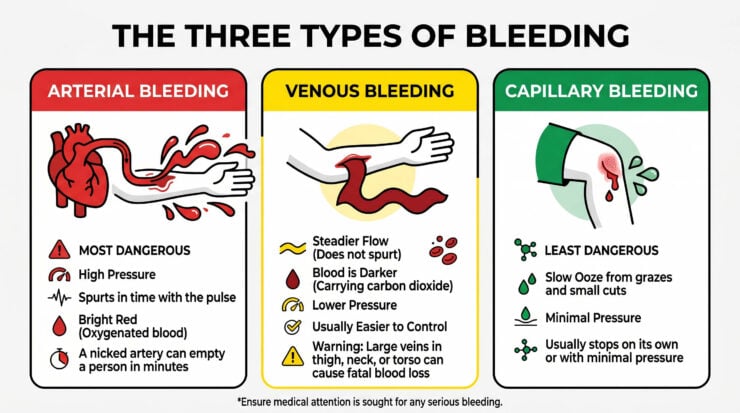
Arterial bleeding is the most dangerous. Arteries carry blood under high pressure straight from the heart, so arterial blood spurts in time with the pulse and is bright red because it’s oxygenated. A nicked artery can empty a person in minutes.
Venous bleeding flows steadily rather than spurting. The blood is darker because it’s carrying carbon dioxide back to the heart. It’s usually easier to control, but large veins in the thigh, neck, or torso can still cause fatal blood loss.
Capillary bleeding is the slow ooze from grazes and small cuts. It’s the least dangerous and usually stops on its own or with minimal pressure.
Direct pressure: the technique that works
For any significant bleeding, direct pressure is the primary tool. Glove up if you can, but don’t delay treatment looking for gloves. If the patient can apply pressure to their own wound while you get sorted, that’s safer for both of you.
Press firmly on the wound with your hand, a pad, or any clean material to hand. The goal is to compress the bleeding vessel against the underlying bone or muscle and let clotting do its work. Lock your elbows. Use straight arms and put your body weight behind the pressure. Research shows that bent-arm pressure rarely reaches the levels needed to stop a serious bleed; straight-arm pressure does.
Hold the pressure for at least 10 minutes before checking. Every time you lift the dressing to look, you disturb the forming clot and the bleeding restarts. If blood soaks through, add another pad on top and press harder. Don’t remove the first dressing. The exception is when bleeding continues despite sustained pressure, which may mean you’ve missed the exact bleeding point; remove the dressing then, find the source, and apply targeted pressure right on it.
Position and reassurance
Get the patient lying down, especially if the wound is on a lower limb or if bleeding is severe. Lying down reduces blood pressure at the wound site and helps maintain blood flow to the brain (this slows the onset of shock). Keep them still. Movement increases blood flow and makes bleeding harder to control. Talk to them. Reassurance reduces stress, and stress drives up heart rate and blood pressure.
What about elevation?
If you were trained years ago, you may have been told to elevate a bleeding limb. Current guidance has dropped that recommendation. There’s no clear evidence that elevation helps control bleeding, and it can cause more pain or worsen the injury (a fractured arm doesn’t want to be lifted). Focus on direct pressure. Leave the limb where it is, unless moving it is part of getting the patient into a safer position.
When direct pressure isn’t enough: haemostatic dressings and tourniquets
If sustained direct pressure isn’t controlling severe bleeding from a limb, the next step is a haemostatic dressing or a tourniquet. The risk of an uncontrolled severe bleed is greater than the risk of these interventions. Use them if you have them and you’re trained to.
Haemostatic dressings (Celox, QuikClot, Combat Gauze) contain agents that promote rapid clotting. Pack them firmly into the wound itself, then apply direct pressure on top. They’re effective for wounds in the neck, armpit, or groin where a tourniquet can’t be applied (“junctional” bleeds).
Tourniquets are bands wrapped tightly around an arm or leg above the wound to stop blood flow completely. Commercial tourniquets like the CAT (Combat Application Tourniquet) are far more effective than improvised ones. Apply 5 to 10cm above the wound, on a single bone segment (above the elbow or above the knee), avoiding the joint itself. Tighten until the bleeding stops. Note the time of application clearly on the tourniquet itself or on the patient’s forehead. Tell the paramedics when they arrive. Do not loosen or remove a tourniquet once applied; that’s a hospital decision.
Never apply a tourniquet to the neck or torso. Tourniquets work because they cut circulation off entirely; you can’t do that to a structure containing the airway or vital organs.
Embedded objects
If something is stuck in the wound (a piece of metal swarf, broken glass, a fragment from a snapped grinding wheel), do not remove it. The object may be plugging the wound and limiting blood loss. Removing it can cause catastrophic bleeding. Use indirect pressure: pad around the object, above and below it, and apply pressure to the pads rather than the object itself. Stabilise the object so it doesn’t move during transport.
Monitor for shock
Significant blood loss leads to shock. Watch for pale or grey skin, cold and clammy skin, rapid breathing, rapid weak pulse, confusion or anxiety, dropping level of consciousness. Cover the patient with a blanket or jacket to keep them warm; cold accelerates shock. Don’t give them anything to eat or drink; they may need surgery. If they become unresponsive and stop breathing normally, start CPR. Massive blood loss can cause cardiac arrest.
A workplace scenario
A workshop fabricator slips while moving a sheet of mild steel. The edge catches his forearm and opens a deep laceration just below the elbow. Blood is spurting in time with his pulse. A colleague reaches him within 20 seconds.
The colleague pulls on gloves from the workshop kit, grabs a sterile dressing, and presses it hard against the wound with the heel of his hand, straight arm, his body weight on it. He gets the fabricator sitting down with his back against the workbench. He tells another worker to call 111 with the address and gate number. He keeps the pressure on. Blood soaks through the first dressing within a minute. He adds a second on top, presses harder. He keeps talking to the fabricator, who’s gone pale and is feeling faint.
Five minutes in, the bleeding is slowing. He doesn’t lift the dressing to check. He waits. The ambulance arrives at the seven-minute mark. The paramedics take over with the dressing still in place, and the fabricator gets to hospital with controlled bleeding and a colleague’s straight-armed pressure to thank for it.
That outcome doesn’t require advanced equipment. It requires gloves, a dressing, body weight, and someone who didn’t let go.


Darren has written over 3000 articles about driving and vehicles, plus almost 500 vehicle reviews and numerous driving courses. Connect with him on LinkedIn by clicking the name above