When people think about injuries related to crane operations, they usually picture dramatic events: dropped loads, collisions, or crushing incidents.
What’s far less visible, but far more common, is musculoskeletal strain, particularly neck strain, among crane operators who work from the ground and spend long periods looking up at suspended loads.
This type of injury develops slowly, is often underreported, and can quietly undermine both operator wellbeing and operational safety.
Why Ground-Based Crane Operators Are Especially Vulnerable
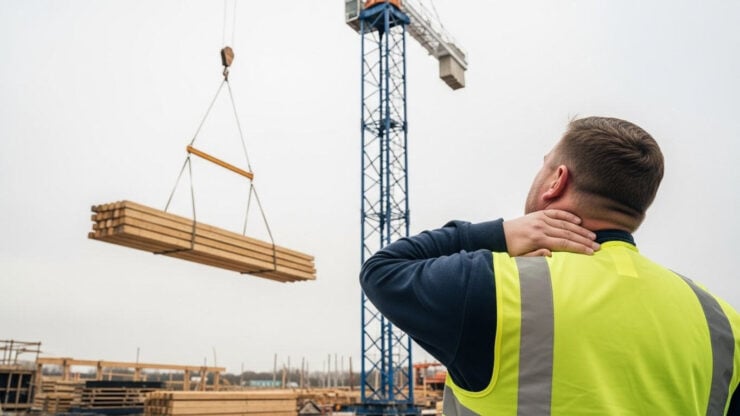
Unlike cab-operated cranes, gantry cranes, truck loader cranes and mobile cranes are controlled from the ground using pendant or remote controls, or a ground-based cab. This often requires the operator to:
- Maintain prolonged upward gaze
- Track a moving load overhead
- Walk while keeping eyes on the hook and load
- Hold the neck in extended or rotated positions
- Remain visually focused for extended periods without relief
It can even affect other team members who may need to look up at loads being lifted by a crane (e.g. dogmen, riggers, spotters, etc).
From a biomechanics perspective, the human neck is not designed for sustained extension. Even relatively small angles, when held for long durations, significantly increase muscular load on the cervical spine.
Research in occupational ergonomics consistently shows that static postures, especially involving neck extension, are strongly associated with neck and shoulder disorders.
The Cumulative Nature of Neck Strain
Neck strain rarely appears suddenly. Instead, it builds up through repeated exposure:
- A long lift where the operator tracks the load continuously
- Repetitive daily tasks with similar viewing angles
- Poor worksite layout that forces awkward positions
- Lack of task rotation or micro-breaks
Because the onset is gradual, operators often normalise the discomfort:
“It’s just part of the job.”
Unfortunately, ignoring early symptoms can lead to chronic conditions such as:
- Cervical muscle strain
- Tension headaches
- Shoulder impingement
- Reduced range of motion
- Ongoing fatigue and discomfort
Once pain becomes persistent, it can affect concentration, reaction time, and judgement – all critical factors in crane safety.
You can learn to recognise what’s happening with your body in terms of awkward positions or repetitive movements by doing manual handling training.
Safety Implications Beyond Physical Discomfort
Musculoskeletal strain is not just a health issue; it’s a safety issue.
Pain and fatigue can lead to:
- Reduced situational awareness
- Slower responses to load movement or hazards
- Increased distraction
- Poorer decision-making under pressure
Studies in occupational health show that physical discomfort significantly increases the likelihood of errors in safety-critical tasks, particularly those requiring sustained attention.
In crane operations, even small lapses can have serious consequences.
Practical Risk Factors in Crane Environments
Several common workplace conditions can worsen neck strain risk:
- Poor lighting, forcing operators to tilt their heads to maintain visibility
- Congested work areas where operators must constantly reposition
- Long lifts without natural pauses
- Lack of spotters, meaning one person monitors everything
- Production pressure discouraging breaks or task rotation
These are system issues, not individual failings.
Practical Strategies to Reduce Neck Strain
The good news is that neck strain risk can be significantly reduced with simple, practical changes.
1. Improve Viewing Angles
Operators should position themselves to minimise extreme neck extension wherever possible. This may involve stepping back, repositioning the load path, or adjusting stance rather than locking into one position.
2. Use Spotters Effectively
Using a spotter allows the operator to share the visual load. This reduces continuous upward gaze and improves overall situational awareness.
3. Take Micro-Breaks
Short breaks (even 20–30 seconds) during long or complex lifts allow muscles to relax and reset. These are especially important during repetitive tasks.
4. Rotate Tasks
Where possible, rotate crane operation duties with other tasks to reduce cumulative strain on one individual.
5. Use Remote Controls Strategically
Wireless remote controls can allow operators to position themselves where visibility is best, rather than standing directly under the load.
6. Encourage Early Reporting
Neck stiffness, headaches, or reduced movement should be treated as early warning signs, not complaints. Early reporting allows adjustments before injury becomes chronic.
7. Do manual handling training
This develops greater awareness of your body. Check in our wellbeing courses section.
The Role of Supervisors and Management
Supervisors play a critical role in preventing strain injuries.
This includes:
- Acknowledging that musculoskeletal strain is a legitimate risk
- Planning lifts to avoid unnecessary prolonged viewing
- Encouraging breaks without stigma
- Supporting operators who raise discomfort concerns
- Including ergonomic risks in hazard assessments
Health and safety legislation in many jurisdictions explicitly recognises musculoskeletal strain as a workplace hazard that must be managed, not accepted.
What Should You Do?
At your next toolbox talk, ask:
“Do you regularly finish crane work with a stiff neck, sore shoulders, or headaches?”
If the answer is yes, that’s not bad luck; it’s a signal that something in the system needs adjusting.
Neck strain among crane operators is common, preventable, and often overlooked.
By recognising it as a genuine safety risk, not just discomfort, organisations can:
- Improve operator wellbeing
- Reduce fatigue-related errors
- Improve long-term productivity
- Strengthen overall safety culture
Safe crane operation isn’t only about the load; it’s also about the human body controlling it.


Darren has written over 3000 articles about driving and vehicles, plus almost 500 vehicle reviews and numerous driving courses. Connect with him on LinkedIn by clicking the name above