• A TR Group Site
  • Help
  • Cart
Driving Tests DT logo small
Driving tests
  • Learner licence
    • Car
    • Motorbike
    • Heavy vehicle
    • Learner Licence Plus
  • Courses
  • Tourist
  • Resources
  • Learn
  • Resources
  • Learner licence
    • Car
    • Motorbike
    • Heavy Vehicle
    • Learner Licence Plus
  • Your courses
    • Enrolled courses
  • View all courses
  • Tourist
  • Resources home
  • iOS application
  • Android application
  • Contact us
  • Terms and conditions
  • Privacy
  • Home
  • /
  • Resources
  • /
  • Heavy Vehicle
  • / What is a reefer truck or trailer?

What is a reefer truck or trailer?

To be able to transport temperature-sensitive products, trucks and trailers must be able to keep a consistent temperature regardless of the outside weather and windchill. In hot weather, a unit must be able to cool, while in very cold weather a unit might need to heat the consignment.

A reefer is a truck or trailer which has a refrigeration unit and a thermostat.

Also called chiller trucks, they can be small class 1 trucks right up to the largest combination vehicles. Reefers come in two types of body: box body (or hardside) and curtainsider. Box body reefers have more natural insulation. Curtainsiders run insulated curtains, which are harder to slide backwards and forwards, but make up for the loss of thermal mass. Curtainside reefers, as standard benefit from being able to be loaded and unloaded from both sides along the length of the deck, as well as from the rear. However, custom bodies can be ordered, like this one from T&G.
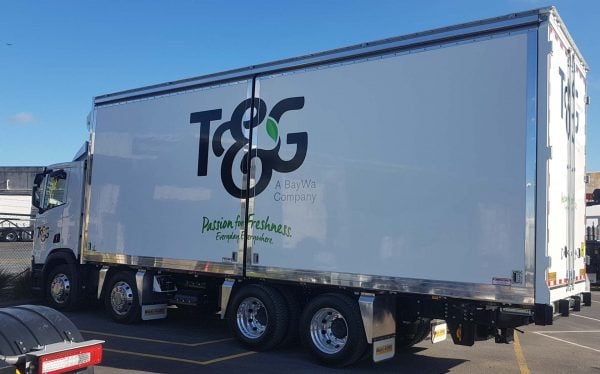
Custom doors on either side of this class 4 truck give full access to the deck
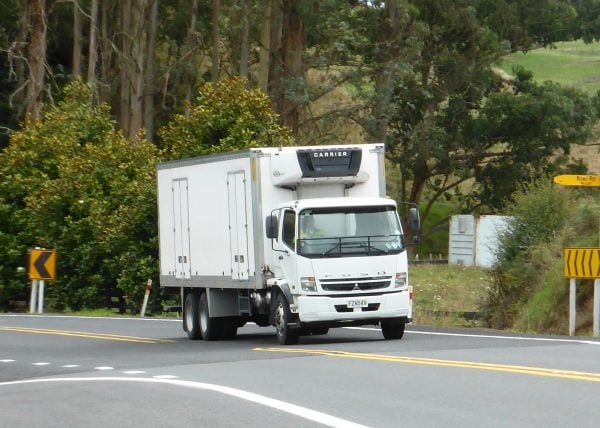
This class 4 rigid truck has the chiller unit above the cab. It’s usual for box body trucks and trailers to have a rear door and at least one set of side doors to make it easy to deliver partial loads, but they’re not as convenient as curtainsiders unless the doors are full length
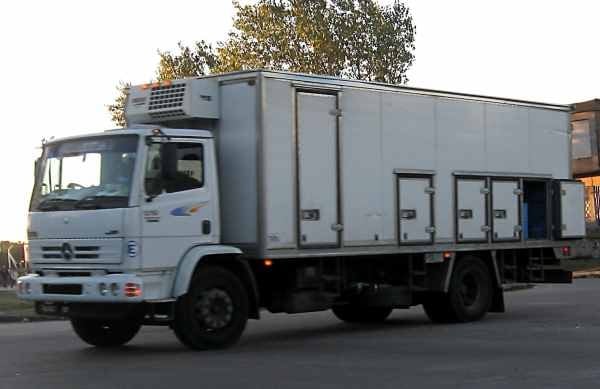
This rigid chiller truck has smaller doors for its load compartments; multiple compartments may be kept at different temperatures

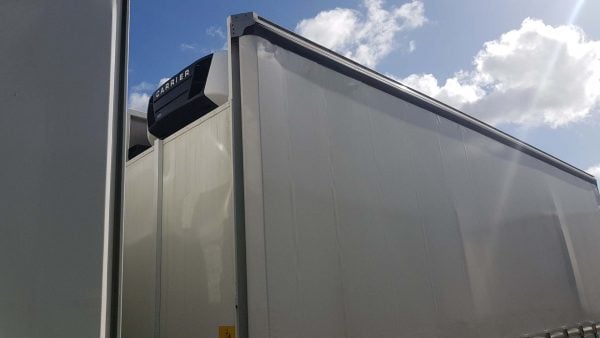
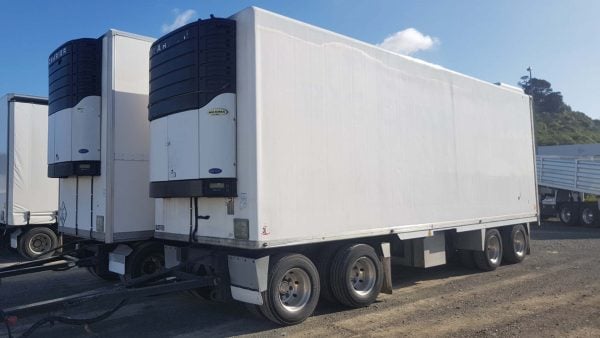
The refrigeration unit sits at the front of the semitrailer or full trailer, or above the cab in a truck. To connect the trailer to the truck or tractor unit, the driver must understand how to couple a truck and trailer or semitrailer.
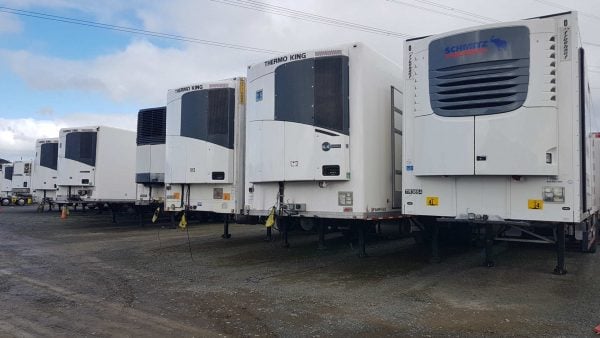
Reefer semitrailers
Refrigerated pull trailers
On the rear b-train trailer, the chiller unit can be at the top front of the trailer, but sometimes it’s underneath

Reefers have a control panel to set the temperature and monitor the load. The driver sets the thermostat well before they reach their pickup point so that the chiller has time to adjust the load space to the correct temperature.
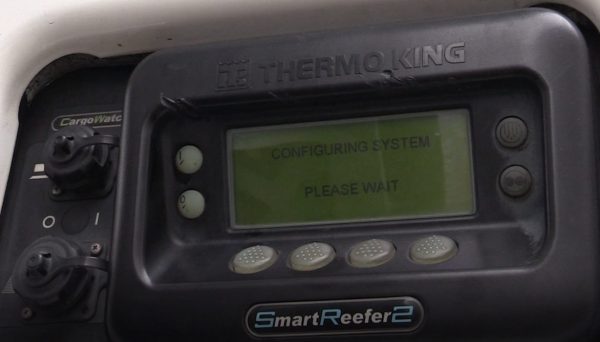
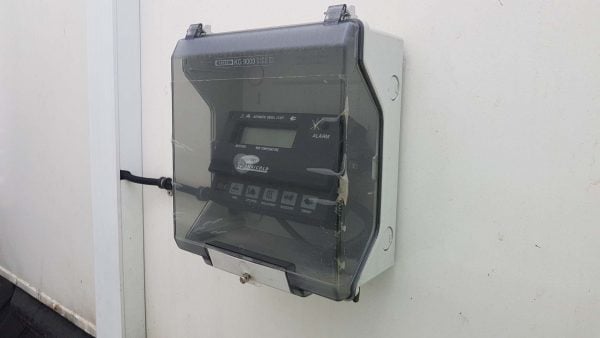
Reefer control units allow the driver to set the temperature and type of chiller cycle
This is the reefer controller for a b-train (the rear trailer)

The driver will wait until the last minute to open the doors or curtains, so as to maintain the temperature inside. The vast majority of chilled trucks and trailers are white because they reflect the most heat, meaning the chiller doesn’t have to work so hard.

Fuel for the chiller unit is contained in a tank underneath the trailer. These typically allow up to a few days of continuous operation, depending on the difference between the outside and inside temperature.
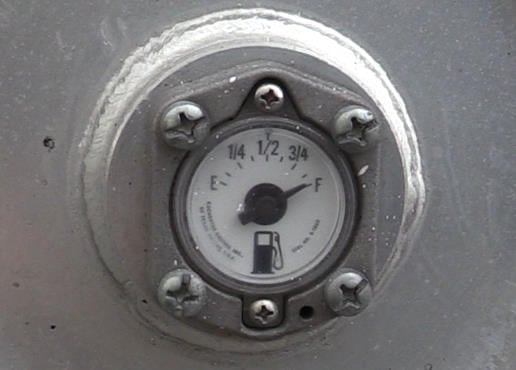
The fuel gauge should always show more than 3/4 full when you pick up a load; some companies won’t let you take a load unless you have a certain amount of fuel for the chiller

Within the trailer, the floor has channels to allow air to circulate. The cool air is introduced from the front, near the chiller unit – you can see the vents at the top of the bulkhead, below.
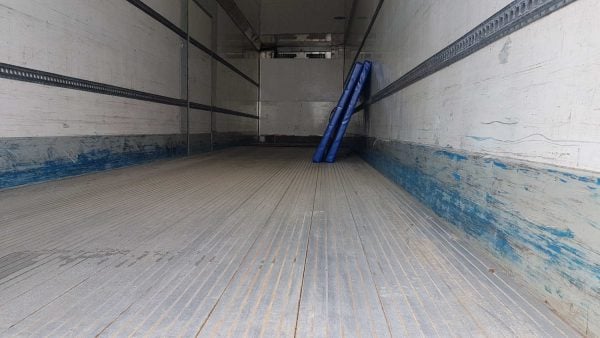
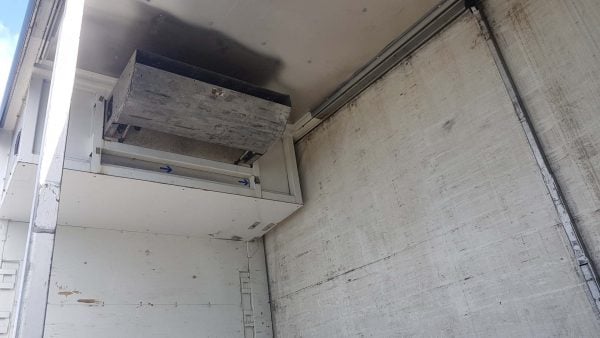
Metal rails down the side are for clipping load security devices
Chiller outlet at the front of a chilled curtainside trailer. The curtains are dual-layer and are more spongy and difficult to draw back than a standard curtainsider. The metal rails in the curtainsider are for supporting the roof and curtains

Dual temperature reefers are available, as are double-stacking reefers that have a mezzanine floor so that produce that can’t be stacked too high can be transported more efficiently.
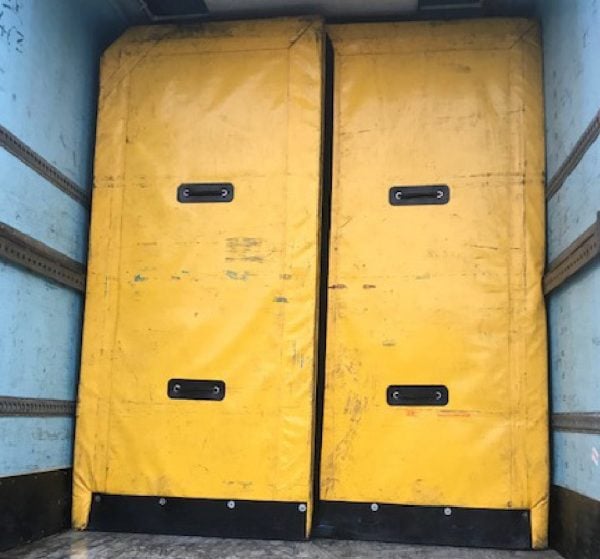
Chilly bungs are used for partial loads so that the reefer doesn’t have to cool the whole trailer, or when it’s possible to have dual temperature zones.

As refrigerated loads are often delicate or fragile, it pays to have good quality air suspension. The trailer should be cleaned out between loads so that it doesn’t smell or go mouldy.

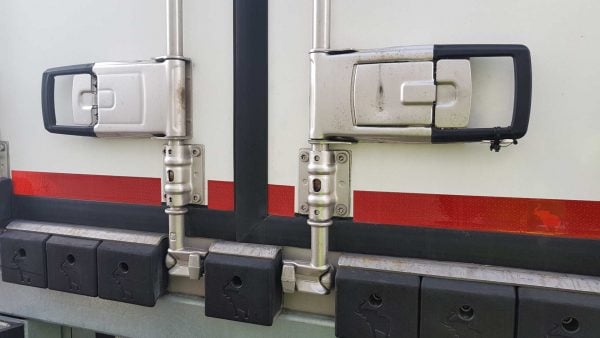
Chilled trucks have rubber seals on the doors to keep the cool air in and the warm air out.
There are refrigerated containers, too. These sit on skeletal or flatbed trailers.

To find out how to load reefers correctly, this online load restraint course has a dedicated module for refrigerated trucks and trailers.

driver training courses
By Darren Cottingham

Darren has written over 3000 articles about driving and vehicles, plus almost 500 vehicle reviews and numerous driving courses. Connect with him on LinkedIn by clicking the name above

‹ How should you signal when you merge?
How to conquer your fear of driving ›
Tagged with: trailer, vehicle type | Posted in Heavy Vehicle
  • DisqusDisqus
Recent Resources
  • Monitoring and closing the permit
  • Protecting yourself from infection when giving first aid at work
  • Why we judge other drivers more harshly than ourselves
  • Issuing a permit to work: conditions, communication and cancellation
  • Dashcam footage and the Privacy Act 2020: what your employer must do, and what you can ask for
  • Issuing a permit to work: scope, inspection and isolation
  • Interpreting Manufacturer Load Capacity Specifications
  • PPE, safety equipment and hazardous substances in permitted work
  • How to find your real driving triggers (and why most drivers get it wrong)
  • PPE Requirements for Truck Loader Crane Operators and Ground Crew

Licences and Courses

  • Car
  • Motorbike
  • Heavy Vehicles
Car
  • Core
  • Behaviour
  • Parking
  • Emergencies
  • Road position
  • Intersection
  • Theory
  • Signs
Motorbike
  • Bike-specific questions
  • Core
  • Behaviour
  • Parking
  • Emergencies
  • Road position
  • Intersection
  • Theory
  • Signs
Heavy Vehicles
  • Class 2
  • Class 3-5
  • Core
  • Behaviour
  • Parking
  • Emergencies
  • Road position
  • Intersection
  • Theory
  • Signs

Vehicle and workplace training

  • About
  • Resources
DT Driver Training TR Group
About
  • About us
  • Contact us
  • Privacy Policy
  • Terms and Conditions
Resources
  • Homepage
  • Driving Tests Android App
  • Driving Tests iPhone App
  • Getting your learner licence
DT Driver Training TR Group
Copyright 2010-2026 DT Driver Training Ltd, PO Box 12541, Penrose, Auckland, 1642. All rights reserved. Questions and images are used with permission from NZTA; question answers are proprietary.