
If you compare a 1950s car to a 2020s car when sitting inside while driving at night, you’ll notice just how dark the 1950s car is. Modern vehicles have screens and dials which are illuminated, plus they have a plethora of interior lights – usually one or two in the middle of the roof, a couple at the front, one that comes on when the passenger opens the mirror on the sun visor, a couple in the footwells, one in the glovebox and perhaps even spotlights for rear seat passengers to read with.
You’ll know how difficult it is to see in the dark if you’ve been looking at a bright light. Are all these lights in our vehicles making it more difficult to see while driving at night, or is it OK for a passenger to turn on a light to rummage through a bag or find a dropped lolly?
Any light source within the vehicle makes it more difficult for you to see outside. You can do this experiment at home at night: open your curtains with a light on and see how much you can see out of the window. Now turn the light off and try again.
The same applies when you are driving, and this effect is much more noticeable on country roads where there’s no outside ambient light to help you. In the city, there’s enough light created by street lights and other light sources that you can usually see to drive around without your headlights on (not that that’s advisable).
When your eyes see a light, the pupils constrict. When that light source has passed, the pupils take some time to dilate again so that you can return to your optimum night-time viewing ability. This happens when you approach a vehicle that blinds you with its full beam headlights, but also if you turn the light on in the car, or if you have screens and dials set too brightly.
Many vehicles will automatically adjust displays for night-time viewing; even Google Maps changes to dark mode at night.
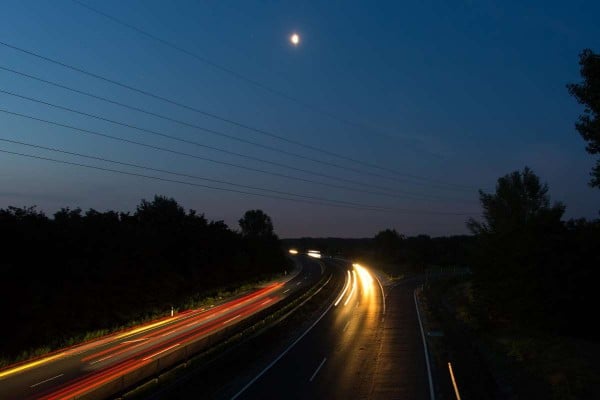
Why does this happen? Your eyes accumulate rhodopsin which is sensitive to low levels of light; it helps you see in the dark. But, it burns out quickly in response to bright light and then your eyes need to build it up again. This can take up to 30 minutes.
The amount of light your headlights produce is only good enough to see in colour for a few metres in front of the car; the rest is in shades of grey.
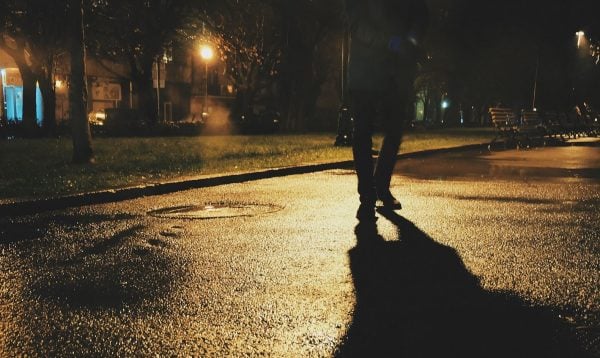
Your eyes have to do a lot of work searching in the shadows for potential danger in this environment, leading to tired eyes when driving at night. In fact, tired eyes are a cause of fatigue, and drivers need to understand how to monitor and deal with fatigue.
Anything you can do to help preserve the rhodopsin levels in your eyes by minimising the lights in your car will mean that you’ll see better and your eyes won’t get tired as quickly. While it might be OK for a rear seat passenger to use a specific spotlight to read (even though it will reduce your vision through the rear view mirror), it’s not ideal to have lights on in the front of the car.


Darren has written over 3000 articles about driving and vehicles, plus almost 500 vehicle reviews and numerous driving courses. Connect with him on LinkedIn by clicking the name above
 Disqus