Cars have had rear view mirrors made of glass since at least the 1920s, so after 100 years, it looks natural for a car to have these reflective appendages sticking out the side. However, given that camera and screen technology is now cheap and high quality, is it better to finally ditch the glass and instead take advantage of technology?
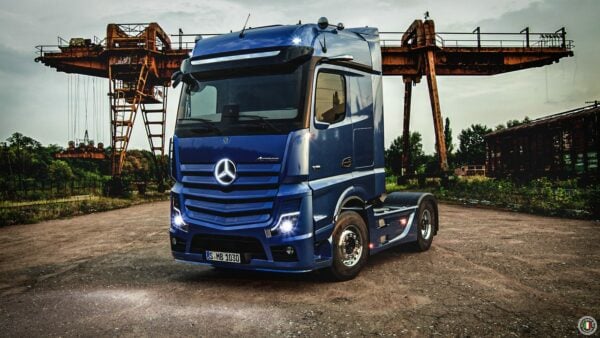
How do camera wing mirrors work?
A conventional wing mirror is as big as the glass needs to be to give an effective view down the side of the vehicle. In fact, we’re so used to them, that the bigger the vehicle, the bigger the wing mirror so that they retain some element of proportion.
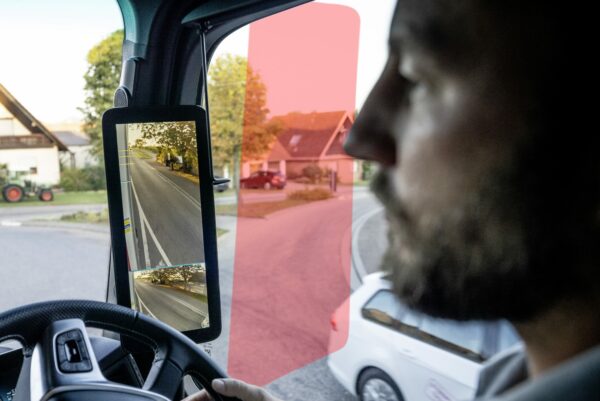
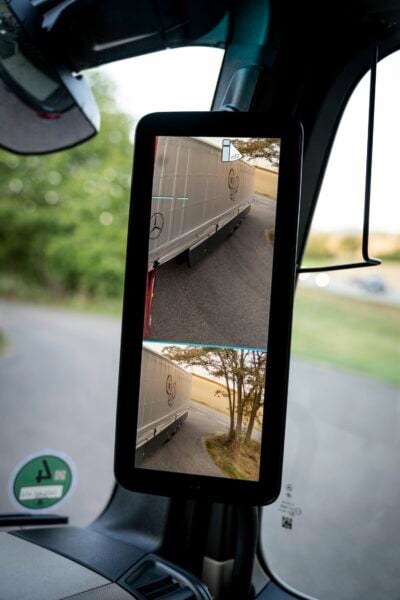
But with a camera, it can be mounted in a streamlined and aerodynamic stalk that projects an image to a screen on the A-pillar or dashboard of the vehicle. This stalk can be hinged to help avoid damage.
What are the advantages of camera wing mirrors
- As wing mirrors create drag, this impacts fuel economy. Making the mirrors much smaller, i.e. creating a lens on a stalk, reduces drag and improves fuel economy. It doesn’t make much difference – around 1% – but over 10,000km, you get 100km extra for your money.
- Large wing mirrors create a blind spot that can be very effective at hiding small, vulnerable road users such as motorcyclists, scooter riders, and kids on bikes. Removing that blind spot reduces the likelihood of having a crash.
- Rain and condensation tends to affect a camera less than a mirror. A heating unit on a camera will work quite quickly on its small surface area, while the screens for the display are on the inside of the vehicle.
- Occasionally, a vehicle will hit another vehicle’s wing mirror. A smaller mirror will mean less chance of this happening.
- The visual display from the camera is flexible and can have different views depending on whether the vehicle is moving forwards or backward, and whether it’s towing a trailer or not.
- It can utilise graphical overlays to help the driver understand distance (it’s harder to perceive distance when looking at a flat screen as opposed to a mirror, but this can be overcome or minimised with graphics)
- Other graphics could include warnings for blind spot monitoring or trailer cut-in.
- When calibrated for a truck towing a long trailer, the mirror could adjust for off-tracking, meaning that the driver can always see the rear of the trailer.
- Camera technology enables low-light situations to be enhanced to improve the driver’s view of what is on the screen at night or gloomy weather.
- Passengers can also see what the driver sees, meaning they can alert the driver to hazards if required.
- The cameras can act as security cameras if the driver is asleep in a sleeper cab.
- If the screen is on the A pillar or dashboard, the driver doesn’t have to turn his or her head as far to see what is happening. This means that more of the road is in the driver’s peripheral vision. This is advantageous for drivers that wear glasses as there is less obstruction by the frame of the glasses when looking straight ahead.
- The nature of the system means that multiple profiles could be set up to accommodate different drivers
- Changing the seating position doesn’t affect the camera’s view.
- When rows of vehicles are parked, access between vehicles is improved due to the wing mirrors not sticking out so far.
Disadvantages of camera wing mirrors
- The screens take up room in the cabin (although, this is often just part of the B pillar or the dashboard, but they can make it look more cluttered).
- Screens and cameras can be expensive to repair if they go wrong.
- Depth perception on the screens is very difficult, meaning that graphics are required to help drivers understand when they are reversing close to something.
- You can’t adjust your view by changing the position of your head; the camera is always pointing in the same direction.
- It’s impossible to make eye contact with other road used via the mirror, something that is sometimes useful for pedestrians and cyclists.
- If the unit fails, there’s no backup (i.e. no other mirror); even a broken mirror could provide some useful image.
- Truck drivers may still want a convex mirror facing downwards on both the front and side of the truck.
- The mirror needs power to function, which means the ignition must be on for it to work. This makes it more challenging to exit the vehicle when there might be cyclists passing close by; the Dutch reach would reduce the risk.
- Pressure washers used to wash larger vehicles can force water into the camera units.


Darren has written over 3000 articles about driving and vehicles, plus almost 500 vehicle reviews and numerous driving courses. Connect with him on LinkedIn by clicking the name above
 Disqus