
Checking your tyres regularly is one of the simplest ways to stay safe on the road. If you’re going to drive in bad weather, it’s the main factor keeping you on the road.
1. Check tyre pressure
Keep a tyre pressure gauge in the car; you can buy one for less than $20, and this means you can check the pressures whenever you need to. Because you need to check tyres when they are cold, if you drive to a petrol station to do it, the tyres are now warm. If they are low, drive to the closest petrol station, then inflate them to the vehicle manufacturer’s recommended pressure (not the number on the tyre sidewall).
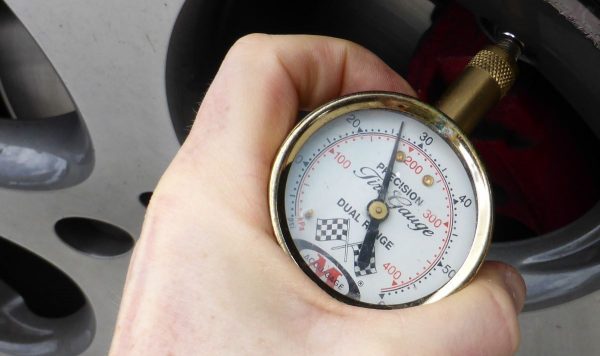
Bear in mind that by the time you get to the petrol station, your tyres might be warm and will read higher than they did when they are cold. You just need to put the difference in. E.g. if you need 40psi, and they were 35psi when you checked, put 5psi in, regardless of what the reading is on the machine at the petrol station.
Incorrect pressure affects braking, handling, and fuel use. The correct pressures are usually on a plate attached to one of the passenger-side door pillars.
2. Check tread depth
Make sure the tread is above the legal minimum (1.5mm) and deep enough to disperse water (preferably 3mm). Look for uneven wear, which can indicate alignment or suspension problems. You can get cheap tread depth gauges from petrol stations or hardware stores.
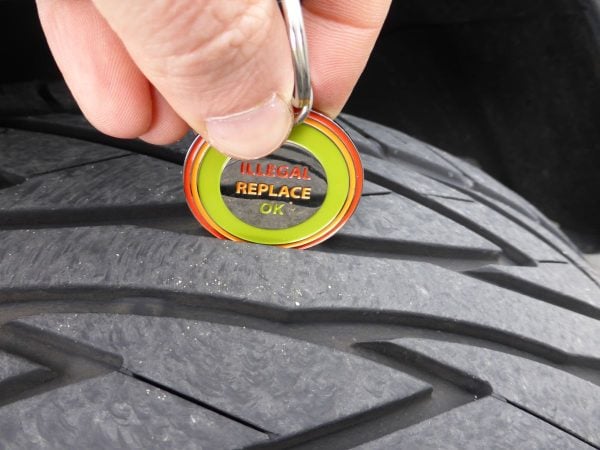
All tyres should be roughly the same, otherwise it’s causing unnecessary wear on your differential
3. Inspect for damage
Look for cuts, cracks, bulges, or exposed cords on the sidewall or tread. Any bulge usually means internal damage, and the tyre should be replaced immediately.
If you have been driving off-road, you’ll need to pay more attention to this as there could also be damage to the rim.
4. Look for embedded objects
Check for nails, screws, stones, or glass. Even small objects can cause slow leaks or sudden punctures.
5. Check valve stems and caps
Ensure valves are straight, not cracked, and have caps fitted to keep dirt and moisture out.
6. Don’t forget the spare
Check that your spare tyre is inflated and in usable condition, and that the jack and wheel brace are present. I forgot to check the spare for a few months (…OK, 9 months…), and when I finally checked it, it was only at half pressure!
How often?
A quick visual check weekly, and a full pressure and tread check at least once a month or before long trips.


Darren has written over 3000 articles about driving and vehicles, plus almost 500 vehicle reviews and numerous driving courses. Connect with him on LinkedIn by clicking the name above