• A TR Group Site
  • Help
  • Cart
Driving Tests DT logo small
Driving tests
  • Learner licence
    • Car
    • Motorbike
    • Heavy vehicle
    • Learner Licence Plus
  • Courses
  • Tourist
  • Resources
  • Learn
  • Resources
  • Learner licence
    • Car
    • Motorbike
    • Heavy Vehicle
    • Learner Licence Plus
  • Your courses
    • Enrolled courses
  • View all courses
  • Tourist
  • Resources home
  • iOS application
  • Android application
  • Contact us
  • Terms and conditions
  • Privacy
  • Home
  • /
  • Resources
  • /
  • Heavy Vehicle
  • / What is a skeletal trailer and how do you load them?

What is a skeletal trailer and how do you load them?

A skeletal trailer is a lightweight semitrailer most commonly used for transporting one or two shipping containers. Shipping containers are intermodal – they can be loaded onto a ship, unloaded using a crane, moved using a forklift, empty container handler, reach stacker or straddle carrier, and transported using a truck or train.

There are multiple sizes of shipping containers, so the load security points are either designed for a specific size, or are duplicated in multiple positions.

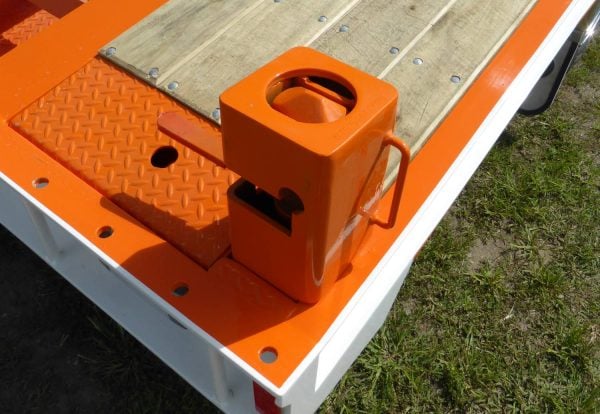
A container is coupled to the trailer using a twistlock.
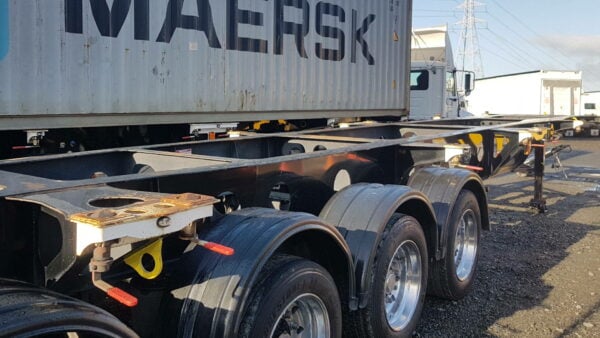
Twistlocks with red handles seen in the foreground of the image of a skeletal trailer
ISO twist lock close up

Four twistlocks are required for a container – one on each corner. A skeletal trailer could have up to 12 twistlocks to give different configurations between the sizes of containers:

  • 20-foot
  • 30-foot
  • 40-foot
  • 45-foot
  • ISO intermodal.

The trailers can have between one and four axles, depending on the desired use. Trucks and trailers used for returning empty containers don’t need to have many axles.

Removable tank on a skeletal trailer

Skeletal full trailers are available, but less common.

How are containers loaded onto a skeletal trailer?

If a skeletal trailer also has hydraulic cranes on the side to self-load the container, it’s called a sideloader. You must complete sideloader training to use these. A lightweight skeletal trailer weighs as little as 4000kg, but add sideloader cranes and more axles and it can double.

A crane, reach truck, forklift or straddle carrier can also load the container onto the truck.
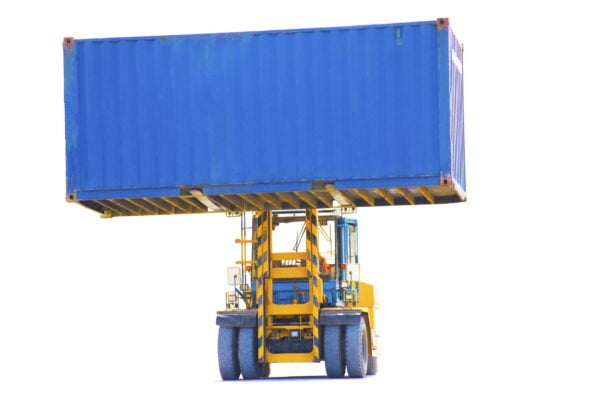
Forklift lifting a container

Drivers need to pay attention to the load plate so that they don’t overload the trailer. Each trailer’s capacity is defined by the lowest of the RUC weight, the maximum GVM on the Certificate of Loading, the manufacturer’s stated maximum GVM, or the VDAM rule in relation to the tyres and axles (understand how to calculate maximum legal mass on each axle in this axle weight limit course). As it’s impossible to know what’s inside a container and how the load is distributed, drivers must be aware of managing rollover risks and understanding axle weight limits and load distribution.

It’s possible to hire a skeletal trailer.

By Darren Cottingham

Darren has written over 3000 articles about driving and vehicles, plus almost 500 vehicle reviews and numerous driving courses. Connect with him on LinkedIn by clicking the name above

‹ What’s a sleeper cab and how should truck drivers use them?
Is reverse parking safer than parking forwards? ›
Tagged with: sideloader, trailer, vehicle type | Posted in Heavy Vehicle
  • DisqusDisqus
Recent Resources
  • How to check responsiveness using the AVPU scale in first aid
  • Scene safety and the DRSABCD action plan
  • Auditing permits for high-risk work
  • What actually happens when you call 111 about a road rage incident
  • First aid kits and workplace readiness
  • Managing concurrent and conflicting works
  • How does music affect your driving?
  • Monitoring and closing the permit
  • Protecting yourself from infection when giving first aid at work
  • Why we judge other drivers more harshly than ourselves

Licences and Courses

  • Car
  • Motorbike
  • Heavy Vehicles
Car
  • Core
  • Behaviour
  • Parking
  • Emergencies
  • Road position
  • Intersection
  • Theory
  • Signs
Motorbike
  • Bike-specific questions
  • Core
  • Behaviour
  • Parking
  • Emergencies
  • Road position
  • Intersection
  • Theory
  • Signs
Heavy Vehicles
  • Class 2
  • Class 3-5
  • Core
  • Behaviour
  • Parking
  • Emergencies
  • Road position
  • Intersection
  • Theory
  • Signs

Vehicle and workplace training

  • About
  • Resources
DT Driver Training TR Group
About
  • About us
  • Contact us
  • Privacy Policy
  • Terms and Conditions
Resources
  • Homepage
  • Driving Tests Android App
  • Driving Tests iPhone App
  • Getting your learner licence
DT Driver Training TR Group
Copyright 2010-2026 DT Driver Training Ltd, PO Box 12541, Penrose, Auckland, 1642. All rights reserved. Questions and images are used with permission from NZTA; question answers are proprietary.