As a sideloader driver, you’ll have had training in how to assess a site’s hazards and you’ll know how to operate your machine, but there are things that are not often taught in sideloader training because they are not part of the curriculum or talked about in the Good Practice Guide.
Container positioning
Proximity to walls and other containers
There are loads of different sideloader configurations from the three main manufacturers. These have different strengths and weaknesses due to the stabiliser and crane configuration.
When you drop off a container at a business, you need to ask the person where they want it and what type of sideloader will be picking it up. If you are using a minilifter or a sideloader with telescopic stabilisers that slide out rather than unfold, you’ll be able to get it very close to a wall, but a sideloader with a leg-over stabiliser then won’t be able to pick up the container because they can’t get close enough to it.
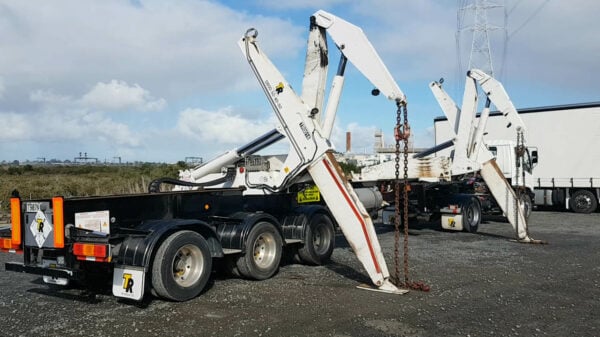
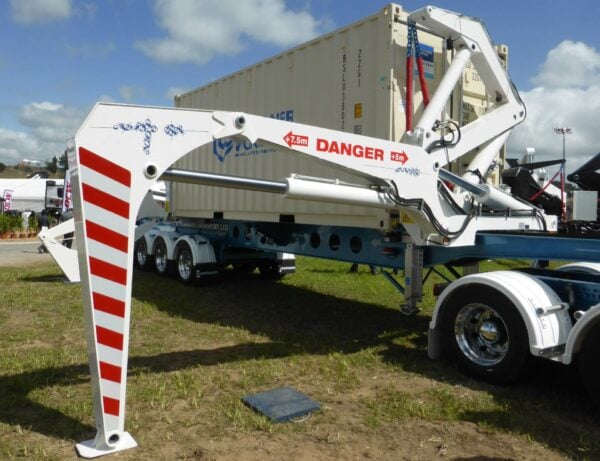
If you are using a Swinglift, you’ll be able to place a container much closer (end-to-end) then someone with a Hammar because your stabilisers are inline with your crane modules; Hammar’s stabilisers are separate from the crane modules.
Slopes
If you are using a Hammar and the owner asks you to drop the container on a slope, this will make it more difficult for a Swinglift operator to pick it up because the stabilisers are much closer to the ends of the container; the container is more likely to swing into the stabiliser legs and then scrape up them as it’s lifted. This makes it very difficult to get the container onto the twistlocks as the corner castings don’t line up with the twistlocks. The operator ends up having to twist the container to get one corner on the twistlock, which then can bend it. It’s best to never leave a container on a slope of any more than a couple of degrees.
Soft ground
If you are dropping off an empty container, consider that your impact on the ground will be much less than when the container is full. Dropping an empty container off on soft ground might be simple for you, but who will pick it up? A fully loaded 30-tonne container could sink slightly, and that would be an indication to a driver picking it up that there’s no way that the small surface area of the stabiliser legs would support the weight.
The most dangerous manoeuvre is unloading. If you are picking a heavy container up, then you’ll know immediately if the legs start sinking in, or the trailer starts to lift its offside wheels off the ground. However, if you are unloading, the point at which this starts to happen could be too late, and the container pulls the trailer over.


Darren has written over 3000 articles about driving and vehicles, plus almost 500 vehicle reviews and numerous driving courses. Connect with him on LinkedIn by clicking the name above
 Disqus