Ask any warehouse worker what causes back injuries and they’ll probably talk about heavy boxes. Maybe awkward loads. Perhaps rushing to meet a deadline.
But here’s something that often gets overlooked: the height you’re lifting from and to has just as much impact on your injury risk as the weight itself.
A 10kg box lifted from floor level puts significantly more strain on your back than the same box lifted from waist height. And that box going up onto a shelf above your head? That’s a different kind of problem altogether. These are common problems for forklift operators, walkie stacker operators and anyone working in a warehouse.
This is the concept of vertical lift zones, and understanding it could change how you think about your warehouse layout.
The Science of Where
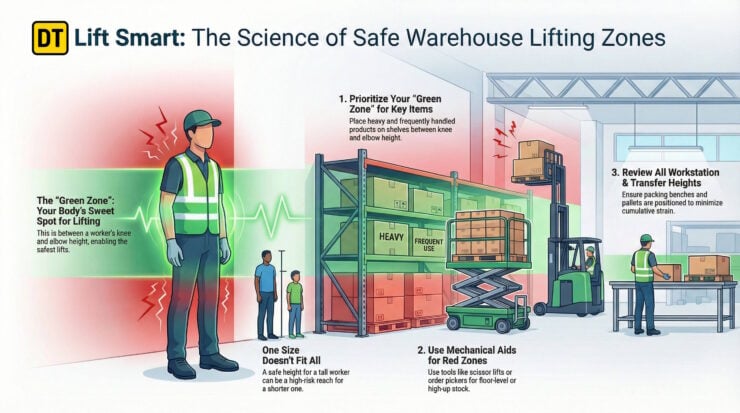
WorkSafe’s Manual Handling Assessment Charts (NZMAC) break lifting heights into colour-coded risk zones. The system is straightforward: green means low risk, amber means moderate risk, and red means you’ve got a problem that needs addressing.
The green zone (the safe zone) is when your hands are between knee and elbow height. This is where your body is designed to handle loads most efficiently. Your spine is in a relatively neutral position, your legs can do most of the work, and you’re not fighting gravity or leverage.
Move outside that zone and the risk climbs quickly.
When you’re lifting from below knee height, or picking up something from floor level, you have to bend forward significantly. Your back muscles and spine take on load they’re not well-suited to handle. The lower you go, the worse it gets. Lifting from floor level scores red on the NZMAC; it’s a significant risk factor regardless of what the load weighs.
The same applies at the other end. Reaching above elbow height means your arms are working away from your body, which dramatically increases the leverage on your shoulders and spine. Go above head height and you’re in the red zone again. Your back is arched, your shoulders are under strain, and you’ve got very little mechanical advantage.
What This Means for Your Racking
Think about a typical warehouse racking system. You’ve got multiple shelf levels, from near the floor up to heights that might require a ladder or order picker to reach.
Now think about how stock gets placed on those shelves. In many operations, items end up wherever there’s space. Fast-moving product might be at floor level simply because that’s where it’s always been. Heavy items might be stored up high because someone didn’t think it through, or because that’s where they fit.
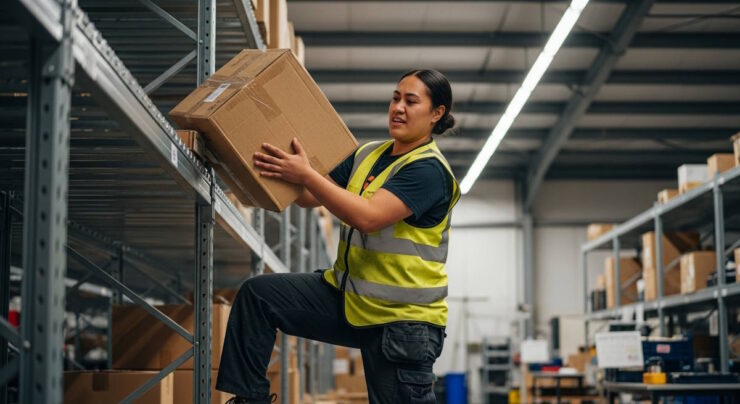
Every time a worker bends down to floor level to grab a frequently-picked item, that’s an amber or red zone lift. Every time they reach overhead to pull something down, same story. Multiply that by hundreds of picks per shift, week after week, and you’ve got a recipe for cumulative injury.
The principle is simple: place regularly handled and heavier objects at optimum heights: between knee and elbow level for your workers. Put the rarely handled or lighter items in the less accessible spots, whether that’s down low or up high.
This isn’t just theory. It’s explicitly recommended in the Approved Code of Practice for Manual Handling. The guidance is clear: working heights that are too low or too high force workers to adopt undesirable postures. And those postures, repeated over time, lead to injury.
The Complication of Different Bodies
Here’s where it gets a bit more complex: elbow height for a 190cm man is very different from elbow height for a 160cm woman.
The NZMAC guidance shows optimal handling zones for people of different sizes, and the differences are significant. What’s a comfortable waist-height lift for one worker might be below knee height for another.
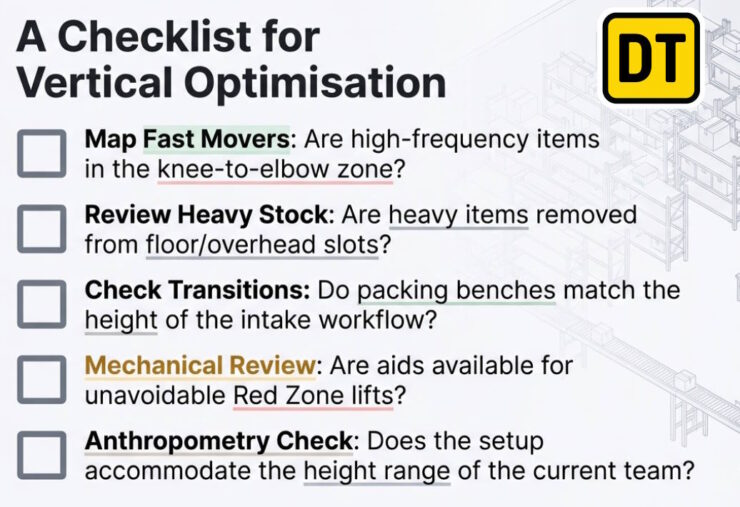
This matters when you’re setting up workstations and deciding where to place stock. If your picking team includes people of varying heights, your “optimal zone” placement needs to accommodate the range. In practice, this often means targeting a middle ground and being aware that some workers will be operating outside their ideal zone more often than others.
For team lifting, the height differences become even more critical. When two people of different heights lift together, the taller person may be in a good position while the shorter person is reaching above their comfortable range, or vice versa.
Practical Changes You Can Make
Redesigning an entire warehouse isn’t always realistic, but there are practical steps that can make a meaningful difference.
Start by identifying your high-frequency picks. What items are your workers handling most often? Those should be positioned in the green zone (between knee and elbow height) wherever possible. This might mean reorganising your slotting strategy so fast-movers are at optimal heights, even if it means slower-moving stock takes the less convenient spots.
Think about the weight distribution on your racking. Heavy items stored at floor level or overhead are a double problem: you’ve combined a high-risk lift zone with a demanding load. Prioritise getting heavy, frequently-handled items into that waist-to-elbow sweet spot.
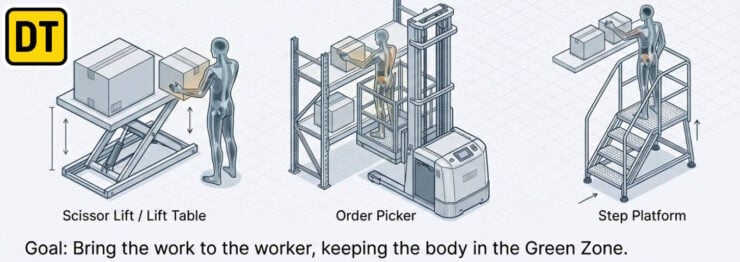
Consider mechanical aids for the difficult zones. If you genuinely can’t avoid storing items at floor level or overhead, look at what equipment could help. Scissor lifts and lift tables can raise loads to working height. Order pickers allow workers to elevate themselves to the product rather than reaching. Even something as simple as a step platform can turn an overhead reach into a more neutral lift.
Anyone using a scissor lift must have scissor lift training.
Anyone using a podium platform or other raised platform must have working at heights training.
Anyone using an order picker must have a forklift operator’s certificate.
Review your packing benches and workstation heights. If workers are lifting items from a pallet at floor level, placing them on a bench, then lifting again to put them on a shelf, each of those transfers is a lift that happens at some height. Getting those heights right across the whole process reduces cumulative strain.
Provide training in manual handling. This will give your workers a good understanding of the risks, plus the techniques for lifting safely.
It’s Not Just About Single Lifts
The vertical lift zone concept matters most when you consider repetition. A single lift from floor level probably won’t injure anyone. But when your workers are making that same movement dozens or hundreds of times per shift, the cumulative effect adds up.
WorkSafe’s approach reflects this: the NZMAC doesn’t just look at a single lift in isolation. It considers the task as a whole, including how often it’s repeated. A task that’s individually low-risk becomes higher risk when it’s performed constantly throughout the day.
This is why warehouse layout matters so much. The decisions made about where stock is placed affect every single pick, every single day. Get it wrong and you’re building injury risk into the structure of the work itself.
The Bottom Line
You can train workers in perfect lifting technique, but if the job requires them to lift from floor level or above their heads hundreds of times a day, technique will only get you so far.
The real gains come from designing the work so that lifts happen in the green zone as often as possible. That means thinking about racking heights, stock placement, workstation design, and mechanical aids.
Where you lift from matters just as much as what you’re lifting. The question is whether your warehouse is set up to reflect that.


Darren has written over 3000 articles about driving and vehicles, plus almost 500 vehicle reviews and numerous driving courses. Connect with him on LinkedIn by clicking the name above